

























































































































Golden Shoe Race Heats Up: Kane, Haaland and Mbappé Set the Pace Across Europe
As the 2025–26 season edges towards its halfway point, the Golden Shoe conversation is beginning to dominate debates across Europe. Every weekend brings another twist, another brace, another reminder that this year’s race is shaping up to be one of the most finely balanced in recent memory. Familiar names sit at the summit, but the margins are razor-thin and the calendar still packed with opportunities for momentum to swing.
In recent seasons, the Golden Shoe has been anything but predictable. A different winner has lifted the award in each of the past three campaigns, underlining just how competitive Europe’s elite leagues have become. And once again, the same trio who defined last season’s battle are back at the forefront.
What Is the Golden Shoe and Why Does It Matter?
The European Golden Shoe, often referred to as the Golden Boot, is one of football’s most prestigious individual honours. First introduced in the 1967–68 season by French newspaper L’Équipe, the award was designed to celebrate the most prolific league goalscorer across Europe.
Since the 1997–98 campaign, responsibility for the prize has sat with European Sports Media, who introduced a weighted points system to reflect the varying strengths of domestic leagues. The concept is simple, but the implications are significant.
Goals scored in Europe’s top five leagues – the Premier League, La Liga, Bundesliga, Serie A, and Ligue 1 – are multiplied by two. Players operating in leagues ranked between sixth and 22nd by UEFA coefficient earn 1.5 points per goal, while those in lower-ranked leagues receive one point per goal.
That system ensures the Golden Shoe remains a true measure of elite-level consistency, rather than raw volume alone. It also explains why players from Europe’s biggest leagues almost always dominate the conversation, even when others rack up extraordinary tallies elsewhere.
Golden Shoe Tiebreakers: Fine Margins Decide Great Prizes
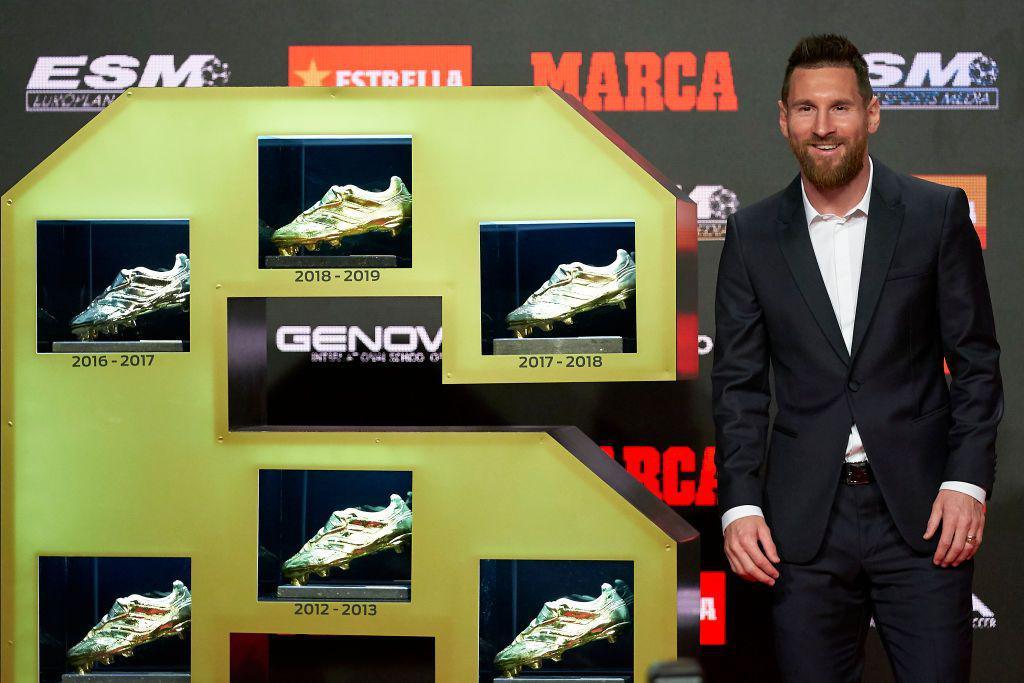
Lionel Messi poses alongside his six European Golden Shoe trophies in 2019
While sharing the Golden Shoe was once common, a rule change introduced in the 2019–20 season added extra drama. If players finish level on points, the award now goes to the one who achieved their tally in fewer minutes. If they are still tied, league assists are considered next, followed by the number of penalties scored.
Only if all those criteria fail to separate the contenders is the award shared. In a race as tight as this season’s, those details could yet prove decisive.
Golden Shoe Standings: Kane, Haaland and Mbappé Locked Together
At present, the Golden Shoe race has a distinctly familiar look. Three previous winners sit within touching distance of each other, separated by the finest of margins.
Harry Kane currently leads the standings with 19 league goals, translating into 38 Golden Shoe points after 15 Bundesliga appearances for Bayern Munich. The England captain has been relentless in Germany, combining his trademark finishing with a growing influence in Bayern’s build-up play.
Matching Kane stride for stride is Erling Haaland, who also sits on 19 goals and 38 points, this time from 17 Premier League matches with Manchester City. After reclaiming his sharpness earlier in the campaign, the Norwegian has returned to his devastating best, bullying defences and turning half-chances into goals with mechanical efficiency.
Just behind them lurks Kylian Mbappé, the reigning Golden Shoe holder. The Real Madrid forward has scored 18 goals (36 points) in 18 La Liga outings, remaining well within striking distance as Madrid continue to navigate a demanding domestic and European schedule.
The margins are so fine that one prolific weekend could completely reshape the table.
Challengers Beyond the Big Three
While Kane, Haaland and Mbappé dominate headlines, the Golden Shoe race is not exclusively their domain. Further down the standings, several names are quietly making their presence felt.
Darko Lemajić of Latvian side RFS currently sits fourth overall with 28 goals, though his tally equates to 28 points due to the league’s lower coefficient. His output has been extraordinary, even if the weighting system makes a podium finish unlikely unless the frontrunners slow dramatically.
Feyenoord striker Ayase Ueda is joint-fifth with 18 goals (27 points) from just 17 Eredivisie matches. The Dutch league’s coefficient keeps him just behind the elite trio, but his efficiency remains eye-catching.
The remainder of the top ten is populated by players competing in leagues that follow a calendar-year format, meaning their seasons are nearing completion. As Europe’s major leagues enter the decisive spring months, the spotlight inevitably returns to the heavyweights.
A Look Back: Golden Shoe Legends and Records
The Golden Shoe’s history reads like a roll call of football royalty. Eusébio was the inaugural winner in 1968 after scoring 42 goals for Benfica, setting the tone for an award that would come to define attacking excellence.
No player has dominated the prize like Lionel Messi, who claimed the Golden Shoe on six occasions during his Barcelona career. His 2011–12 campaign remains untouchable: 50 league goals, 100 points, and a level of consistency that still feels unreal more than a decade on. Messi is also the only player to win the award in three consecutive seasons.
Cristiano Ronaldo first lifted the Golden Shoe in 2007–08 with Manchester United before adding three more during his time at Real Madrid. Together, Messi and Ronaldo transformed the award into a personal duel for more than a decade.
In England, Ian Rush was the first player to win the Golden Shoe while playing for an English club, scoring 32 league goals for Liverpool in the 1983–84 season.
More recently, the prize has rotated between superstars. Haaland claimed it in 2022–23 with a Premier League-record 36 goals, Kane followed in 2023–24 during his debut season at Bayern, and Mbappé reclaimed it last season with 31 goals for Real Madrid.
Why This Golden Shoe Race Feels Different
What makes the 2025–26 Golden Shoe battle especially compelling is the context. All three frontrunners are carrying immense responsibility for clubs with title ambitions. Rotation, injuries, and European commitments will all play their part.
Kane has never been more central to Bayern’s identity. Haaland continues to be the focal point of Guardiola’s evolving City side. Mbappé, meanwhile, is adapting to life as Madrid’s leading man while shouldering expectations that come with wearing white at the Bernabéu.
What Happens Next in the Golden Shoe Race?
With months of football still to be played, predicting a winner feels premature. What is clear, though, is that the Golden Shoe will once again be decided by consistency rather than flashes of brilliance.
Every missed chance matters. Every penalty, assist, and minute played could tip the balance. And as history shows, the race rarely stays static for long.
One thing feels certain: by the time the season reaches its final stretch, the Golden Shoe conversation will be impossible to ignore.


There are no comments yet. Be the first to comment!