







From “I Thought I’d Be Bleeped” to Global Inspiration: How Amy Hunt Words Came to Resonate Beyond the Track
‘I Thought I’d Be Bleeped’ — Why Amy Hunt’s Words Still Resonate Months After Her World 200m Silver
In the immediate aftermath of the biggest race of her life, Amy Hunt wasn’t thinking about legacy, messaging, or viral soundbites. She was barely thinking at all.
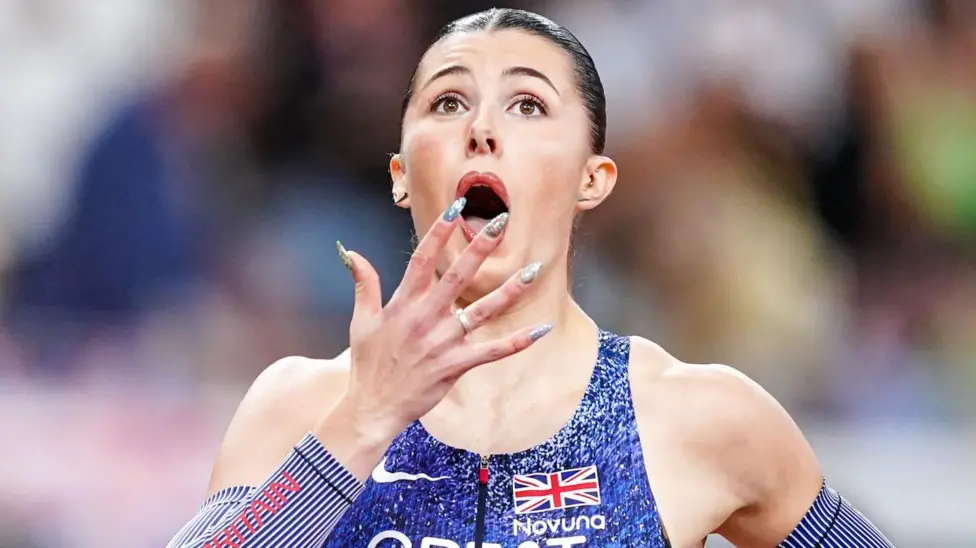
Adrenaline has a way of dissolving filters, and standing trackside in Tokyo after sprinting to a long-awaited world 200m silver medal, Hunt delivered a line that instantly travelled far beyond athletics. Breathless, emotional and still processing what she had just achieved, the 23-year-old turned to young viewers watching at home and declared:
“You can be an academic badass and a track goddess.”
At the time, she feared she might have crossed a line — not on the track, but on live television.
“As soon as I said it, I thought, ‘Oh my gosh, I’m on the BBC — are they going to bleep that out?’” Hunt later admitted with a laugh. “I felt terrible straight away.”
Yet months later, what she initially dismissed as a “corny” comment has taken on a deeper meaning. The phrase has become shorthand for a generation of athletes refusing to choose between intellectual ambition and sporting excellence — and Hunt, somewhat reluctantly, has become its symbol.
The Moment That Changed Everything
Tokyo represented more than a medal. It was validation.
For years, Hunt had carried the label of prodigy after smashing the under-18 world 200m record in 2019 with a stunning 22.42 seconds — a performance that announced her to the athletics world as Britain’s next sprinting superstar. Expectations rose instantly, but reality proved far more complicated.
Injuries interrupted momentum. Academic commitments at the University of Cambridge demanded time and mental energy. Progress stalled just as the spotlight intensified.
So when she crossed the line in Tokyo to claim global silver, the emotional release was inevitable.
“I was so high on adrenaline and endorphins,” she explained. “There wasn’t really a connection between my brain and my mouth.”
The now-famous quote came from a fleeting thought — inspired by a T-shirt she owned bearing the word “Goddess.” That single mental image collided with years of effort, frustration, and perseverance.
Ironically, she says she can hardly wear the shirt anymore.
“It feels too corny now,” she jokes.
Corny or not, the message stuck.
Why Amy Hunt’s Words Resonate With a New Generation
The reaction surprised her most of all.
Within days, messages began flooding her social media accounts. Young athletes, students, and especially girls balancing academic pressure with sporting dreams reached out to say they felt seen.
Six months on, the volume hasn’t slowed.
“There are so many girls messaging me every single day,” Hunt says. “I try to reply to as many as I can, especially those going through the Oxbridge application process. It’s hard to keep up, but I want to help.”
Her journey — excelling in elite sport while completing an English Literature degree at Cambridge — challenges a long-standing narrative that athletes must sacrifice education to reach the top.
Rather than viewing academics and athletics as competing priorities, Hunt embraced both. And now she finds herself mentoring students navigating the same path she once did.
“I’ve helped a couple of girls get into Cambridge,” she says proudly. “Some of them are now close friends. Sometimes just telling someone ‘you can do it’ makes a huge difference.”
In an era increasingly focused on athlete identity beyond performance, Hunt’s story resonates because it feels authentic rather than curated.
The Difficult Years Between Promise and Podium
Success stories often skip the uncomfortable middle chapters. Hunt’s career, however, has been shaped by them.
After her record-breaking teenage breakthrough, progress at senior level proved anything but smooth. Injuries disrupted training cycles, most notably a ruptured quadriceps in 2022 that threatened to derail her trajectory entirely.
At the same time, she was balancing lectures, essays, and exams with elite training demands — a dual existence that required relentless discipline.
Improvement stalled. Personal bests refused to fall. Doubt crept in.
She did not better her teenage record time for nearly five years, an eternity in sprinting terms. Only last summer did everything finally align again. A breakthrough season saw her clock 22.08 seconds in Japan, alongside personal bests in both the 60m and 100m.
The silver medal was not sudden success; it was delayed confirmation.
Building Speed in Padova: The Next Chapter
Now training in Padova under coach Marco Airale, Hunt is focused firmly on progression rather than reflection.
Her immediate target comes at the World Athletics Indoor Championships in Poland, where she will compete in the 60m — an event she openly admits is not her favourite.
Standing 5ft 10in, Hunt’s long stride is better suited to longer sprint distances, and explosive starts from the blocks remain a technical challenge. Still, she views the shorter race as essential development.
“It helps everything else,” she says. “If I improve the start, it carries into the 100m and 200m.”
Her ambitions stretch even further. Longer term, Hunt is eyeing a transition toward the 400m, envisioning herself as a multi-event Olympic contender by 2028.
Winning four Olympic medals, she admits, would make her “an icon.” The statement sounds bold, but after Tokyo, boldness feels entirely on brand.
Beyond Medals: Changing the Athlete Pathway
While medals remain the immediate focus, Hunt’s broader mission lies off the track.
She wants to reshape perceptions of what an elite athlete’s life can look like — particularly in Britain, where young talents often feel pressured to abandon education early.
Inspired partly by initiatives such as rapper Stormzy’s scholarship programme supporting Black students at Cambridge, Hunt hopes to create a similar opportunity for athletes pursuing higher education.
“I didn’t want to take the easy way,” she says. “That’s just not who I am. I want to try to be the best every single day — in everything.”
Her vision is simple: open doors that previously felt closed.
By speaking openly about combining academics with sport, she believes more young women will feel confident enough to attempt both.
“Talking about it makes it possible,” she explains. “It helps people believe they belong there.”
‘I Thought I’d Be Bleeped’ — A Quote That Became a Movement
Looking back, the irony is unmistakable. The sentence she feared might be censored has instead become her defining message.
Athletics has always celebrated speed, strength, and medals. Hunt’s rise adds another dimension — intellect, identity, and balance.
Her words resonate not because they were polished, but because they were real. Spoken without rehearsal, they captured something many athletes feel but rarely articulate: the freedom to exist beyond a single label.
As she prepares for another global championship, Hunt carries expectations not just as a medal contender, but as a role model navigating two demanding worlds.
The T-shirt may remain tucked away in a drawer, too awkward to wear again. But the sentiment it inspired continues to travel — from classrooms to training tracks, from television screens to inboxes filled with hopeful messages.
And perhaps that is the lasting lesson of Amy Hunt’s breakthrough moment.
Sometimes the words you worry might be bleeped out are the very ones people needed to hear most.


There are no comments yet. Be the first to comment!