


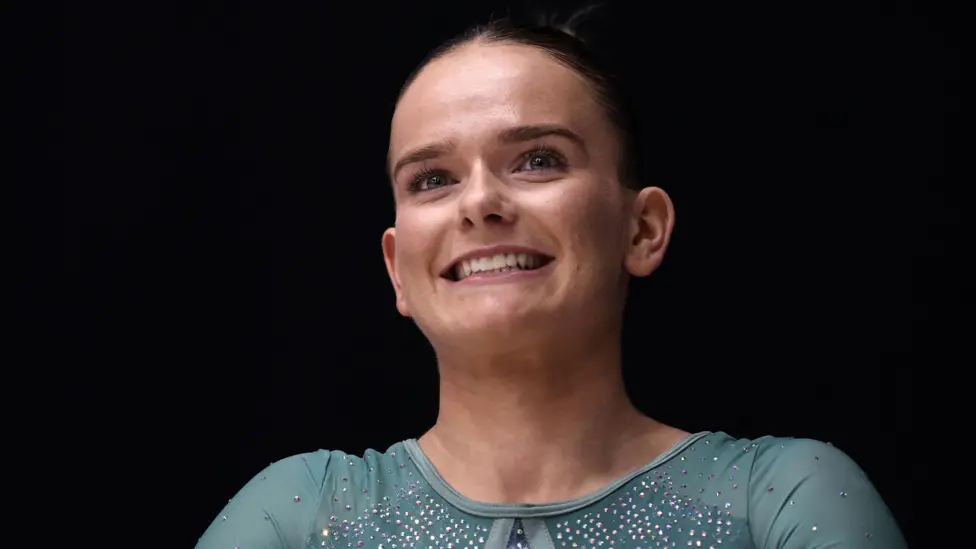
Alice Kinsella Makes GB Gymnastics History — “For My Boy” and a Remarkable Return to Elite Competition
Elite sport rarely pauses for life’s biggest changes. In artistic gymnastics, a discipline built on precision, timing and relentless physical demand, stepping away even briefly can feel like falling years behind. That is why what Alice Kinsella achieved this weekend was more than a competitive comeback — it was a moment that quietly reshaped expectations within British gymnastics.
At the British Artistic Gymnastics Championships, the 25-year-old became the first British artistic gymnast to return to elite-level competition after giving birth. Her fourth-place finish in the balance beam final might not have come with a medal, but the applause inside the arena carried a deeper meaning.
Kinsella wasn’t just competing against fellow gymnasts. She was competing against time, recovery, and the long-held belief that motherhood and elite gymnastics rarely coexist.
And, as she admitted afterward with a tired smile, she was doing it for someone very specific.
“For my little boy.”
Alice Kinsella and GB Gymnastics History: A Return Few Thought Possible
When Kinsella’s son Parker was born last September, few expected to see her back on a competition floor so soon — if at all. Artistic gymnastics places extraordinary strain on the body, particularly the core and pelvic floor muscles, both heavily affected during pregnancy.
Unlike endurance sports or even many team disciplines, gymnastics demands explosive power, aerial awareness, and pinpoint balance. A fraction of hesitation can mean the difference between a clean landing and a fall.
Yet only months after childbirth, Kinsella was back training.
She revealed she took just “three or four weeks off” before gradually returning to movement — a decision that highlights both her dedication and the carefully managed support around her. Even then, expectations were modest. The goal wasn’t medals; it was simply stepping back onto the mat.
“I kind of expected just to do Saturday,” she admitted after the competition. Making the beam final the following day came as a welcome surprise.
Watching from the stands was Parker — unaware, perhaps, of the significance of the moment but central to everything his mother was attempting.
Being able to finish her routine and glance toward him in the crowd, Kinsella said, made the entire journey worthwhile.
From Tokyo 2020 Olympic Bronze to Motherhood and Back
Kinsella’s name was already firmly etched into British gymnastics history long before this comeback. She played a crucial role in Team GB’s bronze-medal performance at the Tokyo 2020 Olympic Games, helping secure one of the sport’s landmark achievements for Britain.
That Olympic success represented years of relentless preparation — early mornings, injury setbacks, and the mental toll that accompanies elite gymnastics.
Motherhood introduced an entirely different challenge.
Many athletes across various sports have successfully returned after childbirth, but gymnastics remains an exception rather than the rule. The technical demands mean even minor physical changes can alter timing, rotation speed, and spatial awareness.
Kinsella’s journey has become so unusual that it is now the subject of academic research, with a university study examining how elite gymnasts might safely resume high-level competition after pregnancy.
It speaks volumes about how rare her path truly is.
The Physical Reality Behind the Comeback
Medical guidance typically urges caution following childbirth. According to the National Health Service (NHS), gentle exercise can begin when a mother feels ready after a straightforward birth, but high-impact training is usually delayed until after a six-week postnatal check.
For a gymnast, however, nearly every movement qualifies as high impact.
Landings send force through ankles, knees, hips and spine. Beam routines demand unwavering core stability. Even basic training drills require strength levels many athletes spend years building.
Kinsella approached her return carefully, beginning with limited sessions — just three training days per week.
“It’s been nice on the body,” she explained. “It’s not enough to feel super confident, but I’m starting somewhere.”
That honesty captures the reality of elite sport better than any highlight reel. Comebacks are rarely glamorous. They are incremental, uncertain, and often exhausting.
“I’m absolutely shattered,” she admitted after competing. “But I’m really happy.”
The exhaustion wasn’t just physical. Balancing elite training with early motherhood introduces logistical and emotional demands unfamiliar to most athletes.
Sleep schedules, recovery routines, and travel plans suddenly revolve around more than performance cycles.
Nerves, Expectations, and Finding Joy Again
Kinsella confessed she felt nervous during her first day back in competition, fearing mistakes might overshadow the occasion.
“I thought I was going to bomb it,” she said candidly.
But by the time the beam final arrived, something had shifted. The pressure felt lighter. The objective wasn’t perfection — it was participation, progress, and rediscovering the joy of competing.
“I wasn’t nervous at all. I just wanted to get on and off.”
That statement may sound modest, but within gymnastics culture — often defined by perfectionism — it reflects a powerful mental evolution.
Motherhood, she suggested indirectly, has reshaped her relationship with the sport. The stakes feel different now. Results matter, but perspective matters more.
What Alice Kinsella’s Return Means for the Future of Gymnastics
Kinsella’s comeback could carry implications far beyond British gymnastics.
For decades, female gymnasts have often retired young, constrained by the sport’s physical intensity and traditional pathways. Seeing an Olympic medallist return after childbirth challenges long-standing assumptions about career longevity.
It also opens conversations about support structures — coaching flexibility, medical guidance, and federation policies that allow athletes to balance family life with elite ambitions.
Her next step is already planned: increasing training from three days per week to four. It’s a small adjustment on paper but a significant marker of intent.
“We’ll just see how it goes,” she said — a phrase that reflects patience rather than pressure.
There is no rigid timeline, no declared Olympic target, just gradual rebuilding.
And perhaps that is why her story resonates so strongly.
“For My Boy”: A Different Kind of Motivation
Elite athletes often speak about medals, rankings, or national pride as motivation. Kinsella’s reason feels more personal and quietly powerful.
Doing it “for my little boy” reframes the entire comeback narrative. The beam routine wasn’t just about scores; it was about identity — proving that motherhood does not signal an ending.
As she looked toward the crowd after finishing her routine, the moment symbolised something gymnastics rarely sees: an athlete redefining success on her own terms.
Fourth place may not enter record books alongside Olympic podiums, but within British gymnastics, it marked history nonetheless.
Because sometimes the most meaningful victories are not measured in medals, but in returns once thought impossible.


There are no comments yet. Be the first to comment!