



















































































































































































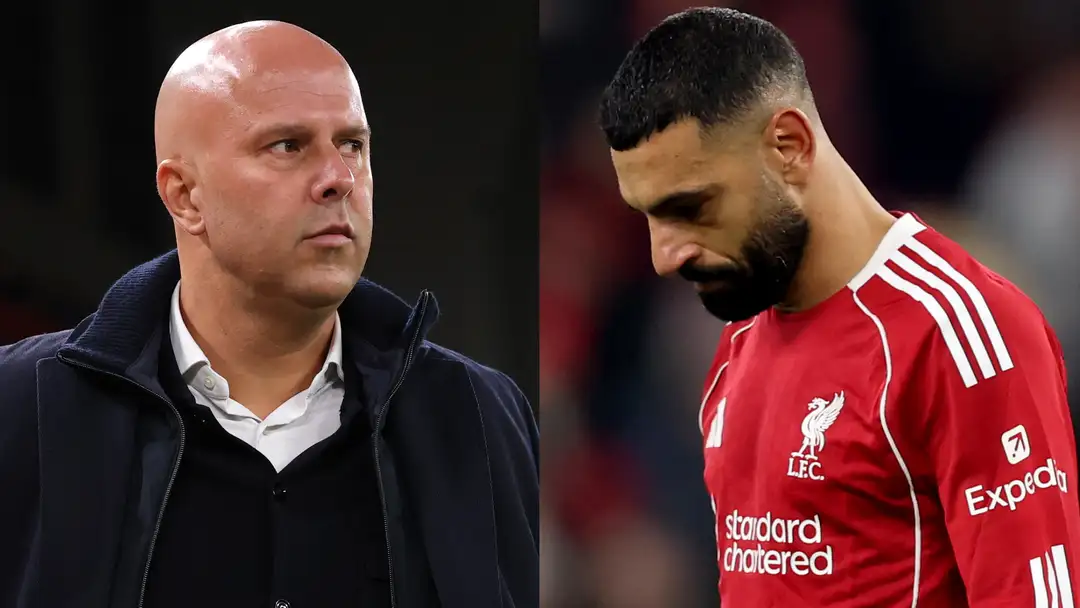
Arne Slot Defends Mohamed Salah Decision After Liverpool Struggle Against PSG
Arne Slot explains Mohamed Salah bench decision as Liverpool enter “survival mode” vs PSG
Liverpool’s Champions League night in Paris was supposed to be about control, courage, and keeping their European ambitions alive. Instead, it became a night defined by resistance, frustration, and one managerial decision that instantly dominated post-match discussion: why Mohamed Salah never left the bench.
Following Liverpool’s 2-0 defeat to Paris Saint-Germain in the first leg of their Champions League quarter-final, manager Arne Slot offered an explanation that surprised supporters and pundits alike. According to the Dutch coach, the closing stages of the match were not about chasing goals — they were about survival.
It was a statement that perfectly captured the reality of Liverpool’s performance at the Parc des Princes, where they were outplayed for long stretches and failed to register a single shot on target.
Liverpool overwhelmed in Paris as PSG dictate the tempo
From the opening whistle, PSG imposed their rhythm on the game. Luis Enrique’s side pressed aggressively, controlled possession, and repeatedly forced Liverpool deeper into their own defensive third.
Liverpool, usually associated with fast transitions and attacking width, instead looked compact and reactive. The midfield struggled to establish control, while the forward line found little space between PSG’s defensive structure.
By halftime, the warning signs were already clear. Liverpool were spending extended periods defending their penalty area, with Virgil van Dijk and the back line forced into constant emergency actions.
The second half followed a similar pattern. PSG increased the pressure, eventually converting their dominance into two goals that reflected both territorial superiority and attacking clarity.
As the clock ticked down, Liverpool appeared less like a team chasing an away goal and more like one attempting to limit the damage.
Why Arne Slot left Mohamed Salah on the bench
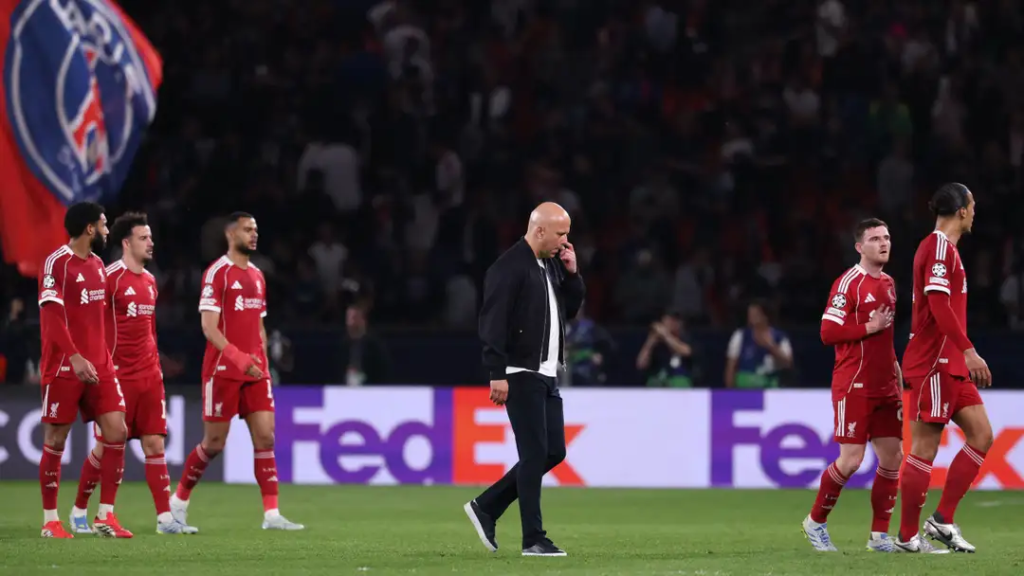
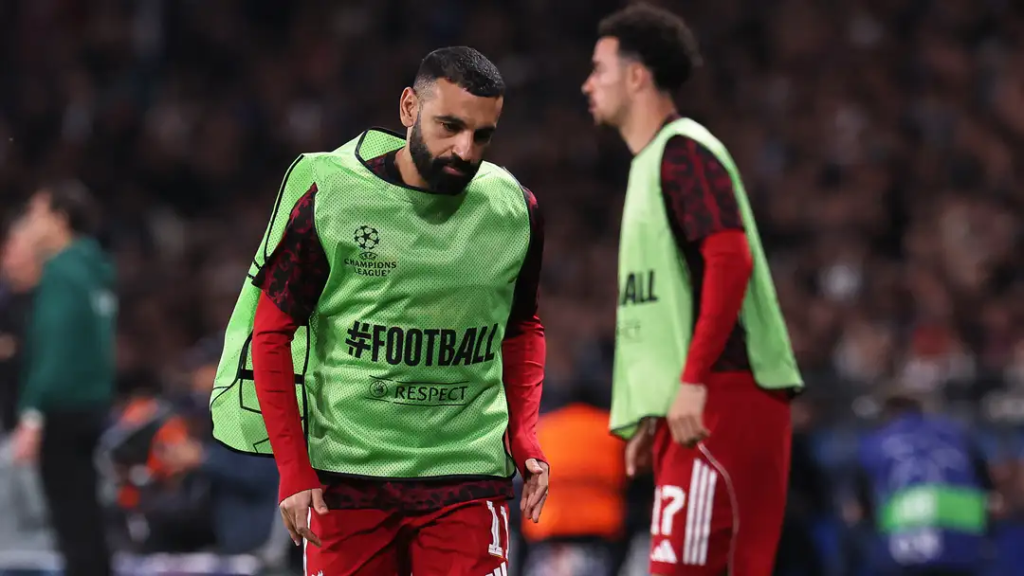
The most debated moment of the evening wasn’t a goal or a refereeing decision — it was the absence of Mohamed Salah.
Despite Liverpool trailing 2-0, Slot chose not to introduce the Egyptian forward at any stage, even while making five other substitutions. Among those introduced were Alexander Isak, recently recovered from a long-term injury, and teenage midfielder Trey Nyoni.
For many observers, leaving one of the world’s most decisive attackers unused in a Champions League quarter-final seemed unthinkable.
Slot, however, defended the call with calm logic.
“I think in the last part of the game, it was more about surviving for us than there was ever a chance that we could score,” he explained after the match.
The manager suggested that the final 20 to 25 minutes were spent almost entirely inside Liverpool’s defensive phase. Asking Salah to track runners and defend deep inside his own box, Slot argued, would neither maximize the player’s strengths nor protect him physically during a demanding run of fixtures.
“And Mo has so much quality,” Slot added, “but for him to spend that period only defending, it’s better to save his energy for the games coming up.”
It was a pragmatic explanation — one rooted in long-term squad management rather than emotional decision-making.
Tactical caution or missed opportunity?
Still, the reasoning has divided opinion.
Liverpool supporters are accustomed to bold European moments, late comebacks, and aggressive substitutions when chasing results. Seeing Salah remain seated while the team struggled creatively felt, to many, like a surrender of attacking intent.
Critics argue that even a single away goal could have dramatically changed the psychological balance heading into the return leg at Anfield. Salah’s ability to produce moments of individual brilliance has rescued Liverpool countless times before, making his absence feel especially glaring.
Yet Slot’s perspective reflects a different reality: Liverpool were not controlling the match. They were enduring it.
Introducing an attack-minded player into a game dominated by defensive transitions may have exposed the team further, potentially leading to a heavier defeat — something that could have effectively ended the tie.
Virgil van Dijk acknowledges a difficult night
Captain Virgil van Dijk did not attempt to soften the assessment afterward. Speaking candidly, the defender admitted Liverpool had expected a challenging evening but struggled to impose themselves at any stage.
“Tough. Tough work, which was expected,” he said. “We defended with a lot of bodies around the box.”
His comments underlined the collective nature of the struggle. Liverpool were not simply lacking finishing quality; they were unable to build sustained attacking sequences at all.
Van Dijk also pointed to the only immediate positive — the tie remains alive.
“There’s another game next week,” he added, already shifting focus toward the decisive second leg.
A mountain to climb at Anfield
The 2-0 deficit leaves Liverpool facing a familiar but daunting European scenario. Anfield has witnessed historic comebacks before, but overturning PSG’s advantage will require a dramatic improvement in attacking fluency.
Most notably, it will almost certainly require Mohamed Salah.
The Egyptian remains Liverpool’s most reliable source of goals and creativity, and expectations are high that he will return to the starting lineup for the return fixture. The challenge for Slot will be balancing tactical discipline with the attacking aggression required to break down a confident PSG side.
Before that showdown arrives, however, Liverpool must quickly refocus on domestic duties. A Premier League clash with Fulham awaits, and with the race for top-five qualification intensifying, dropped points are no longer affordable.
The bigger picture behind Slot’s decision
Slot’s choice ultimately highlights a broader managerial philosophy. Rather than chasing a low-probability comeback in Paris, he prioritized preserving energy, limiting damage, and keeping the tie within reach.
It is a decision that may only be fully judged after the second leg.
If Liverpool produce another famous European turnaround at Anfield, Slot’s restraint could be viewed as calculated foresight. If they fall short, the image of Salah unused on the bench will remain one of the defining talking points of their European campaign.
Football often rewards bravery, but it also punishes recklessness. In Paris, Arne Slot chose caution.
Now Liverpool must prove that survival mode was only the beginning — not the end — of their Champions League story.


There are no comments yet. Be the first to comment!