


































Bahrain F1 Test Week 2: Who Is Driving When?
Bahrain F1 Test Week 2 Driving Schedules Confirmed as Teams Finalise Plans
The long winter is nearly over. After months of speculation, simulations and factory miles, Formula 1’s 2026 pre-season enters its decisive phase with Bahrain F1 test week 2 — the final three-day dress rehearsal before the championship lights go out in Australia.
From Wednesday 18 February to Friday 20 February, all 11 teams will return to the Bahrain International Circuit for one last opportunity to understand their new-generation machines under genuine track conditions. It is the final chance to iron out reliability concerns, refine set-ups and — perhaps most importantly — decide who gets the most valuable seat time before the season opener on 8 March.
So, who is driving when? That question carries more significance than ever in a year shaped by fresh technical regulations and evolving power unit characteristics.
Let’s take a closer look at how Bahrain F1 test week 2 is shaping up.
The Structure of Bahrain F1 Test Week 2
As was the case in the opening week of testing, each team will run a single car per day across the three-day programme. That means careful planning is required. Every lap counts. Every stint provides data that could influence the early championship picture.
Track action will run in two daily sessions:
- Morning: 10:00am – 2:00pm local Bahrain time (AST, GMT+3)
- Afternoon: 3:00pm – 7:00pm local Bahrain time
Many teams are expected to split driving duties between the morning and afternoon sessions, though some have opted to dedicate full days to a single driver in order to build rhythm and continuity.
With limited mileage available, balancing development work against driver preparation is one of the key strategic calls of the week.
Why Driver Allocation Matters More in 2026
Under the sweeping 2026 regulations, both chassis and power units have undergone substantial redesigns. The removal of the MGU-H, the rebalancing of hybrid deployment, and significant aerodynamic adjustments have created a new learning curve for engineers and drivers alike.
In practical terms, that means pre-season mileage is priceless.
Drivers must recalibrate launch procedures, adapt to altered downforce characteristics and understand new brake-by-wire behaviours. Engineers, meanwhile, are busy validating correlation between wind tunnel data and real-world performance.
Every session allocation reflects internal priorities. Does a team want its lead driver to build momentum? Does it want its newcomer to gather maximum experience? Or does it need to split the workload evenly for data comparison?
Bahrain F1 test week 2 is not simply about speed — it’s about preparation.
Confirmed Line-Ups for Bahrain F1 Test Week 2
While several teams are still finalising their exact session splits, a handful have already confirmed their plans.
Here’s how the current picture looks:
Racing Bulls
- Wednesday: Arvid Lindblad / Liam Lawson
- Thursday: Liam Lawson
- Friday: Arvid Lindblad
Racing Bulls appear to be dividing responsibilities strategically. Lawson receives a full day on Thursday, likely signalling the team’s desire to provide him with extended long-run and race simulation work. Lindblad, meanwhile, will handle split duties on Wednesday before closing out the test on Friday — a strong vote of confidence in the young driver’s development trajectory.
Aston Martin
- Wednesday: Lance Stroll / Fernando Alonso
- Thursday: Fernando Alonso
- Friday: Lance Stroll
Aston Martin’s allocation is telling. Alonso, the veteran anchor, receives the uninterrupted Thursday programme — prime conditions for evaluating set-up consistency and tyre degradation patterns. Stroll will bookend the test, taking initial mileage on Wednesday and concluding proceedings on Friday.
With expectations high around Aston Martin’s 2026 package, this balanced approach reflects both stability and ambition.
Alpine
- Wednesday: Pierre Gasly / Franco Colapinto
- Thursday: Franco Colapinto
- Friday: Pierre Gasly
Alpine’s split suggests a clear development plan. Colapinto, still relatively early in his Formula 1 journey, secures a full day on Thursday to deepen his understanding of the new car’s behaviour. Gasly, the experienced reference point, will open and close the week.
For Alpine, consistency between driver feedback and engineering direction is crucial — particularly after a transitional 2025 campaign.
Teams Yet to Confirm Full Schedules
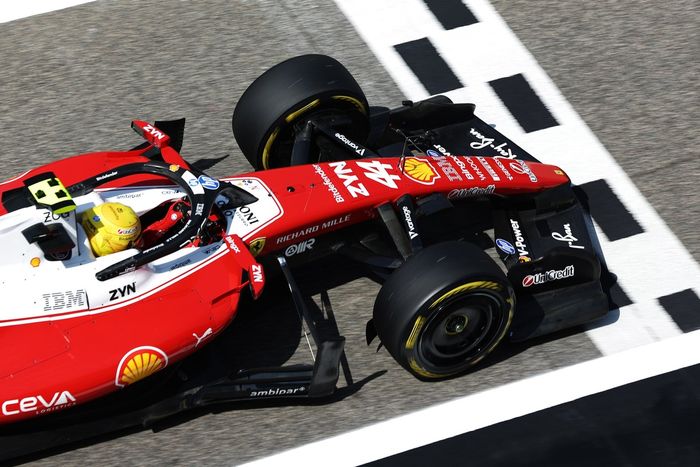
Lewis Hamilton, Ferrari
Several major outfits — including McLaren, Mercedes, Red Bull, Ferrari, Williams, Haas, Audi and Cadillac — have yet to formally announce their final session splits at the time of writing.
That does not mean plans are uncertain. Rather, it reflects the fluid nature of pre-season preparation. Weather forecasts, simulation outcomes and even minor component upgrades can influence last-minute decisions.
For front-running teams, the focus will likely be on validating race pace and reliability rather than headline-grabbing single-lap times. For midfield contenders and new entrants such as Cadillac and Audi, establishing baseline performance metrics will be paramount.
Expect announcements to continue trickling in as Bahrain F1 test week 2 approaches.
The Broader Context: Australia Awaits
Once the Bahrain test concludes on 20 February, attention will shift rapidly toward Melbourne. The 2026 season opener takes place on 8 March at Albert Park — a circuit that traditionally delivers unpredictability, particularly in the early stages of a new regulatory era.
Data gathered during Bahrain F1 test week 2 will heavily influence car set-up philosophy heading into Australia. However, teams are acutely aware that Bahrain’s abrasive surface and desert climate differ markedly from Melbourne’s evolving street circuit conditions.
Correlation remains king.
A smooth, productive Bahrain test does not guarantee dominance in Australia. But a troubled week in Sakhir can cast long shadows over early-season confidence.
What to Watch During Bahrain F1 Test Week 2
Beyond lap times — which are notoriously misleading in testing — there are several key storylines to monitor:
1. Reliability Runs
How many uninterrupted race simulations can each team complete? Reliability under the new power unit regulations will be scrutinised closely.
2. Launch Practice
With altered turbo characteristics and revised energy deployment, start procedures have become more delicate. Expect teams to rehearse launch simulations repeatedly.
3. Tyre Behaviour
Understanding degradation patterns in Bahrain’s heat remains a priority. Pirelli’s latest compounds introduce subtle changes that teams must interpret accurately.
4. Driver Adaptation
New pairings and rookies will be under particular observation. How quickly can they adapt to the altered aerodynamic balance and energy management systems?
The Calm Before Competitive Fire
Pre-season testing often presents a paradox. On the surface, it can appear methodical and subdued — cars circulating with aero rakes, engineers hunched over laptops, drivers quietly debriefing in air-conditioned motorhomes.
Yet beneath that calm lies urgency.
Bahrain F1 test week 2 is the final opportunity to correct missteps before championship points are at stake. There is no substitute for track time. No simulation fully replicates race intensity.
For some teams, these three days represent validation. For others, they may expose uncomfortable questions.
Final Thoughts: Who Is Driving When — and Why It Matters
At first glance, the question “Who is driving when?” may seem administrative. In reality, it reveals strategic intent.
Full-day allocations suggest trust and responsibility. Split sessions indicate balance and comparative evaluation. Delayed announcements hint at flexibility and internal recalibration.
As the grid prepares to leave Bahrain and head toward Australia, the narrative of the 2026 season will quietly begin to take shape here.
And while lap charts and sector times will dominate headlines, the true story of Bahrain F1 test week 2 will be written in the details — in who drives when, how effectively they use their hours, and whether the data gathered under the desert sun translates into success when the lights go out in Melbourne.
For now, the focus remains on preparation. Soon enough, it will shift to performance.


There are no comments yet. Be the first to comment!