















































































































































































































































































































































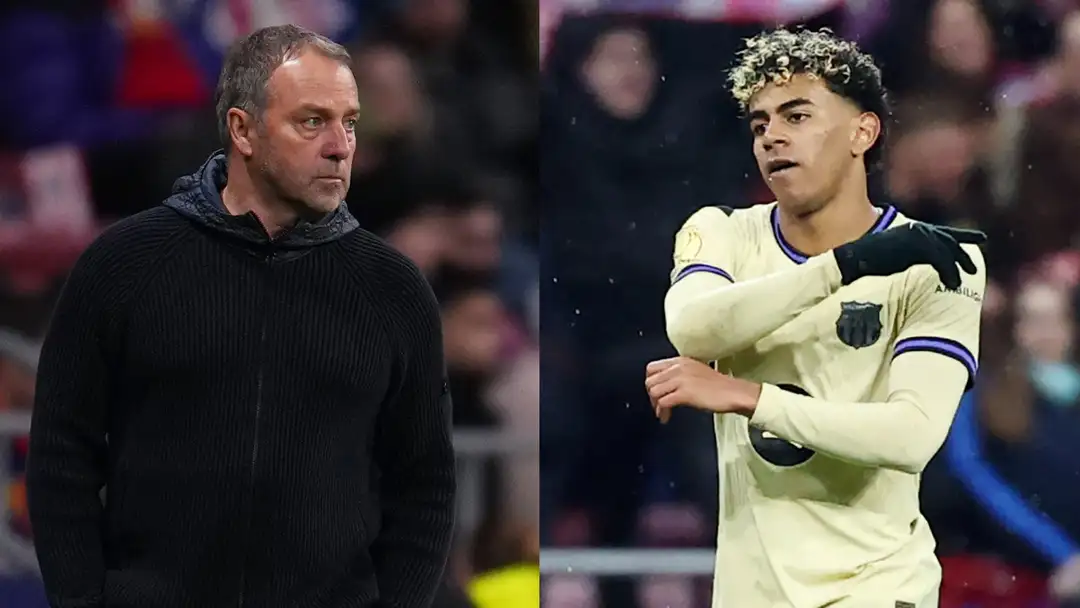
Barcelona Players Fire Back at Head Coach Hansi Flick in Tense Training Ground Meeting After Atletico Madrid Debacle
Barcelona Dressing Room Questions Hansi Flick Tactics Following Atletico Madrid Humbling
There are defeats, and then there are nights that leave a mark. Barcelona’s 4-0 thrashing at the hands of Atletico Madrid in the Copa del Rey semi-final first leg was firmly in the latter category. It wasn’t just the scoreline that stung — it was the manner of it. The gaps, the vulnerability, the sense that Diego Simeone’s side had found a blueprint and executed it without mercy.
And by the time the dust settled, the fallout had extended beyond the pitch.
According to reports, Barcelona’s players confronted head coach Hansi Flick in a tense training ground meeting the following day, voicing their concerns over his tactical approach — specifically the aggressive high line that Atletico sliced through with ruthless efficiency.
For a side that has enjoyed a largely impressive campaign, the debacle has exposed underlying tensions. And suddenly, what looked like a season of promise has acquired a layer of fragility.
Barcelona Battered by Atletico Madrid in Copa del Rey Semi-Final
Let’s be clear: this has not been a season of failure for Barcelona. Under Hansi Flick, the Blaugrana have topped the La Liga table for significant stretches, navigated their way into the Champions League knockout stages and lifted the Spanish Super Cup after defeating Real Madrid in January. There has been progress, identity, and at times, real fluency.
But Atletico Madrid delivered a brutal reminder that ambition without balance can be punished.
From the opening whistle, Simeone’s side targeted Barcelona’s defensive line. Flick’s commitment to a high block — compressing space, pressing high, holding defenders near the halfway line — has been central to his philosophy. When it works, it suffocates opponents. When it doesn’t, it leaves acres of space behind.
On this occasion, it unravelled spectacularly.
Atletico’s forwards timed their runs perfectly, exploiting the space in transition. Barcelona’s midfield struggled to close passing lanes. Distances between units stretched. Communication faltered. By half-time, the damage was evident; by full-time, it was humiliating.
The night spiralled further when Pau Cubarsí’s goal was ruled out after an eight-minute VAR delay, and Eric García’s late red card compounded the frustration. Barcelona ended the match with ten men, trailing 4-0, and facing an uphill battle in the return leg at Camp Nou in March.
Tension on the Training Ground: Players Fire Back at Hansi Flick
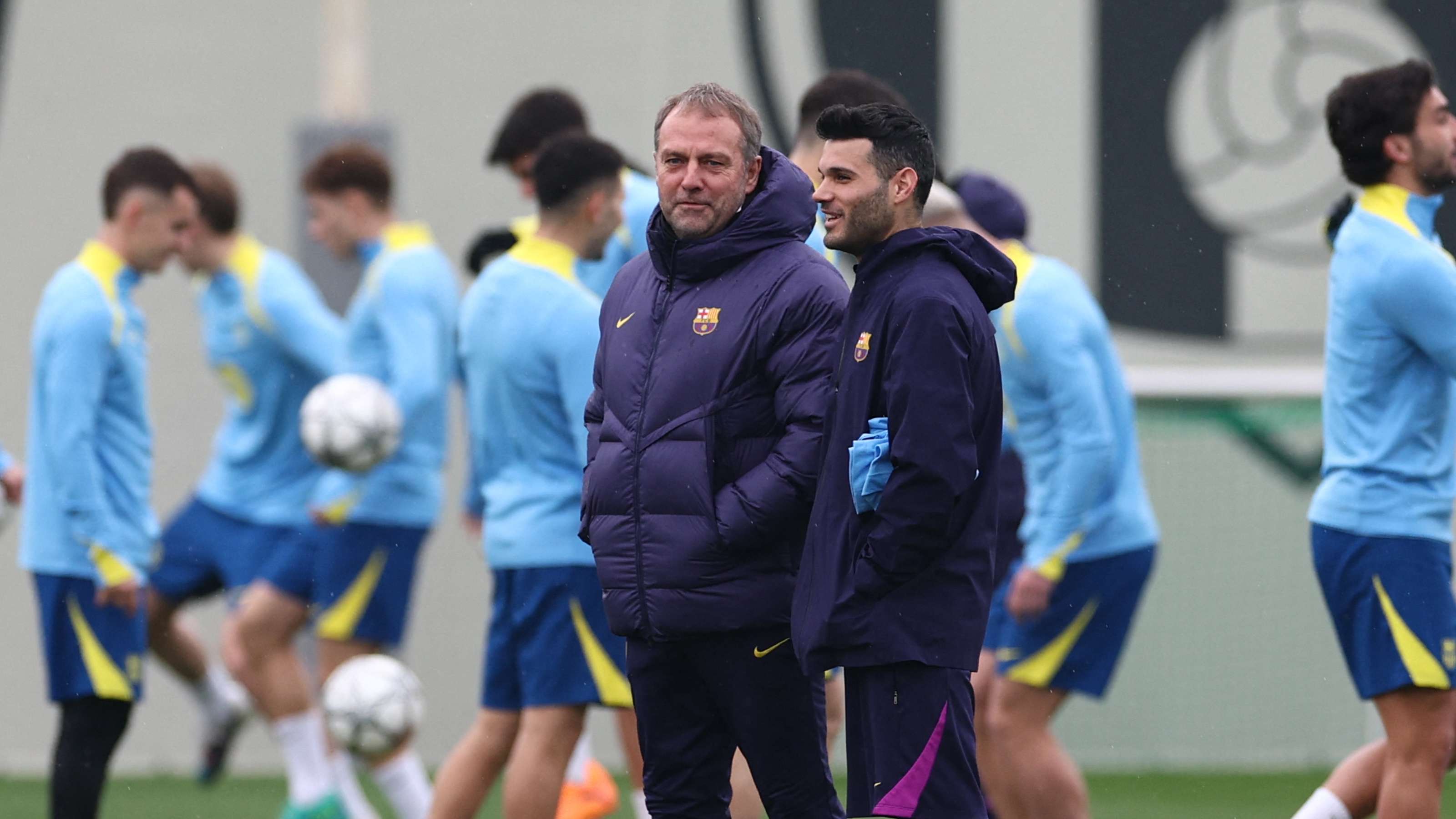
FBL-EUR-C1-BARCELONA-TRAINING
Defeats of this magnitude rarely pass quietly in elite dressing rooms.
The following day, emotions carried into the training ground. Flick reportedly addressed the squad first, questioning their mentality and intensity. He highlighted the lack of hunger in the opening 45 minutes, the failure to press collectively, and the gaps that Atletico exploited.
But this was not a one-way conversation.
Several senior players are understood to have pushed back, expressing doubts about the tactical setup — particularly the high defensive line in a match where conditions and personnel arguably did not suit it. They reportedly told Flick that maintaining such an aggressive structure without key players like Raphinha and Pedri was “not the best idea.”
It was not a rebellion. Nor was it an outright rejection of Flick’s philosophy. The message, instead, was nuanced: stick to the principles, yes — but apply them with greater pragmatism in decisive fixtures.
In elite football, fine margins separate bravery from recklessness. Barcelona’s players felt that line had been crossed.
The High Line Debate: Identity vs Adaptation
Flick’s system is built on proactive control. He wants his team high up the pitch, compressing play, forcing turnovers in advanced zones. It is bold, aggressive, and modern. But it demands synchronisation and physical sharpness.
Without Raphinha’s relentless pressing or Pedri’s composure in possession, the structure wobbled. The distances between defence and midfield widened. Atletico needed only a single vertical pass to bypass pressure.
The players’ argument was not to abandon Flick’s style entirely. Instead, they advocated situational flexibility — especially against opponents like Atletico, who thrive on transitions and defensive organisation.
Against Simeone’s side, perhaps a slightly deeper line, more compact spacing, and controlled aggression would have reduced exposure.
Elite teams evolve within matches. Barcelona, on this night, appeared rigid.
Hansi Flick Admits Barcelona Were Taught a Lesson
To his credit, Flick did not hide from the reality post-match.
“We didn’t play very good in the first half as a team,” he admitted. “We had too much distance between everyone. We didn’t press how we wanted. In the first 45 minutes, we got a lesson.”
The word “lesson” resonated. Flick acknowledged Atletico’s greater will and hunger. He conceded that his side lacked intensity from the first whistle — a damning admission in a semi-final.
Yet he also struck a defiant note. He pointed to the injuries that have disrupted Barcelona’s rhythm all season and expressed pride in the broader campaign. “Today was a heavy loss, but I am proud of my team,” he insisted.
He also made it clear the tie is not over. The objective, he said, is simple: win each half 2-0 in the return leg.
Mathematically, that’s possible. Emotionally and tactically, it will require near perfection.
VAR Controversy Adds Fuel to the Fire
As if the tactical collapse weren’t enough, controversy over Pau Cubarsí’s disallowed goal added another layer of frustration.
With Barcelona trailing 4-0, Cubarsí’s second-half strike offered a glimmer of hope — until it was chalked off for offside following an agonising eight-minute VAR review. The semi-automated offside system reportedly malfunctioned, forcing officials to draw lines manually.
Frenkie de Jong did not mince his words afterwards.
“In the offside photo, you can’t even see the contact with the ball at the moment Fermin shoots,” he said. “Later, another image came out where it was clear the defender was a meter behind Lewandowski. This is very strange. It’s a scandal.”
Whether or not the decision was technically correct, the optics did Barcelona no favours. The lengthy delay drained momentum and intensified a sense of injustice.
Still, the reality remains: the scoreline was not shaped by one call alone.
Squad Depth and the Injury Factor
One cannot ignore the context of absences. Raphinha’s directness and pressing intelligence were sorely missed. Pedri’s absence removed Barcelona’s most reliable rhythm-setter. In their absence, Flick’s system lacked its usual balance.
This is where the players’ plea for pragmatism gains weight. Tactical ideals must reflect available resources. A high line demands coordination, pace and relentless pressing triggers. When key components are missing, recalibration may be necessary.
Barcelona’s squad remains talented, but not immune to vulnerability.
What Comes Next for Barcelona?
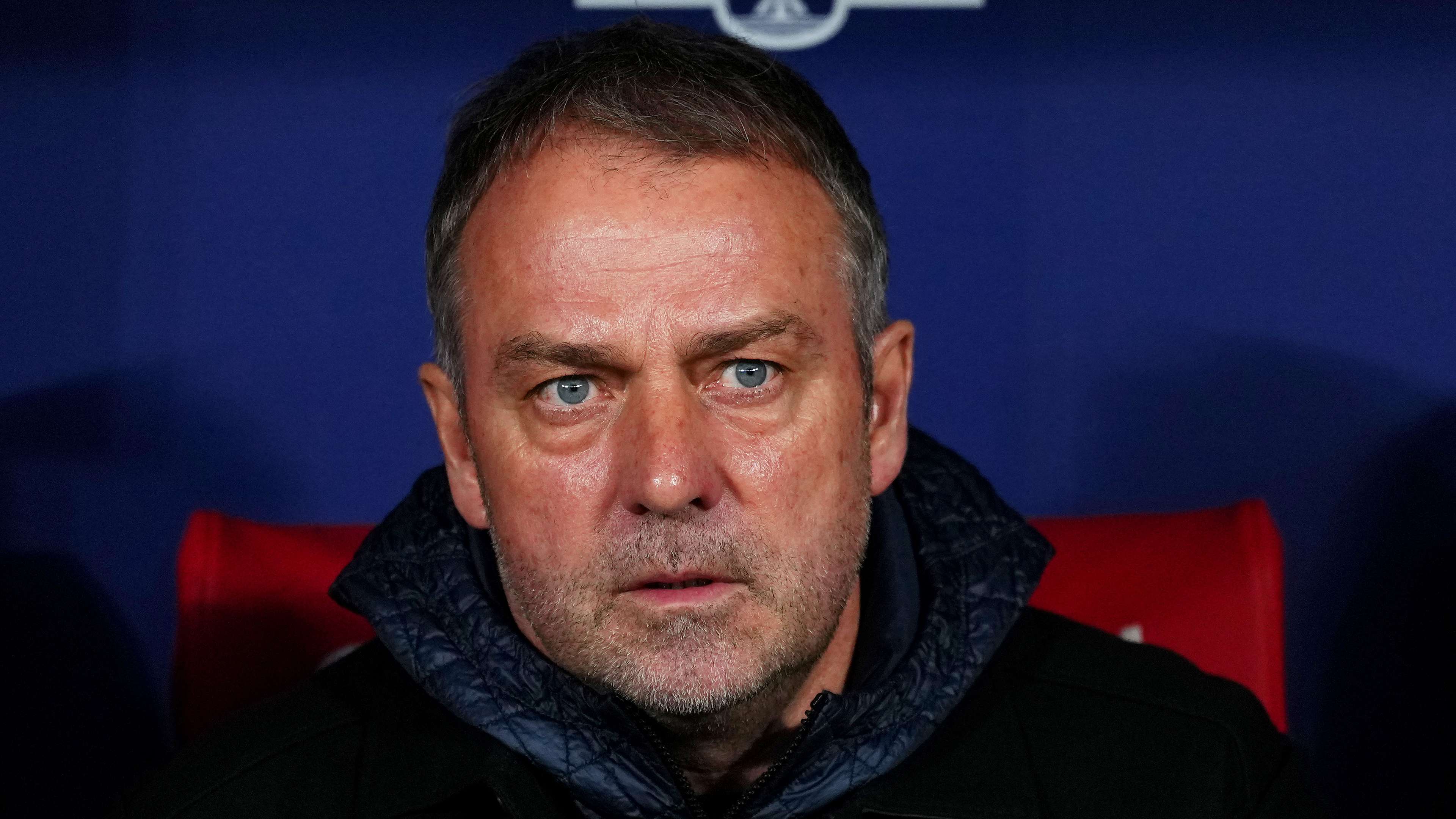
Atletico de Madrid v FC Barcelona – Copa Del Rey
The second leg of the Copa del Rey semi-final is scheduled for March 3 at Camp Nou, offering time for reflection — and recovery. Injured players may return. Tactical tweaks can be rehearsed. Communication lines can be strengthened.
But first comes a crucial La Liga fixture away at Girona. Title races are unforgiving. Momentum swings quickly. A convincing response would steady nerves and reaffirm belief in Flick’s project.
Failure to react, however, would deepen scrutiny.
Elite clubs are built not just on victories, but on how they respond to adversity. Barcelona now stand at such a crossroads.
A Defining Moment for Flick’s Authority
Moments like this test managerial authority.
Flick must balance conviction in his philosophy with openness to feedback. Great coaches listen without surrendering control. The reported training ground exchange, tense as it may have been, could ultimately strengthen internal dialogue.
If handled correctly, it becomes constructive friction — the kind that sharpens focus rather than fractures unity.
Barcelona’s season remains alive on multiple fronts. They lead in La Liga. They are in Europe. The Copa del Rey tie, while daunting, is not mathematically closed.
But the Atletico Madrid debacle has shifted the tone.
This is no longer just about tactics. It is about adaptability, humility, and collective accountability.
Barcelona players have fired back at Hansi Flick — not out of rebellion, but out of belief that adjustments are necessary. Whether that conversation sparks recalibration or deeper tension will define the months ahead.
For now, one thing is certain: Camp Nou awaits the second leg with a mixture of hope and apprehension.
And Barcelona, bruised but unbowed, must decide how they respond.


There are no comments yet. Be the first to comment!