
























































Chelsea Aren’t Going Anywhere! Women’s League Cup Triumph Shows What Bruised Blues Are Still Capable Of
Chelsea Aren’t Going Anywhere: Why the Women’s League Cup Triumph Proved These Bruised Blues Still Have Plenty Left
For all the talk about Chelsea being vulnerable, for all the noise around a bruising season, injuries, inconsistency and a Women’s Super League title slipping through their fingers, one truth came roaring back in Bristol on Sunday:
Chelsea still know how to win when it matters most.
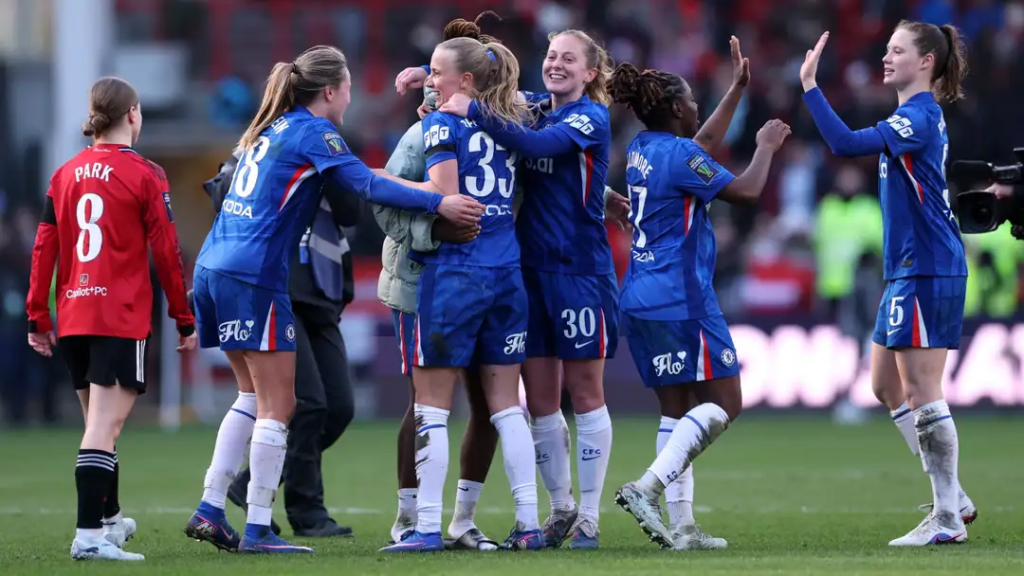
That, in the end, was the biggest takeaway from their Women’s League Cup triumph over Manchester United. Not just that they lifted the first silverware of the season. Not just that they beat a dangerous United side with genuine momentum behind them. But that, when the stakes rose and the pressure tightened, the Blues reached for something they have built over years of winning — a mentality that does not disappear just because the season has been bumpier than usual.
Before the final, Sonia Bompastor reportedly gave her players a simple message: winners win trophies.
It sounds obvious. Almost too obvious. But sometimes football is like that. In the biggest games, the smartest ideas are often the simplest ones. And Chelsea responded exactly like a team that has spent years collecting medals, surviving pressure and refusing to blink.
This was not a flawless Chelsea performance in the sense of 90 minutes of total domination. It was something more impressive than that. It was a mature, hardened, intelligent cup-final display from a side that has not looked fully comfortable for much of this campaign.
And that is precisely why it felt so significant.
Because the Women’s League Cup triumph did not just put a trophy in the cabinet. It reminded everyone — in England and across Europe — that Chelsea aren’t going anywhere.
Chelsea Aren’t Going Anywhere! Women’s League Cup Triumph Arrives at the Perfect Time
If you have watched Chelsea regularly this season, you will know this has not felt like the all-conquering machine of recent years.
By their own towering standards, the campaign has been messy.
This is a club that has won the last six WSL titles. A club that has built an identity around relentless standards, ruthless efficiency and an ability to squeeze the life out of title races. Last season, they went through the league unbeaten — a staggering achievement in itself, but also one that created an impossible benchmark for the season that followed.
This year, they have not looked like that side often enough.
They have dropped points in games they normally control. They have lacked the killer edge in front of goal that once made them so intimidating. They have looked a little more fragile, a little more stretched, a little less protected by the fine margins that seemed to fall their way in previous campaigns.
That is why they now sit 10 points behind Manchester City in the Women’s Super League, and why the title they have treated like personal property for years appears increasingly likely to head north to the blue side of Manchester.
So yes, in pure league terms, Chelsea have been below par.
And that is exactly what made Sunday’s performance so compelling.
Because cup finals have a way of stripping everything down. League form, long-term narratives, injury lists, tactical debates — all of it can get flattened into one simple question:
Who can handle the moment better?
Chelsea answered that emphatically.

Bruised Blues, Big Mentality: Why This Women’s League Cup Triumph Was About More Than Tactics
You could argue that Chelsea needed this trophy emotionally almost as much as they needed it competitively.
This has been a season where confidence has been tested. There have been flat performances, frustrating results, and a constant sense that the side has been searching for its best version without fully finding it. In previous years, Chelsea have often looked inevitable. This season, they have looked human.
And yet, when the pressure rose in a final, they found their old habits.
That is the thing about elite teams. Even when the rhythm is not quite there, even when the football is not flowing every week, the best ones usually retain one priceless quality: they know how to survive high-stakes moments.
That is what Chelsea did against United.
This was a final, not a regular league fixture. It was a game with silverware attached, with tension in every tackle and consequence in every mistake. And in that environment, Chelsea rediscovered a version of themselves that has won so much over the last few years.
They defended with conviction.
They attacked with clarity.
They looked sharper in the key moments.
And above all, they looked like a team that trusted itself.
That trust is hard-earned. It comes from years of winning finals, years of pressure, years of being the side everyone wants to beat.
And on Sunday, it showed.
Chelsea’s Injury Crisis Makes the Women’s League Cup Triumph Even More Impressive
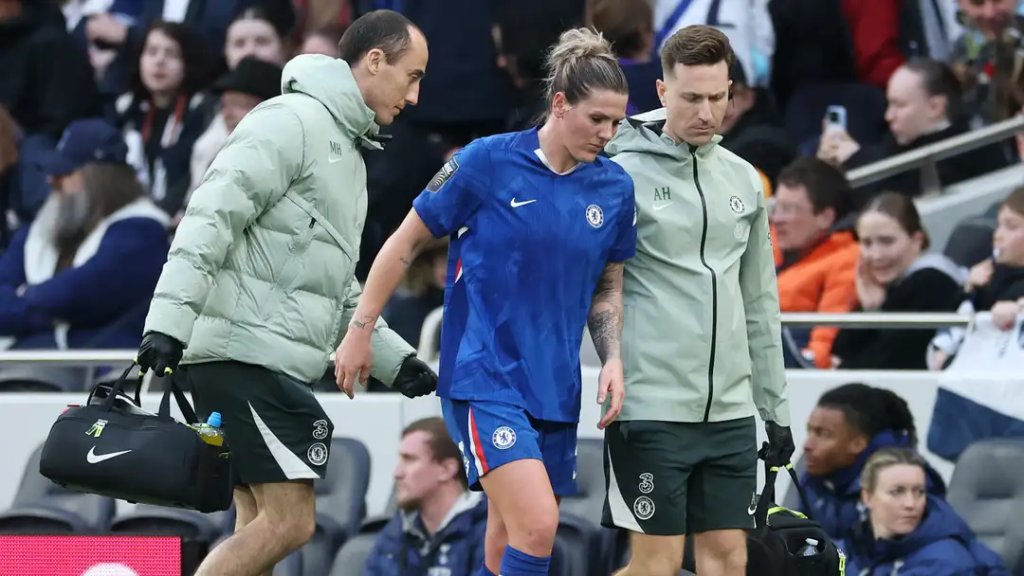
It is impossible to properly appreciate this result without looking at the state of Chelsea’s squad going into the final.
The injury list was not just inconvenient. It was brutal.
Millie Bright, the club captain, was unavailable.
Naomi Girma, a world-class centre-back, picked up a knock the day before the game.
Kadeisha Buchanan, making her first start since November 2024, could only manage around an hour after her own injury issues.
Then Nathalie Bjorn, who replaced her, lasted only minutes before limping off.
By the end of the match, Veerle Buurman, just 19 years old, was the only player in the back line still operating in her natural position.
That is the kind of situation that can derail even very good teams, never mind one facing a Manchester United side full of confidence and attacking threat.
And yet Chelsea still found a way.
That says a lot.
It says something about coaching, yes. It says something about structure, certainly. But more than anything, it says something about the collective character of the squad. Teams can only improvise under pressure if the group believes in itself and understands the task.
Chelsea did.
They were patched together in places, reshuffled in others, and still they looked like a team with a clear idea of what the game required.
That is not luck. That is culture.

How Chelsea Silenced Manchester United and Won the Women’s League Cup Final
Manchester United came into the game with every reason to believe.
Their attack has been one of the most productive in the WSL this season. They had momentum. They had options. They had a stronger bench than Chelsea on the day, something that would have sounded strange a few months ago but was undeniably true given how well United recruited in January and how badly injuries have hit the Blues.
And yet, Chelsea handled them.
That is what stands out.
This was not a case of surviving wave after wave with pure desperation. Chelsea were organised, disciplined and clever. They took away key threats and forced United into less dangerous areas.
Jess Park, in excellent form and one of the most dangerous English attacking players around right now, was largely quiet.
Melvine Malard, who has been such an influential presence from the left, was contained.
Elisabeth Terland, United’s central attacking reference point, was restricted mostly to efforts from distance rather than the sort of close-range chances strikers thrive on.
For a makeshift defence to do that in a final is seriously impressive.
And then, when the moments came at the other end, Chelsea looked more like Chelsea.
Lauren James was electric in flashes — not just because of the obvious technical brilliance, but because she looked like a player who understood exactly when to take control of the game. Her ability to lift the level of a team around her remains rare.
Aggie Beever-Jones did what all top forwards must do in finals: she took her chance.
That clinical touch has deserted Chelsea at times this season. On Sunday, it returned.
And in finals, that is usually the difference.
Sonia Bompastor’s Chelsea: Below Par in the WSL, But Still Dangerous Everywhere Else
There is no point pretending the WSL title race looks healthy for Chelsea.
It doesn’t.
Even with Manchester City dropping points in a frustrating draw against Aston Villa, the league table still points heavily in City’s favour. The gap is significant, and Chelsea have not shown enough consistency this season to suggest a dramatic turnaround is guaranteed.
That matters, of course. Chelsea do not exist to settle for cup runs and moral victories. This is a club built to win leagues.
But the danger for everyone else is assuming that a wobbling Chelsea is the same thing as a finished Chelsea.
It isn’t.
If anything, this season has shown that even a bruised version of this team still has an annoyingly high floor. Even when they are not fluent. Even when the injuries pile up. Even when the league form is patchy. They remain deeply competitive.
That is a terrifying trait in knockout football.
The Champions League is still alive.
Other domestic silverware is still on the table.
And cup football has always rewarded teams that can handle chaos better than everyone else.
Chelsea, historically, are excellent at that.

Chelsea’s Edge in Finals Is Real — and It’s Why They Can Never Be Counted Out
Manchester United manager Marc Skinner put it quite well after the final when he said Chelsea have “the edge” because they have been winning finals for years.
That was not excuse-making. That was reality.
Chelsea’s edge in finals is not a myth. It is built on evidence.
Since 2020, the Blues have played 10 cup finals and won seven of them. That is a ridiculous strike rate. It is the sort of number that changes how players walk onto the pitch. It changes how opponents feel too, even if no one will admit it publicly.
Because when one team has done it again and again and again, there is always a psychological residue.
United have now lost three finals to Chelsea, including previous FA Cup final defeats. That history does not automatically decide the next match, but it sits in the background. It lingers. It shapes tension. It can affect the way moments are played.
Chelsea know what these games feel like.
They know what they require.
And they know how to stay calm when others get a little too caught up in the occasion.
That is exactly what Erin Cuthbert was getting at when she spoke about every game at this stage of the season feeling like a final. It sounds cliché until you watch Chelsea in these moments. Then it makes perfect sense.
For them, pressure has become normal.
And when pressure becomes normal, finals start to feel less dramatic than they do for everyone else.
Lauren James, Erin Cuthbert and the Character That Keeps Chelsea Alive
You can talk systems, injuries, squad depth and tactical match-ups all day, but teams like Chelsea are still driven by personalities.
Lauren James is the obvious headline act. When she is fully fit and confident, she gives Chelsea something few sides in Europe can match: a player who can distort a game with one piece of skill, one burst of acceleration, one disguised pass, one finish that nobody else on the pitch even sees.
She is not just talented. She is talismanic.
Then there is Erin Cuthbert, who may not always dominate the headlines but embodies so much of what Chelsea are about. Her mentality, her edge, her refusal to let the game drift — those things matter in finals, especially when the team is under strain.
And then there are players like Veerle Buurman, who stepped into a huge occasion at 19 and looked anything but overwhelmed. That is another sign of a healthy culture. Young players can only perform like that if the environment around them gives them belief.
Chelsea, even in a season with flaws, still have that.
Plenty to Play For: Why Chelsea’s Women’s League Cup Triumph Could Change the Feel of Their Season

Trophies do not just reward teams. Sometimes they reset them.
That is the opportunity now in front of Chelsea.
A season that has felt frustrating in the league can still become a memorable one if they channel this result properly. Winning a cup final gives a squad energy. It gives players proof. It gives them something tangible to point to when confidence has been wobbling.
And confidence matters more than people like to admit.
Bompastor herself hinted at that after the final, noting that when players are fully confident, pressing becomes easier, the intensity rises naturally, and the team begins to look more like itself again.
That was visible against United.
Chelsea pressed with purpose.
They competed with conviction.
They looked emotionally lighter, even within the tension of a final.
If they can carry that into the next few weeks, suddenly the season changes shape.
The WSL title may still be slipping away.
But the campaign does not have to be defined by that alone.
There is still the chance to win more silverware.
There is still the chance to chase the Champions League, the one trophy this club still craves above all others.
There is still the chance to turn a bruising year into a meaningful one.
And after Sunday, it would be foolish to dismiss that possibility.
Final Verdict: Chelsea Aren’t Going Anywhere — and the Women’s League Cup Triumph Proved It
So yes, Chelsea aren’t going anywhere.
Not this season.
Not in England.
Not in Europe.
The Women’s League Cup triumph was more than a trophy. It was a reminder. A reminder that the bruised version of Chelsea is still capable of looking like champions when the moment demands it. A reminder that mentality can carry a team through injury chaos. A reminder that finals are still Chelsea territory more often than not.
This side may not be as dominant in the league as it has been in recent years. The WSL crown may be drifting away. The football has not always been smooth. The confidence has clearly taken hits.
But even with all of that, they remain one of the most dangerous teams around.
Because some teams need perfect conditions to win.
Chelsea don’t.
Give them a final.
Give them pressure.
Give them adversity.
And more often than not, they will still find a way.
That is what the best teams do.
And that is why, with two months left and more silverware still in play, nobody should be writing off Sonia Bompastor’s Blues just yet.


There are no comments yet. Be the first to comment!