





















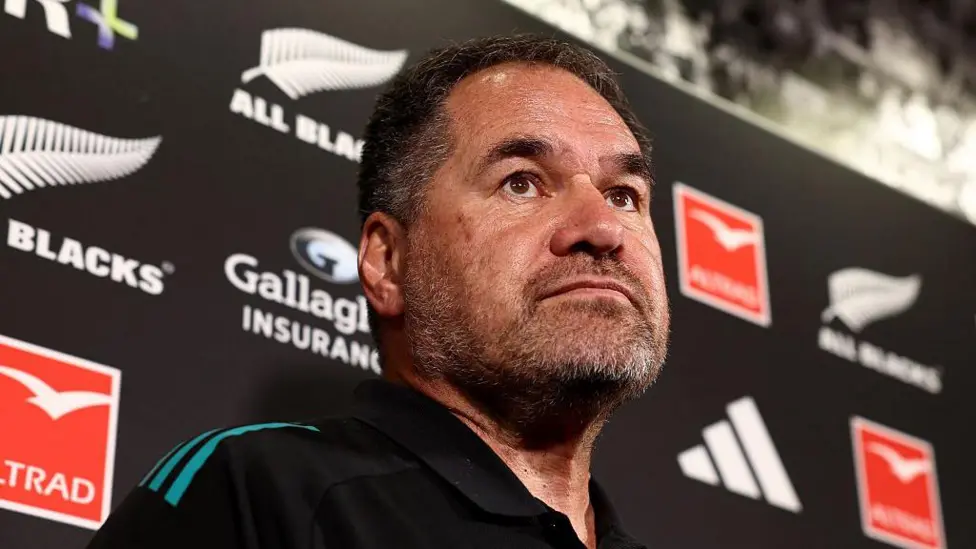
Dave Rennie Appointed New All Blacks Coach as New Zealand Begins a Bold New Era
New Zealand rugby rarely moves quietly, and the announcement that Dave Rennie appointed new All Blacks coach marks the beginning of another defining chapter for one of sport’s most iconic national teams. In a decision loaded with symbolism, expectation, and urgency, New Zealand Rugby has turned to an experienced figure tasked with restoring stability while steering the All Blacks toward Rugby World Cup glory.
At 62, Rennie arrives not merely as a replacement but as a cultural milestone — becoming the first head coach of Pasifika heritage to lead the national side. His appointment follows the departure of Scott Robertson earlier this year after a turbulent period marked by inconsistent results and internal tensions.
Dave Rennie Appointed New All Blacks Coach Amid High Expectations and Cultural Significance
The official unveiling in Auckland carried both tradition and quiet symbolism. Rennie opened his first press conference with the Māori greeting “Kia orana koutou,” immediately signaling respect for heritage and community — values deeply embedded within New Zealand rugby culture.
His Pasifika roots, linked to the Cook Islands through his mother, add another historic layer to the appointment. For many supporters across Polynesia, Melanesia, and Micronesia, Rennie’s rise represents long-awaited representation at the very top of the sport.
Yet sentiment alone will not define his tenure. The All Blacks operate in a results-driven environment where legacy is measured almost exclusively by victories.
New Zealand Rugby chairman David Kirk emphasized Rennie’s experience as a decisive factor in the selection process. After a competitive recruitment battle that also included Jamie Joseph, Rennie emerged as the preferred candidate — seen as a steady hand capable of guiding the team through transition.
His mission is already clear: prepare New Zealand to chase a fourth Rugby World Cup title when the tournament kicks off in Australia next October.
“It’s a sprint from here,” Rennie admitted during his introduction, acknowledging the limited preparation time ahead.
A Difficult Transition After Scott Robertson’s Departure
Rennie inherits a squad still processing a turbulent recent era. Scott Robertson’s dismissal in January followed two challenging seasons punctuated by high-profile defeats to South Africa, Argentina, and England. Reports of friction between senior players and management further complicated matters, creating an atmosphere that demanded reset rather than minor adjustment.
The All Blacks, long considered rugby’s gold standard, suddenly appeared vulnerable — not devoid of talent, but searching for cohesion and clarity.
Rennie has made it clear that rebuilding team culture will sit at the center of his approach. Without criticizing previous leadership, he hinted strongly that adjustments are coming.
He spoke carefully, refusing to publicly dissect past shortcomings while confirming he already has “firm ideas” about tactical and structural changes needed to elevate performances.
That balance — honesty without disruption — may prove essential in a role where media scrutiny and national expectation collide daily.
The Road Back to Test Rugby for Rennie
Rennie’s return to elite Test coaching comes after a mixed but often misunderstood spell with Australia’s Wallabies between 2019 and 2023. Statistically, his tenure produced a modest record: 13 wins, four draws, and 18 losses across 34 Tests.
On paper, those numbers raised questions. Context, however, tells a more nuanced story.
Rennie coached during one of the most difficult periods in modern sport, navigating pandemic disruptions, travel restrictions, and recurring injuries to key players. Despite those obstacles, Australia recorded notable victories over New Zealand, South Africa, and France while developing a competitive identity built on resilience.
Observers noted that several narrow defeats — including close losses to France and Ireland — came against teams that later emerged as World Cup contenders.
Ironically, Rennie’s reputation improved after his departure. Successor Eddie Jones endured a disastrous 2023 World Cup campaign, with Australia failing to escape the pool stage for the first time in history. In hindsight, Rennie’s Wallabies appeared more stable than many initially believed.
Before his Test coaching career, Rennie also earned widespread respect at Glasgow Warriors, guiding the Scottish club to the Pro14 final in 2019 while building a disciplined, hard-working squad culture.
Those experiences now shape expectations for his All Blacks tenure.
Balancing Immediate Demands with Long-Term Vision
One of the unique challenges facing Rennie is timing. He will temporarily remain committed to Japan’s Kobe Steelers before fully transitioning into All Blacks preparations ahead of July Test matches against France, Italy, and Ireland.
That compressed timeline leaves little margin for experimentation.
New Zealand supporters traditionally demand attacking rugby combined with tactical precision — a balance the All Blacks have not consistently achieved in recent seasons. Rennie has already begun studying matches extensively, searching for adjustments that can unlock greater efficiency without abandoning the team’s traditional flair.
He has avoided outlining specific tactical shifts publicly, preferring to work internally before revealing changes on the field.
That measured approach reflects his reputation as a calm, analytical coach — qualities many believe will help stabilize a high-pressure environment that appeared to unsettle his predecessor.
Composure Required in Rugby’s Most Demanding Job
Coaching the All Blacks carries unique psychological weight. Every selection, substitution, and tactical decision becomes a national conversation. Success is expected; rebuilding phases are rarely tolerated.
BBC rugby analyst Mike Henson described Rennie’s temperament as one of his greatest strengths. Throughout his career, he has cultivated an image of composure and thoughtful leadership rather than emotional volatility.
That demeanor could prove crucial.
Modern Test rugby demands adaptability as much as authority. Opponents have closed the historical gap on New Zealand, and the All Blacks can no longer rely solely on tradition or individual brilliance. Strategic clarity, squad unity, and player welfare now play equally vital roles.
Rennie appears aware of that reality. His emphasis on athlete preparation and collective responsibility suggests a coaching philosophy centered on sustainability rather than short-term fixes.
A New Chapter Begins for the All Blacks
Ultimately, the significance of Dave Rennie appointed new All Blacks coach extends beyond tactics or results. It represents a reset moment for New Zealand rugby — culturally, strategically, and emotionally.
The next year will determine whether Rennie can transform promise into performance. The July Test window will offer the first glimpse of his influence, while the looming Rugby World Cup provides the ultimate measuring stick.
For now, optimism mixes with caution. Rennie inherits immense talent but equally immense expectation.
If he succeeds, he will not only guide the All Blacks back toward global dominance but also redefine leadership pathways within the sport by showing that calm authority and cultural connection can coexist at rugby’s highest level.
And in a nation where rugby is more than a game, that journey begins immediately — because, as Rennie himself put it, the race has already started.


There are no comments yet. Be the first to comment!