







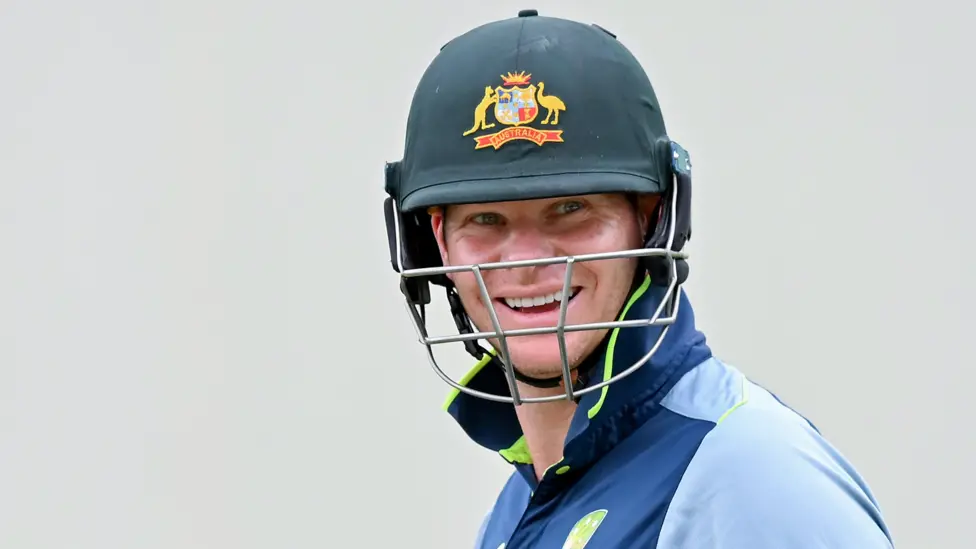
Smith Added to Australia Squad as T20 World Cup Hopes Hang by a Thread
Australia have turned to experience at a moment of genuine uncertainty. Steve Smith has been added to Australia’s T20 World Cup squad ahead of Monday’s crucial match against Sri Lanka in Pallekele, a move that speaks as much about urgency as it does about faith in one of the country’s most accomplished batters.
This was not part of the original script.
Smith, now 36, travelled to Sri Lanka initially as cover after captain Mitchell Marsh suffered a painful blow to the groin area in training last week, later diagnosed as testicular bleeding. At the time, Cricket Australia stopped short of formally adding Smith to the squad. The management wanted clarity. They wanted medical certainty. They wanted time.
Time, however, is a luxury rarely afforded in tournament cricket.
With Australia’s campaign wobbling and selection options narrowing, Smith has now been officially drafted in, replacing fast bowler Josh Hazlewood, who had been ruled out on the eve of the competition and never replaced.
The message is clear: this is a team searching for stability.
Smith Added to Australia Squad Before Crucial Match Against Sri Lanka
The timing of the decision feels significant. Australia’s meeting with Sri Lanka in Pallekele is not just another group-stage fixture. It is, in all likelihood, a defining one.
Defeat would leave Australia’s T20 World Cup fate out of their own hands. If they lose and Zimbabwe overcome Ireland the following day, the defending champions will be eliminated before the Super 8s. Even victory may not guarantee smooth passage; net run-rate calculations could yet enter the equation.
In that context, activating Smith makes strategic sense.
Selector Tony Dodemaide explained the thinking plainly. With uncertainty lingering over both Mitchell Marsh and Marcus Stoinis, Australia needed flexibility. Smith’s presence in Sri Lanka made the decision easier. He was fit, available, and ready if required.
But beyond logistics lies something more nuanced.
Australia’s batting has faltered alarmingly in this tournament. The shock 23-run defeat to Zimbabwe, where they were bowled out for 146, exposed fragility in the middle order. Even in their opening 67-run win over Ireland, fluency was intermittent rather than sustained.
This is not the free-flowing Australian batting unit many expected.
Smith may not be the archetypal modern T20 aggressor, but what he offers is composure under pressure — and right now, that quality feels priceless.
A Return to the T20 Fold
It has been some time since Smith last featured in a T20 international for Australia. His previous appearance came in February 2024, and for a while it seemed his white-ball future might quietly fade in favour of younger, more explosive options.
Yet form has a habit of reopening doors.
After the Ashes in January, Smith produced a compelling run in the Big Bash League: one century and two fifties in six matches. Those performances reignited debate about his omission from Australia’s original World Cup squad. Critics argued that adaptability and cricket intelligence can be as valuable as raw power in the shortest format.
In hindsight, that argument appears stronger.
Smith’s domestic numbers were not merely respectable; they were authoritative. He found ways to manipulate fields, pierce gaps, and accelerate when needed. While others swung for the stands, he accumulated with precision.
Tournament cricket often demands exactly that.
There is also the psychological dimension. Smith’s presence in the dressing room alters the atmosphere. Younger players tend to listen when he speaks. Bowlers know he will scrap for every run. Coaches trust his reading of match situations.
Australia are not simply adding a batter; they are reinforcing their spine.
The Hazlewood Factor and Squad Balance
Josh Hazlewood’s absence has quietly reshaped Australia’s plans. The experienced seamer was ruled out before the tournament began, and the decision not to replace him at the time suggested confidence in the existing bowling depth.
Now, circumstances have forced a different calculation.
Replacing Hazlewood with Smith signals a subtle shift in priorities. Australia appear more concerned about stabilising their batting than reinforcing their pace attack. That in itself tells a story.
In T20 cricket, momentum can swing violently within a few overs. Australia’s recent struggles suggest that once wickets begin to fall, panic is not far behind. Smith’s game, built on control rather than chaos, could help arrest that pattern.
The question, of course, is where he fits.
Does he open to provide early assurance? Slot in at No.3 to rebuild if required? Or anchor the middle overs while power hitters attack around him? The flexibility he offers may prove as valuable as any single role.
Pressure Mounting on Australia
It would be disingenuous to pretend this is a routine group stage for Australia. The 3-0 series defeat in Pakistan prior to the World Cup hinted at vulnerabilities. The loss to Zimbabwe confirmed them.
For a nation accustomed to dictating tournaments rather than chasing qualification scenarios, this is unfamiliar territory.
The mathematics are uncomfortable. Australia may need to win both remaining matches and still rely on net run-rate. Margins suddenly matter. Strike rates matter. Every dropped catch, every mistimed shot, carries amplified consequence.
Against Sri Lanka in Pallekele, conditions are likely to test technique as much as temperament. Spin will play a role. Patience may be required. In such circumstances, Smith’s methodical approach could align neatly with the surface.
He is not the most explosive option in Australia’s arsenal, but he may be the most reliable.
Experience in a Time of Uncertainty
Marcus Stoinis, too, remains under a cloud. That dual uncertainty has left Australia searching for ballast.
Smith has built a career on resilience. He has navigated personal setbacks, form slumps, and tactical shifts. Few players understand the rhythms of international cricket as intimately.
In tournament play, that matters.
When the noise grows loud — when qualification tables flash on screens and commentators dissect net run-rate permutations — calm heads are invaluable. Smith rarely appears rushed. He calculates. He adapts.
That might be exactly what Australia need.
A Defining Night in Pallekele
Monday’s clash with Sri Lanka is shaping as a watershed moment. Win, and Australia keep their destiny alive. Lose, and they edge towards an early exit few would have predicted.
The decision to add Smith to Australia’s T20 World Cup squad before this crucial match is not merely administrative. It is symbolic. It acknowledges vulnerability while expressing belief that experience can steady the course.
Whether Smith walks straight into the XI or waits for his opportunity, his reintroduction changes the narrative.
For Australia, this is about survival. For Smith, it is another chapter in a career defined by reinvention and persistence.
In Pallekele, under humid Sri Lankan skies, the margins will be thin. Australia’s campaign hangs in delicate balance. And once again, they are turning to Steve Smith — not for fireworks, but for substance.


There are no comments yet. Be the first to comment!