



































‘We Have to Make Clear Rules!’ – Brighton Boss Fabian Hurzeler Speaks Out Against Arsenal’s Time-Wasting Tactics
Brighton Boss Fabian Hurzeler Calls for Clear Rules as Arsenal’s Time-Wasting Tactics Spark Debate
There are moments in a title race when the tension spills beyond the pitch. Not into touchline bust-ups or heated handshakes, but into something subtler — a war of words about the very shape of the game itself.
Ahead of Brighton’s meeting with league leaders Arsenal FC at the Amex Stadium, Fabian Hurzeler has done exactly that. The Brighton head coach has publicly questioned the lack of clarity around time-wasting and set-piece management, arguing that modern football urgently needs “clear rules” to preserve its integrity.
It’s not the first time Arsenal’s game management has drawn scrutiny this season. But when a manager voices concerns so directly on the eve of a high-stakes Premier League clash, it inevitably sharpens the spotlight.
And make no mistake — this is about more than just one corner kick.
The Fight Against Football’s “Dark Arts”
If there is one area where Arsenal have become ruthlessly efficient under Mikel Arteta, it is set-pieces.
Against Chelsea FC recently, the Gunners once again demonstrated their dead-ball precision. Goals from William Saliba and Jurrien Timber, delivered with trademark quality by Declan Rice and Bukayo Saka, secured a vital victory in the title race.
But it wasn’t just the goals that caught attention. It was the orchestration leading up to them — the blocking runs, the grappling inside the box, the subtle nudges and tactical pauses before the ball was finally struck.
Hurzeler’s frustration lies not in Arsenal’s effectiveness, but in what he perceives as inconsistency in officiating.
“Some of the blockings or the way teams are blocking, there is no clear rule,” he said ahead of the clash. “Sometimes the referee whistles and it’s a foul, sometimes he doesn’t whistle.”
And therein lies the heart of his complaint. Not necessarily that Arsenal are breaking rules — but that the rules themselves lack precision in their application.
Time as a Tactical Weapon
Set-pieces have long been described as moments where matches can pivot. Hurzeler himself acknowledges their importance. But his broader concern extends beyond jostling in the penalty area.
It’s about time.
Specifically, how it is used — or, as he sees it, deliberately stretched — when a team is leading.
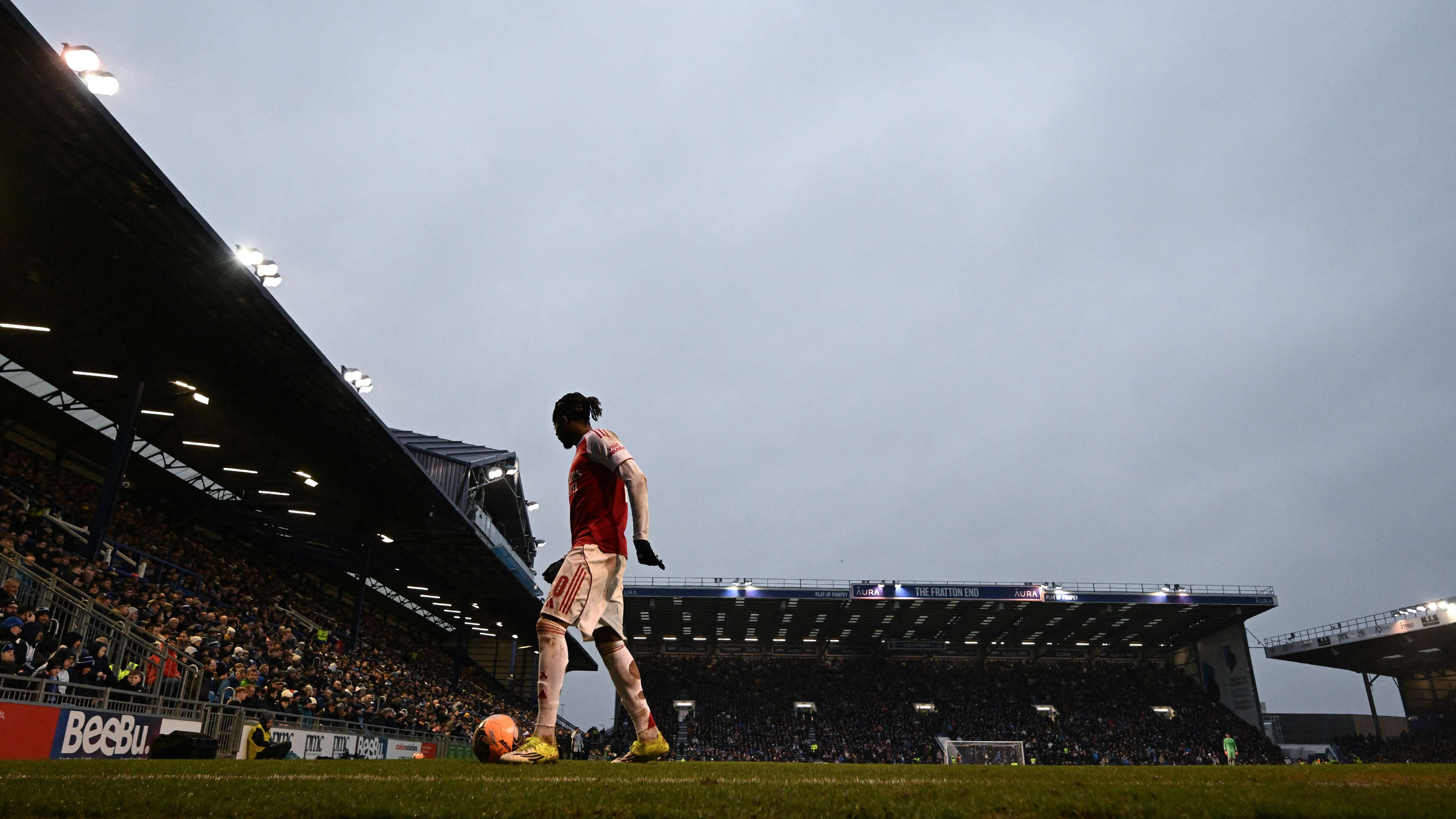
“No-one recognises it,” Hurzeler argued, “but when Arsenal have a corner and they are leading, sometimes they spend over a minute just to take a corner.”
A minute may not sound dramatic in isolation. But multiply that across a half, across a match, across a season — and it becomes a strategic device.
Modern football is full of such micro-delays: the goalkeeper adjusting socks before a goal kick, a throw-in taker wiping the ball, a player repositioning it twice before a free-kick. Individually minor. Collectively significant.
Hurzeler believes those seconds erode something fundamental.
FBL-ENG-FACUP-PORTSMOUTH-ARSENAL
The Demand for “Natural Game Time”
The Brighton manager’s solution is bold in its simplicity: enforce stricter, standardized limits on how long teams can take over restarts.
“We have to make clear rules,” he insisted. “Because then in the end we have a natural game time of 50 minutes instead of sometimes 65 minutes.”
His wording may have been slightly tangled, but the message was unmistakable. Supporters are paying to watch football — not stoppages.
Data increasingly supports the idea that actual ball-in-play time varies dramatically from match to match. While official match duration remains 90 minutes plus stoppage time, the “natural” or active playing time can differ by significant margins depending on game state and tactical approach.
Hurzeler claims Brighton’s own analysis highlights a “massive” discrepancy across fixtures.
“The game is changing so much if you don’t have natural game time for all the games,” he said. “Every supporter who pays a lot of money to watch our games should see the same natural game time.”
It’s a consumer-driven argument as much as a sporting one. In an era of escalating ticket prices and broadcast revenues, consistency matters.
Entertainment vs. Efficiency
There is an uncomfortable tension here. On one hand, Arsenal are doing what elite teams have always done — controlling tempo, managing risk, maximizing advantage. On the other, critics argue that such methods chip away at the spectacle.
Arteta’s side are hardly alone. Across Europe, leading teams have mastered the art of slowing matches when ahead. It is not new. It is not illegal. But it is increasingly visible.
The irony? Arsenal’s meticulous structure and set-piece dominance have been widely praised as evidence of elite coaching.
Yet that same precision invites scrutiny when it edges toward time manipulation.
For Brighton, the issue is practical as much as philosophical. If you’re chasing a game, every second matters.
Pragmatism in the Present
Despite his public stance, Hurzeler is no idealist detached from reality. He knows rule changes won’t arrive overnight. The Premier League will not rewrite its officiating handbook before Wednesday’s kickoff.
“We won’t change these rules immediately,” he admitted.
So Brighton must adapt.
Set-pieces, after all, are not just Arsenal’s weapon. They are universal game-changers. Hurzeler emphasized the need for his own side to become more clinical in similar situations.
“We know how important set pieces are. They can be game changers. So we have to use it as well.”
There’s an edge of competitive acceptance in that remark. If the environment rewards efficiency at corners and free-kicks, then Brighton must compete on the same battlefield.
Complaining without adjusting would be naive. Hurzeler seems determined not to fall into that trap.
A Tactical Chess Match at the Amex
The narrative now adds spice to what was already an intriguing contest.
Arsenal, chasing the title. Brighton, striving to disrupt hierarchy. A young, progressive coach publicly challenging the league leaders’ methods.
The Amex crowd will be alert to every delay, every drawn-out corner routine. Every second will feel amplified.
Arteta, seasoned in the psychological theatre of title races, is unlikely to be rattled. His focus will remain on execution. Arsenal’s structure, particularly from dead balls, has been one of their most reliable sources of advantage.
And yet, the discourse matters. When managers speak, referees listen. Even subconsciously.
Will officials clamp down more decisively on blocking at corners? Will throw-ins be hurried along? It’s impossible to say. But the debate has been planted firmly in the public domain.
The Broader Picture
Hurzeler’s comments tap into a wider conversation about football’s evolution.
VAR has already altered tempo. Added stoppage time has increased match duration. Tactical fouling and structured restarts are part of the modern toolkit.
The sport constantly balances innovation with entertainment.
In basketball, shot clocks transformed pace. In rugby, stricter enforcement of ruck timing reshaped flow. Football, traditionally resistant to radical reform, now finds itself at a similar crossroads.
Hurzeler’s demand for “clear rules” is not revolutionary — but it is pointed.
Consistency, above all, is what he wants.

FBL-ENG-PR-BRIGHTON-BURNLEY
More Than Mind Games?
Cynics might frame this as psychological maneuvering — an attempt to nudge referees before kickoff. That possibility cannot be dismissed.
Managers have long used press conferences to influence perception.
But there was something measured, almost analytical, in Hurzeler’s tone. This did not feel like a rant. It felt like a coach studying margins.
And in a league where margins decide titles and European qualification, those details matter.
What Happens Next?
Whether the Premier League hierarchy responds remains uncertain. Structural rule changes tend to move slowly. Pilot schemes, IFAB consultations, stakeholder reviews — reform is rarely immediate.
For now, the responsibility rests with referees to apply existing guidelines as consistently as possible.
And on Wednesday night, all eyes will be watching.
Every delayed corner. Every blocked run. Every whistle — or absence of one.
Hurzeler has ensured that Arsenal’s time-wasting tactics, real or perceived, are part of the pre-match narrative. He has shifted focus onto process rather than just result.
In a title race defined by fine margins, even seconds can feel decisive.
Whether this becomes a turning point in the broader conversation about game management, or simply another subplot in Arsenal’s march toward silverware, will unfold in due course.
But one thing is certain: the next time Arsenal take their time over a corner at the Amex, 30,000 pairs of eyes will be counting.


There are no comments yet. Be the first to comment!