




































































Zeynep Sonmez Shows True Class After Ball Girl Collapses at Australian Open
Moments of genuine humanity can sometimes eclipse the scoreline, and at the Australian Open, Turkey’s Zeynep Sonmez delivered one of the tournament’s most powerful reminders of that truth. In searing Melbourne conditions, the world number 112 paused her own match to help a distressed ball girl who collapsed courtside — an instinctive act that quickly resonated far beyond the result itself.
What followed was not just a dramatic interruption to a Grand Slam match, but a quiet, moving demonstration of sportsmanship that embodied everything tennis likes to believe it stands for.
Player Helps Ball Girl After Collapse at Australian Open in Emotional Scene
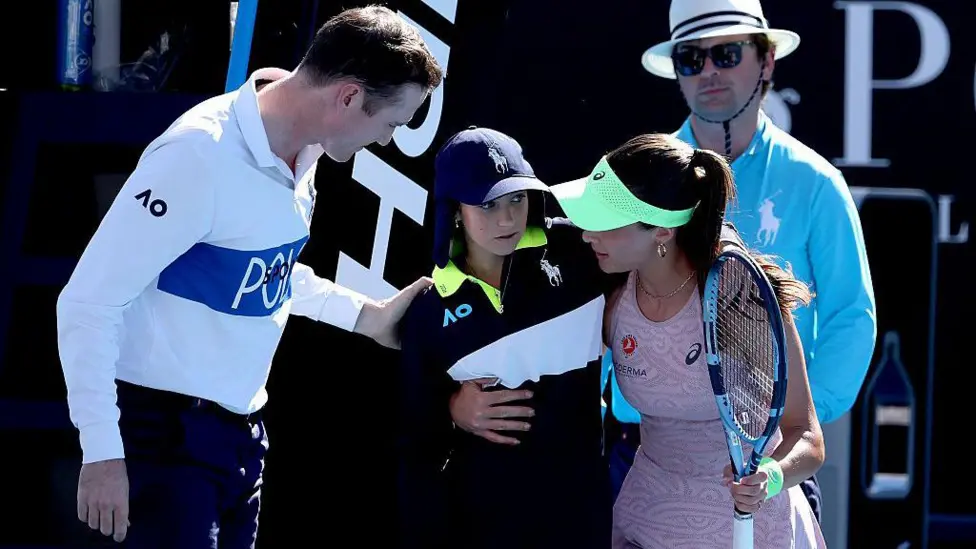
The incident occurred during Sonmez’s opening-round match against Russia’s Ekaterina Alexandrova. With Alexandrova serving late in the second set, play was suddenly halted when a ball girl standing beside the umpire’s chair fainted and fell flat on her back.
Although the youngster quickly attempted to get back to her feet, it was immediately clear something was wrong. Before officials or medical staff could fully react, Sonmez sprinted across the court, placing her arm around the ball girl and guiding her carefully toward the side of the court.
As they walked, the ball girl fainted again. Sonmez tightened her grip, ensuring she didn’t fall, before helping her sit down in the shade where medical staff rushed in with water and assistance. The match was suspended for around six minutes while the girl received treatment, eventually being helped off court by Tennis Australia staff.
The applause that followed felt less like polite recognition and more like a collective acknowledgement that everyone in the stadium had just witnessed something far more important than a forehand winner.
“Being a Good Human Being Matters More Than Tennis”
Speaking afterwards, Sonmez played down her actions, framing them as nothing more than basic human instinct.
“She was really struggling,” Sonmez told BBC Sport. “She said she was fine but it was really obvious she was not fine. So I went to grab her and said, ‘Sit down and drink something, you’re not fine.’”
The most alarming moment, Sonmez admitted, came as they were walking away from the court.
“As we were walking she fainted, so luckily I grabbed her. She was really shaking,” she said.
For Sonmez, there was never any question about what to do.
“I always say it is more important to be a good human being than a good tennis player,” she added. “It was just my instinct to help her, and I think everyone would do the same. I’m happy I got to help.”
Tennis Australia later confirmed the ball girl received medical attention on site and was able to go home safely. Sonmez also expressed a desire to check in with her later in the tournament, underlining that her concern extended well beyond the brief interruption.
Australian Open Heat Puts Focus Back on Player and Staff Welfare
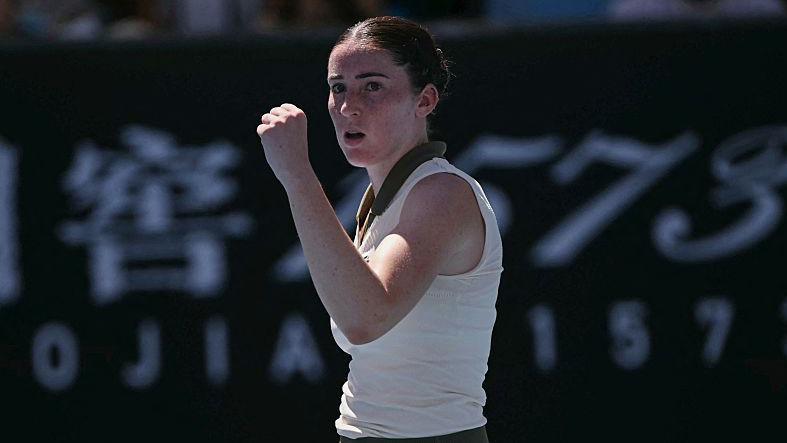
France’s Elsa Jacquemot celebrates
The collapse inevitably reignited discussion around the intense heat that so often defines the Australian Open. Temperatures reached 28°C on Sunday at Melbourne Park, with forecasts suggesting the mercury could climb to 35°C by the following weekend.
In response to similar incidents in the past, the Australian Open updated its Extreme Heat Policy in 2019, introducing the Heat Stress Scale (HSS). The scale, which runs from zero to five, is designed to assess when playing conditions may become dangerous for players and on-court staff.
At the time of the ball girl’s collapse, the HSS registered at 2.8. According to tournament guidelines, that reading triggers advice to increase hydration rather than suspending play. While conditions were not deemed extreme enough to halt matches, the incident served as a stark reminder that ball kids, umpires, and line judges are also exposed to the same demanding environment as players — often without the same recovery opportunities.
Sonmez’s intervention highlighted that welfare at major tournaments extends beyond those holding rackets.
Sonmez’s Grit Completes Memorable Australian Open Upset
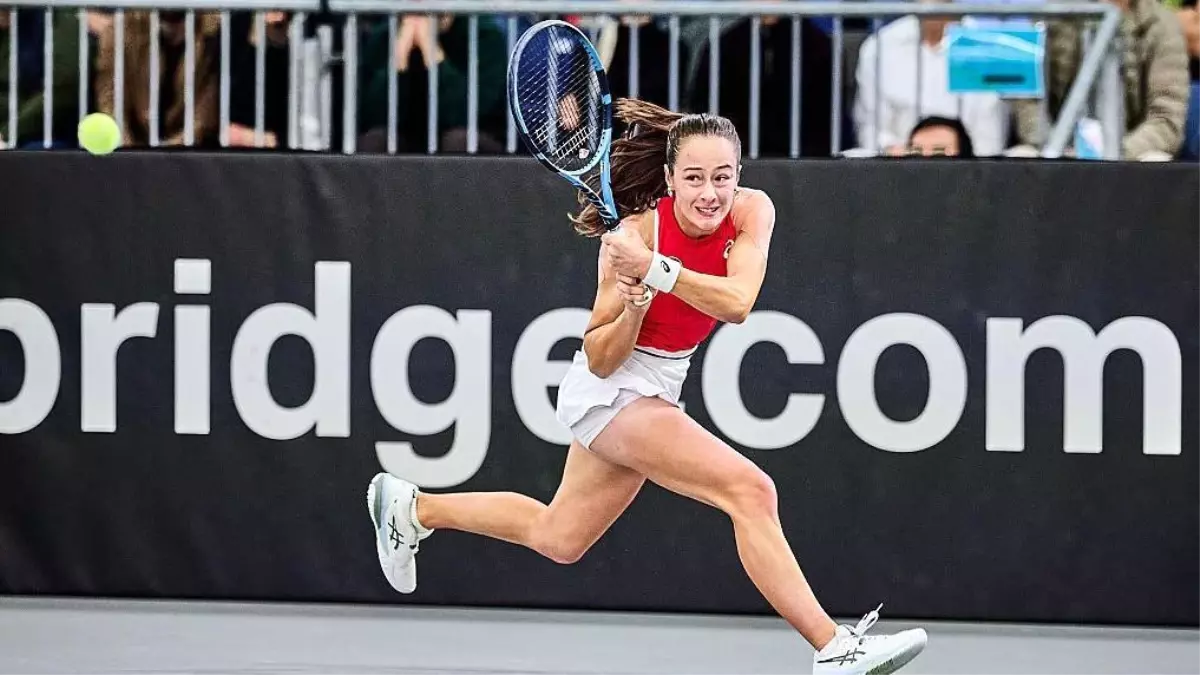
ZEYNEP SONMEZ
Remarkably, the emotional interruption did not derail Sonmez’s focus on the match itself. After Alexandrova claimed the second set, the Turkish qualifier dug deep in the decider, recovering from a 3-0 deficit to seal a 7-5, 4-6, 6-4 victory on her fourth match point.
It was a performance defined by resilience as much as shot-making, and one that underlined why Sonmez’s actions resonated so strongly. She was not insulated from the pressure of competition; she was living it in real time. Yet when faced with a situation that demanded compassion over concentration, she didn’t hesitate.
In a sport often criticised for its individualism, Sonmez showed that empathy and competitiveness do not have to exist in opposition.
A Day of Drama Beyond One Match at the Australian Open
Elsewhere on day one in Melbourne, the tournament delivered its usual share of surprises. Britain’s Jacob Fery caused a stir with a notable upset, while Ukraine’s 20th seed Marta Kostyuk suffered a shock exit at the hands of France’s Elsa Jacquemot.
Jacquemot prevailed 6-7 (4-7), 7-6 (7-4), 7-6 (10-7) in a marathon encounter that made history as the first triple tie-break match at the Australian Open in the Open era. The contest lasted three hours and 31 minutes, with Jacquemot saving a match point and fighting back from a set and 5-3 down.
“I won it with the heart and with the guts,” Jacquemot said afterwards — a sentiment that, fittingly, echoed the spirit shown by Sonmez earlier in the day.
Why Zeynep Sonmez’s Moment Will Be Remembered
Grand Slams are built on epic rallies, five-set battles, and dramatic finales under lights. Yet some of the most enduring memories come from moments that have nothing to do with trophies or rankings.
Zeynep Sonmez may not leave Melbourne with the same headlines as the tournament’s biggest stars, but her instinctive act of kindness has already secured her a place in the Australian Open’s quieter, more meaningful history.
In a week where the focus will inevitably turn to champions and champions-in-waiting, Sonmez offered a simple reminder: tennis, at its best, is still played by people first — and athletes second.


There are no comments yet. Be the first to comment!