







































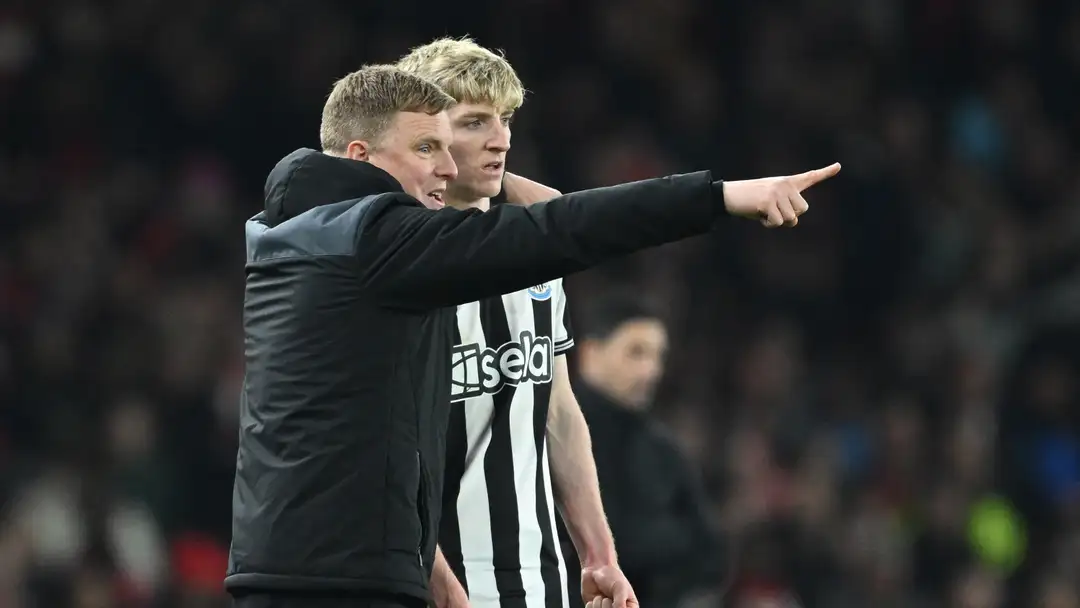
Eddie Howe Defends Newcastle Star Anthony Gordon Amid Wayne Rooney, Roy Keane and Alan Shearer Criticism Over Bench Role Against Barcelona
Eddie Howe Defends Anthony Gordon as Rooney, Keane and Shearer Question Newcastle Forward’s Bench Role Against Barcelona
There are some nights in football when the result is only half the story. Newcastle United’s tense 1-1 draw with Barcelona at St James’ Park was one of those evenings. On paper, it was a strong enough performance from Eddie Howe’s side against one of Europe’s elite clubs, a result that keeps the tie alive ahead of the return leg. But by the final whistle, much of the conversation had drifted away from tactics, shape and the late drama, and instead landed on one man sitting among the substitutes: Anthony Gordon.
The Newcastle forward was not named in the starting XI for one of the biggest matches of the club’s modern era, and that immediately raised eyebrows. Then came the explanation — illness. Gordon had missed training earlier in the day, had not been considered fully fit to start, and was therefore held back. Simple enough, you’d think. In reality, it opened the door for a familiar storm of old-school punditry.
Wayne Rooney, Roy Keane and Alan Shearer all publicly questioned the logic of the decision. If Gordon was too ill to start, they argued, how could he be fit enough to sit on the bench and potentially come on later? For some, it sounded like contradiction. For others, especially within Newcastle’s camp, it was a medical management issue being turned into a debate about toughness.
Now, Howe has stepped in to set the record straight — and, in doing so, offered a forceful defence not just of Gordon’s availability, but of the player’s mentality and character.
Anthony Gordon’s Absence Sparks Instant Debate

When the Newcastle teamsheet dropped ahead of kick-off against Barcelona, Gordon’s absence from the starting lineup was one of the first things supporters noticed. Given his importance to the side this season, especially in Europe, it was always going to attract attention.
Gordon has been one of Newcastle’s most dangerous attacking outlets in the Champions League this campaign. His energy, direct running and willingness to press from the front have become essential to Howe’s system. So when he wasn’t in the XI for a knockout tie against Barcelona, it naturally led to questions.
The official reason was that the England international had been ill. He had missed Tuesday morning’s training session and had not been deemed ready to begin the match from the start.
Still, the fact he was named on the bench complicated the optics.
To some former players, particularly those from an older generation, that kind of decision doesn’t sit easily. In their minds, if you are available, you start. If you’re not, you don’t make the squad at all.
That black-and-white view quickly dominated the post-match reaction.
Alan Shearer Questions the Decision
Few voices carry more weight on Tyneside than Alan Shearer’s, so when the Newcastle legend spoke before kick-off, people listened.
On Amazon Prime’s coverage, Shearer made it clear he struggled to understand why Gordon would not push through the discomfort for such a major occasion.
“I know he doesn’t feel well,” Shearer said, “but this is Barcelona at Newcastle for a place in the quarter-finals of the Champions League.”
Then came the line that summed up his thinking.
“It would take something extraordinary to keep myself out of this game tonight.”
That is classic Shearer — uncompromising, fiercely competitive, and speaking from the perspective of a man who built a career on playing through pain barriers. It was also, in fairness, the kind of comment many fans of a certain generation instinctively understand.
But football, especially at elite level, is a different landscape now.
Roy Keane and Wayne Rooney Add to the Criticism
Roy Keane, unsurprisingly, was even less forgiving.
Speaking on The Overlap, the former Manchester United captain boiled the issue down to a simple question:
“How can you be ill but come on for half an hour?”
That’s Keane in a nutshell. Minimal fuss, maximum challenge.
To him, the contradiction was obvious. If a player is genuinely unwell, they shouldn’t be involved at all. If they are involved, then surely they should be capable of starting.
Wayne Rooney took a similar line, but added a detail that made the story even more personal.
According to Rooney, Gordon walked past the pundits before the game and declined to shake hands, explaining that he didn’t want to pass on whatever illness he had.
Rooney’s response was blunt.
“If you’re ill, you’re ill. You shouldn’t be there,” he said.
“He walked past us before the game and wouldn’t shake our hands. He said he didn’t want us to catch anything, but then he’s going into the dressing room with his team-mates.”
On the surface, it sounds like a fair challenge. But it also ignores the nuance that modern medical staff are paid to consider.
Eddie Howe Clears the Air
By the time Eddie Howe faced the media on Friday, the issue had grown legs. He clearly knew the noise around Gordon was building, and he was keen to kill the narrative before it got any worse.
More importantly, he wanted to take the pressure off the player.
“I do have to clear something up with Anthony Gordon,” Howe said.
“He was absolutely willing to play in the game against Barcelona.”
That line matters. Howe wasn’t just defending the decision; he was defending Gordon’s reputation.
The manager then made it crystal clear that the call to leave him out of the starting side was his, not the player’s.
“It was my decision not to start him based on the fact that he’d been ill that morning and hadn’t attended the training session.”
That is a key distinction.
In other words: Gordon did not rule himself out. Gordon did not duck the game. Gordon was available in a limited capacity, but the coaching and medical staff decided that throwing him in from the first whistle carried too much risk.
That’s not weakness. That’s management.
The Medical Reality Modern Football Often Ignores
This is where the whole debate gets interesting, because it says a lot about how football still talks about illness.
There remains a strong old-school belief that if you can stand up, you can play. That’s the sort of logic many ex-pros were raised on, especially in the 1990s and early 2000s. But modern clubs, especially those competing on multiple fronts, simply don’t work like that anymore.
A player can be too unwell to complete 90 minutes at the intensity required in a Champions League quarter-final, while still being able to offer 20 or 30 minutes off the bench if the game state demands it.
That’s not contradictory. It’s sensible.
You might not trust a player’s energy levels. You might not want them pressing for an hour at full speed. You might worry about dehydration, reduced recovery or a virus spreading through the squad. But if the match is in the balance late on, a half-fit version of Anthony Gordon could still be useful.
That appears to be exactly how Newcastle viewed it.
Howe Praises Gordon’s Competitive Edge
Once Howe had dealt with the criticism, he moved on to something just as important: explaining what Anthony Gordon is really like behind the scenes.
And his praise was striking.
“Ant, I’d probably categorise him as a winner,” Howe said.
That’s not a throwaway line. Managers don’t use that word lightly.
“He wants to win everything; he’s a real competitor.”
For Howe, Gordon’s greatest value is not just in goals or assists, but in mentality. The edge. The intensity. The single-mindedness that separates talented players from top players.
“He’s got that streak to him that I think all top players need,” Howe added, “where he’s very single-minded and very focused on his development and his game.”
That, more than anything, felt like a message aimed squarely at the critics.
You can question the team selection. You can debate the medical decision. But don’t question the player’s appetite for the fight.
Gordon’s Season Has Been Anything But Straightforward
Howe also hinted that Gordon’s campaign hasn’t been smooth from start to finish, even if the numbers look impressive.
This has not been one of those seasons where everything has clicked effortlessly. There have been dips, frustrations, outside noise and the usual pressure that comes with being one of Newcastle’s key attacking players.
But right now, Howe believes Gordon is in the best place he has been all season.
“I think he’s probably in the best moment that he’s been this season currently,” he said.
“He’s playing really well.”
That should encourage Newcastle fans.
Because with the return leg against Barcelona looming, and with the domestic schedule still demanding, Gordon could yet become one of the defining figures in this stretch of the season.
A Huge Week Ahead for Newcastle
The timing of all this only adds to the drama.
Newcastle now face a difficult Premier League trip to Chelsea before travelling to Spain for the second leg against Barcelona. That’s two massive games in quick succession, and Howe has some major decisions to make.
Does he start Gordon against Chelsea to sharpen him up and build rhythm? Or does he protect him, limit his minutes and keep him as fresh as possible for the Camp Nou?
Neither option is risk-free.
Newcastle are balancing ambition with fatigue. This squad has been stretched hard, and there are signs of wear. Injuries, illness and sheer workload are all starting to bite at the sharp end of the season.
Yet the opportunity in front of them is enormous.
A place in the Champions League quarter-finals is still there to be won.
The Bigger Picture

Sometimes football needs a bit of context.
Anthony Gordon did not refuse to play. He did not hide. He did not shrink from the occasion. By Eddie Howe’s own account, he was prepared to start if asked.
The decision to keep him on the bench was a calculated one, made by the manager and the medical staff, not by the player.
That should matter.
And maybe it’s a reminder that not every story needs to be forced into the old cliché of “soft modern footballers” versus “hard men from the past.” Sometimes a player is simply ill, but still willing to help. Sometimes a manager protects him. Sometimes that’s not drama — it’s just good judgment.
Newcastle will need Anthony Gordon in the days ahead.
And if Howe is right, they’re not just relying on a talented winger.
They’re relying on a winner.


There are no comments yet. Be the first to comment!