














Emily Harrop: The Olympic Favourite Who Could Have Competed for GB but Chose France
There’s a quiet irony at the heart of Emily Harrop’s Olympic story. In another version of events — in another federation meeting room, perhaps — the Union Jack might have been rising for her in Milan-Cortina. Instead, when ski mountaineering makes its long-awaited Olympic debut, it will almost certainly be the French tricolour fluttering in celebration.
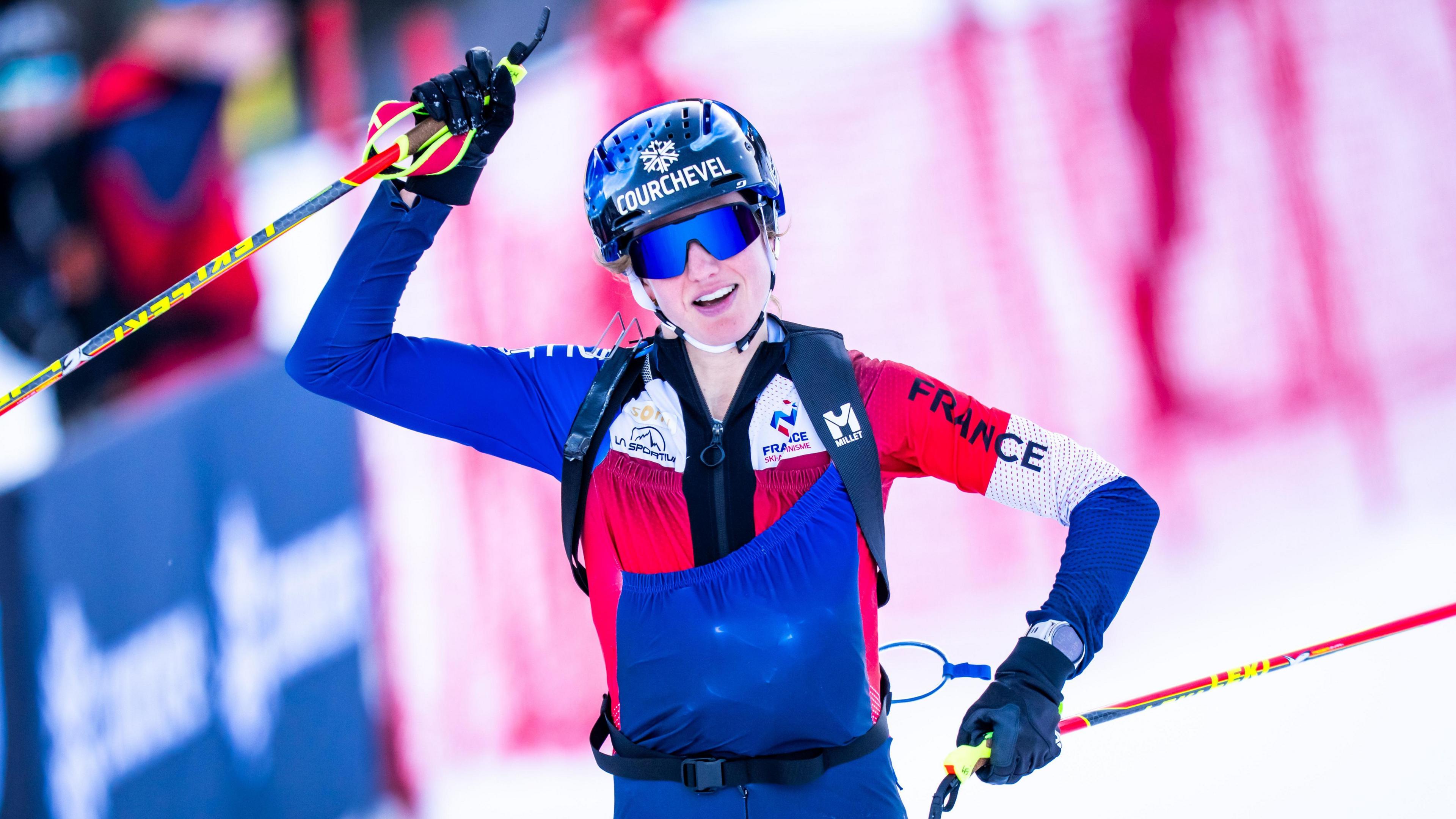
Emily Harrop, three-time world champion and one of the standout names in ski mountaineering, is not just heading to the Winter Games as a participant. She is travelling to Italy as an Olympic favourite.
And yet, for British fans, there’s that lingering “what if?”
Emily Harrop and the Olympic Favourite Who Could Have Competed for GB
Harrop’s roots are unmistakably British. Born in the French Alps to English parents, she grew up with a dual sense of identity. British television in the living room, French mountains outside the window. The cultural blend was natural, effortless — just part of daily life.
Her father, by her own admission, hoped she might one day represent Great Britain. There was even logic behind it. As a talented alpine skier in her teens, she became British downhill champion in 2015. The pathway was open.
But elite sport is rarely about sentiment. It’s about systems, infrastructure, and environment. And Harrop’s environment was French through and through.
She was shaped by the French coaching structure, sharpened by French training partners, and immersed in a programme that understood mountain sport at its core. When the question of allegiance eventually surfaced, it felt less like a decision and more like an acknowledgment of reality.
“I’ve grown up in France,” she has explained in previous interviews. “All my coaches, all my training partners — it’s been through the French system. It would have been hard to turn my back on that.”
So while she could have competed for GB, the path she chose was the one that made competitive sense. And looking at her medal haul today, it’s difficult to argue with the outcome.
From Alpine Skier to Ski Mountaineering Star
Harrop’s journey to Olympic favourite status wasn’t linear. In fact, it nearly derailed entirely.
Her early career was built around alpine skiing. Speed. Precision. Downhill aggression. But injuries intervened at a critical stage, forcing her to reassess her direction. For many athletes, that crossroads becomes an exit sign. For Harrop, it became a detour into ski mountaineering — or skimo, as insiders call it.
She didn’t even begin in the discipline until she was 20. At that time, the British skimo structure barely existed on the World Cup circuit. The sport had little visibility outside traditional alpine regions. Olympic inclusion wasn’t even on the horizon.
“In skimo, when I started, the British team didn’t really exist at World Cup level,” she has noted. The idea of competing for GB in that discipline wasn’t so much rejected as irrelevant.
What followed was a steady, relentless ascent. Harrop found her rhythm in a sport that blends lung-bursting endurance with technical precision and tactical intelligence. She discovered not only resilience but dominance.
Three world championship titles in mixed relay and team events. Individual silver and bronze medals. Two victories at the legendary Pierra Menta — widely dubbed the “Tour de France of ski mountaineering.” Four overall World Cup titles.
These are not flashes of brilliance. They are markers of sustained excellence.
What Is Ski Mountaineering? The Sport Making Its Olympic Debut
For many casual fans, ski mountaineering remains something of a mystery. That changes in Milan-Cortina 2026, where the sport officially joins the Winter Olympic programme.
The Olympic events will take place in Bormio, in the dramatic Dolomites landscape. Three medal disciplines are scheduled: men’s sprint, women’s sprint, and mixed relay.
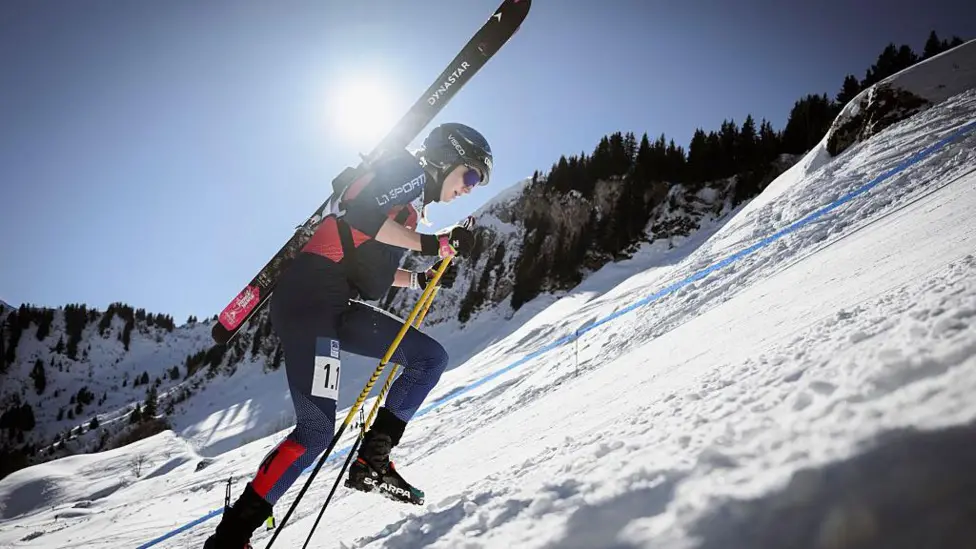
The sprint event is an explosive three-minute test of transitions and endurance. Athletes begin climbing uphill on skis fitted with skins for traction. At a designated point, they remove their skis, secure them to their backpacks, and continue ascending on foot. Another ski ascent follows before they strip the skins and launch into a downhill sprint to the finish.
It’s fast. It’s technical. It punishes hesitation.
The mixed relay adds another layer of strategy. Teams of one male and one female athlete alternate on a course featuring two ski ascents, boot-packing sections on foot, and two descents. Efficiency in transitions often determines podium positions as much as raw power.
Harrop describes it bluntly: “It’s a brutal sport. Probably one of the hardest out there.”
There is no hiding in skimo. Heart rate spikes almost immediately. Margins are razor thin. A mistimed skin removal or sloppy backpack transition can cost seconds that cannot be recovered.
For an athlete with Harrop’s endurance base and composure, it is the perfect stage.
Olympic Status and a Career Reborn
Ironically, the Olympic dream almost slipped away before it truly began.
Around the time ski mountaineering was confirmed for Milan-Cortina, Harrop was contemplating stepping back from elite competition. Financial strain, the grind of balancing training with work, and the uncertain future of a niche sport weighed heavily.
Then came the announcement that changed everything.
Olympic inclusion transformed the discipline overnight. Funding improved. Visibility increased. Pathways clarified. For Harrop, the shift was profound.
“The fact that it became Olympic made life completely change,” she has reflected. “That dream became more of a reality.”
She turned professional and joined the French military’s elite sports programme — the “Army of Champions.” The initiative supports more than 200 high-performance athletes targeting Olympic and Paralympic success. Holding the rank of sergeant, Harrop now trains within a structured, stable system built for podium pursuits.
The difference is visible not just in resources, but in confidence.
Living with Pressure as an Olympic Favourite
With Olympic debutants, there is often a sense of collective discovery. No defending champions. No established Games hierarchy. But that doesn’t mean the pressure is lighter.
Harrop enters Milan-Cortina as one of France’s most realistic medal hopes in the discipline. Expectations have grown steadily with each World Cup triumph.
Yet she speaks about pressure with an almost philosophical calm.
“We’re lucky to live that pressure,” she has said. “It means we’re holding on to something that’s worth something.”
There is maturity in that perspective. She recognises the historical moment — this generation of skimo athletes stands at the threshold of the sport’s Olympic identity. Those who medal first will forever be woven into its foundation story.
And she knows how easily it could have unfolded differently.
In a parallel sporting universe, British fans might have been debating her podium chances under the Team GB banner. Instead, they may watch with admiration — and perhaps a flicker of regret.
A Historic Moment in the Making
Emily Harrop’s journey captures the complexity of modern elite sport. National identity, opportunity structures, injury setbacks, financial uncertainty — all of it intersects on the road to Olympic glory.
She was once a British downhill champion. She could have worn GB colours. But the mountains shaped her within the French system, and that environment forged a world champion.
Now, as ski mountaineering steps onto the Olympic stage for the first time, Harrop stands not just as a competitor but as a symbol of the sport’s evolution.
There will be nerves in Bormio. There will be unforgiving climbs and split-second transitions. There will be rivals equally determined to carve their names into Olympic history.
But make no mistake: when the starting gun fires in the Dolomites, Emily Harrop will not be thinking about alternate flags or hypothetical paths.
She will be thinking about three minutes of controlled chaos, about skins and snow, about timing every movement with surgical precision.
And if form holds, she may well leave Italy not as the athlete who could have competed for GB — but as the Olympic champion who seized her moment.


There are no comments yet. Be the first to comment!