























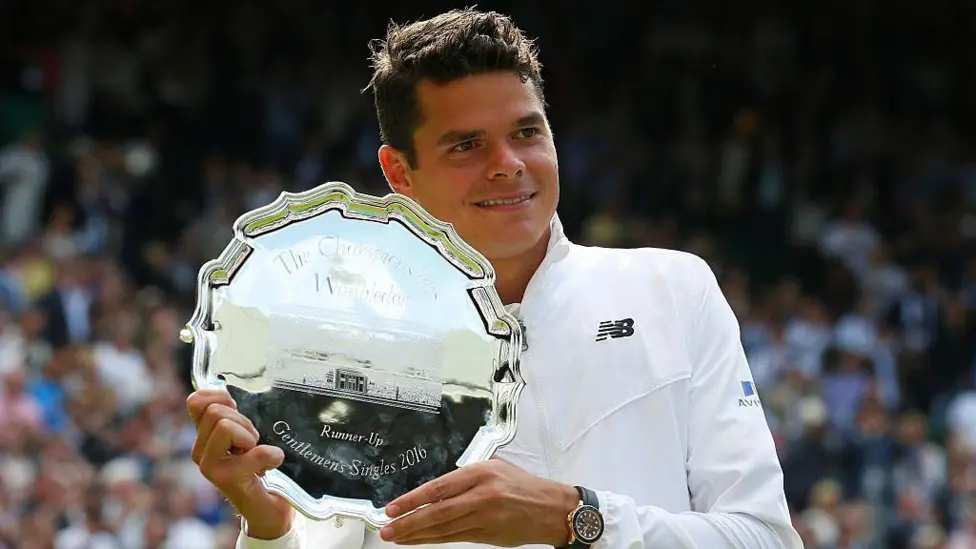
Former Wimbledon Finalist Milos Raonic Retires After a Career Built on Power, Patience and Perseverance
When Milos Raonic first stepped onto a tennis court as an eight-year-old, there was no grand plan, no carefully mapped-out future. It was, as he has often said, pure luck. Yet that chance introduction would eventually carry him all the way to Centre Court, a Wimbledon final, and a place among the very best players of his generation. Now, at the age of 35, the former Wimbledon finalist Milos Raonic has officially retired, bringing an end to a career defined by resilience, quiet ambition and one of the most feared serves the sport has ever seen.
Raonic announced his decision on social media, striking a reflective and emotional tone rather than one of regret. For a player who spent much of his career battling injuries and expectations, it felt like a fitting goodbye: thoughtful, honest and deeply grateful.
Milos Raonic Retires: ‘The Luckiest Person’ to Live His Dream
“This is a moment you know will come one day, but somehow you never feel ready for it,” Raonic wrote. “This is as ready as I will ever be.”
Those words captured the complexity of retirement for elite athletes — especially one like Raonic, whose love for tennis was never in doubt. He described the sport as both his “love and obsession”, something that shaped his childhood before becoming his profession and his life.
Calling himself “the luckiest person” to live out his dreams, Raonic spoke less about trophies and rankings, and more about the simple privilege of waking up each day with a singular purpose: to get better. That mindset, more than raw talent alone, carried him to the very top of the game.
Former Wimbledon Finalist Milos Raonic and the Peak of 2016
The defining chapter of Raonic’s career came in 2016, a year that showcased both his potential and his limits. At Wimbledon, he produced one of the biggest wins of his life, defeating Roger Federer in the semi-finals to reach the final. It was a moment that confirmed his place among tennis’ elite — not just a big server, but a complete competitor capable of troubling the sport’s greatest names on the biggest stage.
The final itself ended in disappointment, with a straight-sets loss to Andy Murray, who was playing some of the best tennis of his career. Yet even in defeat, Raonic’s achievement stood tall. Reaching a Wimbledon final is a milestone few ever touch, and it cemented his legacy as one of the standout players of his era.
That same year, Raonic climbed to a career-high world ranking of number three. He also reached the semi-finals of the Australian Open, underlining his consistency at the majors during his peak. For a brief but brilliant period, he looked capable of challenging the dominance of the so-called “Big Four”.
The Serve That Defined a Career
Best known for his thunderous delivery, Raonic’s serve earned him the nickname “Missile” — and with good reason. At his best, it was almost untouchable, regularly breaking speed records and overwhelming opponents before rallies could even begin.
But to reduce Raonic’s career to just his serve would be unfair. Over time, he worked tirelessly to improve his movement, his return game and his touch at the net. Coaches and peers often spoke about his professionalism and willingness to evolve, traits that allowed him to remain competitive even as injuries disrupted his momentum.
Across his career, Raonic won eight ATP tour-level titles and reached numerous finals. While the elusive Grand Slam title never arrived, his body of work speaks for itself — especially in an era dominated by some of the greatest players the sport has ever known.
Injuries, Setbacks and Quiet Resilience
If there is one lingering “what if” attached to Raonic’s career, it revolves around fitness. Injuries repeatedly interrupted his progress, particularly during the years when he seemed closest to breaking through at the very top.
Rather than complaining publicly, Raonic chose a quieter path. He worked through rehabilitation, returned when he could, and adjusted expectations when necessary. That resilience became a hallmark of his later years, as he shifted from chasing rankings to simply enjoying the chance to compete again.
His final professional match came at the 2024 Olympic Games, where he lost in the first round to Germany’s Dominik Koepfer. There was no dramatic farewell on court, no extended ceremony — just another match, another handshake, and the closing of a long chapter.
From Yugoslavia to Canada: A Journey Across Continents
Raonic’s story is also one of migration and identity. Born in Titograd, Yugoslavia — now Podgorica, Montenegro — he moved to Canada with his family at the age of three. It was there that his tennis journey truly began, and where he would eventually become one of the most successful players in Canadian tennis history.
He won his first ATP title in 2011 at the Pacific Coast Championships, a breakthrough that announced his arrival on the tour. From that moment on, Raonic carried the Canadian flag with pride, inspiring a new generation of players and helping elevate the country’s profile in the sport.
What Comes Next After Milos Raonic Retires?
Raonic was clear that retirement does not mean slowing down. If anything, his words suggested a familiar hunger — the same one that drove him as a young player breaking onto the tour more than a decade ago.
“There is so much more life to live,” he wrote. “I will put the same effort and intensity into the next thing.”
What that next chapter looks like remains to be seen. Coaching, mentoring, business or something entirely different — Raonic has options. What is certain is that he leaves the sport with his integrity intact and his contribution secure.
As the tennis world says goodbye to a former Wimbledon finalist, it does so with respect. Milos Raonic may never have lifted a Grand Slam trophy, but his career stands as a reminder that success in sport is not measured by titles alone — sometimes, it is about how far dedication, humility and a little bit of luck can take you.


There are no comments yet. Be the first to comment!