









IOC Bans Ukrainian Skeleton Racer Over Helmet Tribute at Winter Olympics
The Winter Olympics are meant to be a celebration of sport at its purest — speed, precision, courage, and the quiet drama of athletes pushing themselves to the edge. Yet in Cortina this week, attention shifted from the icy track to a helmet, and from split times to symbolism.
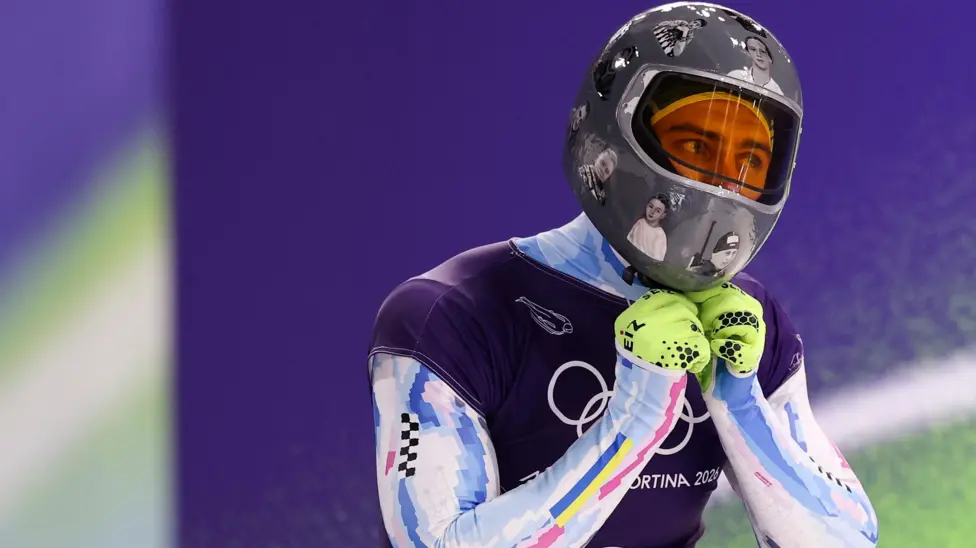
Ukrainian skeleton racer Vladyslav Heraskevych has been banned from competing after the International Olympic Committee (IOC) ruled that his helmet — featuring images of Ukrainian athletes killed during Russia’s invasion — violated the Olympic Charter.
It is a decision that has sparked debate well beyond the sliding track.
IOC Bans Ukrainian Skeleton Racer Over Helmet Despite Talks
Heraskevych, 26, had worn the helmet during all of his training runs ahead of the competition. The design carried powerful images: athletes who lost their lives since Russia’s full-scale invasion of Ukraine in 2022. For Heraskevych, it was not a political slogan or protest banner — it was remembrance.
On Tuesday, the IOC informed him that the helmet “does not comply” with Olympic regulations and that he would not be permitted to wear it in competition. The governing body cited Rule 50.2 of the Olympic Charter, which states: “No kind of demonstration or political, religious or racial propaganda is permitted in any Olympic sites, venues or other areas.”
The message was clear: if he wanted to compete, the helmet had to go.
But Heraskevych did not back down. On Wednesday, he appeared again at official training wearing the same helmet. Speaking to BBC Sport, he insisted he believed he “has all the rights” to honour those who had died.
IOC president Kirsty Coventry personally visited Heraskevych at Cortina’s sliding track before the opening skeleton heat on Thursday. According to the IOC, discussions were held in an effort to find “the most respectful way” to accommodate his wishes.
In the end, there was no compromise.
“The IOC was very keen for Mr Heraskevych to compete,” the organisation said in a statement. “This is why the IOC sat down with him to look for the most respectful way to address his desire to remember his fellow athletes who have lost their lives following Russia’s invasion of Ukraine.”
However, the IOC added that Heraskevych “did not consider any form of compromise.” The decision to withdraw his accreditation was formally taken by the jury of the International Bobsleigh and Skeleton Federation (IBSF), on the grounds that the helmet was not compliant with competition rules.
The consequence: Heraskevych was barred from racing.
Helmet Tribute at the Centre of Olympic Neutrality Debate
At the heart of this controversy lies the Olympic principle of neutrality.
The IOC offered alternatives. Heraskevych was told he could wear a black armband during competition. He was permitted to display his helmet in mixed zones, at press conferences, and across social media platforms. But, as the IOC phrased it, “the field of play is sacrosanct.”
To the governing body, allowing the helmet during competition would set a precedent that risks blurring the line between remembrance and political expression.
To Heraskevych, the distinction feels artificial.
Many of the faces on his helmet were not abstract symbols but fellow athletes — some of them personal friends. Teenage weightlifter Alina Peregudova. Boxer Pavlo Ishchenko. Ice hockey player Oleksiy Loginov. These were young sportspeople whose careers, like so many others, were cut short by war.
Heraskevych has long been vocal about the impact of the invasion on Ukrainian sport. Training facilities destroyed. Teammates displaced. Lives lost. For him, the helmet was not propaganda. It was memory.
He has also pointed to what he sees as inconsistencies. Figure skater Maxim Naumov, competing earlier in the Games, held up a photograph of his parents — among 67 victims of a plane crash in Washington DC — while waiting for his score. That gesture was widely received as a moving tribute.
Heraskevych believes his act falls within the same human impulse: to honour the dead.
The IOC counters that the contexts differ, and that its responsibility is to uphold uniform standards across all Olympic venues.
A Sporting Opportunity Lost
Beyond the legal language and philosophical debate lies a simpler truth: a race that will not be run.
Based on training times, Heraskevych was considered an outside contender for a medal. While not among the favourites, he had shown steady progression and the potential to challenge in a discipline where hundredths of a second define history.
Instead, his Olympic campaign ended before it truly began.
For Ukrainian sport, the moment carries symbolic weight. The IOC noted that Heraskevych has been supported through Olympic scholarship programmes and that a solidarity fund was established following the 2022 invasion to assist Ukrainian athletes preparing for Paris 2024.
“The IOC has supported Mr Heraskevych for the last three editions of the Games,” the statement emphasised.
But financial assistance does not soften the emotional dimension of this decision. In Ukraine, where sport and national identity have become tightly interwoven during wartime, the image of an athlete barred for honouring fallen compatriots will resonate deeply.
The Line Between Tribute and Protest
The Olympic Games have long wrestled with the balance between free expression and institutional neutrality. From raised fists in 1968 to more recent symbolic gestures across multiple sports, the field of play has occasionally become a stage for statements that extend beyond competition.
Rule 50 was designed to protect the Games from overt political messaging. Yet global conflict inevitably intrudes into global events.
The IOC maintains that athletes are free to “express grief with dignity and respect” in designated areas, including multi-faith centres within Olympic villages. But the restriction on in-competition displays remains firm.
For some, that line is essential. For others, it feels detached from the lived realities athletes carry with them onto the ice, snow or track.
Heraskevych’s stance suggests he saw no meaningful difference between remembrance and representation. The IOC’s stance insists that once symbolism enters the field of play, it risks becoming political by default.
Neither side appears likely to shift.
IOC Bans Ukrainian Skeleton Racer Over Helmet — What It Means
In practical terms, the decision closes this chapter swiftly. The IBSF jury’s ruling stands. Heraskevych will not compete at these Games wearing his tribute helmet.
But the broader conversation will continue.
The Winter Olympics are often described as a gathering of nations united through sport. Yet unity does not erase conflict; it merely pauses it at the boundary of competition. This episode reminds us how thin that boundary can be.
For Vladyslav Heraskevych, the helmet was personal. For the IOC, it was procedural. Between those positions lies a debate that touches on grief, identity, regulation and the purpose of the Olympic stage itself.
As the skeleton competition unfolds without him, the stopwatch will measure speed as always. But off the ice, questions about expression and neutrality will linger long after the final medal ceremony.
And in that quiet space between sport and symbolism, one athlete’s tribute has become one of the defining stories of these Games.


There are no comments yet. Be the first to comment!