








































































































Why England Legend Joe Root Is So Effective in Asia: The Art of Batting That Travels Anywhere
Another day in Asia, another elegant innings from Joe Root, and another reminder of why England’s greatest modern batter feels so at home on the toughest stages cricket has to offer. As England wrapped up a rare one-day international series victory in Sri Lanka this week, Root once again stood at the centre of it all, bat raised, calm expression unchanged, scoreboard quietly ticking in his favour.
At the R Premadasa Stadium in Colombo, Root compiled two half-centuries and an unbeaten 111, guiding England through unfamiliar conditions with a familiarity that borders on the uncanny. It was not flashy, not loud, but it was utterly authoritative. In the process, the England legend reaffirmed his reputation as one of the most effective non-Asian batters the sub-continent has ever seen.
This was more than just another hundred. Root’s 247 runs across the series saw him surpass Kevin Pietersen to become England’s leading ODI run-scorer in Asia. The numbers now tell a remarkable story: 1,813 ODI runs in Asian conditions, an average north of 53, three centuries and 15 half-centuries. Yet statistics alone do not explain why Joe Root is so effective in Asia. For that, you have to look deeper.
The England Legend Who Masters Asian Conditions
Sub-continental cricket has long been England’s Achilles heel. Tours to India, Pakistan, Bangladesh and Sri Lanka have often exposed technical flaws, impatience and a lack of adaptability. Root, though, has repeatedly swum against that tide.
Part of his greatness lies in how un-English his batting can look in Asia. Where others prod nervously or retreat into survival mode, Root leans into the challenge. He reads length early, trusts his feet, and is content to score in ones and twos until bowlers lose their discipline.
Former England batter Dawid Malan summed it up neatly when he described Root’s ability to “manoeuvre the ball” against spin. Asian pitches demand flexibility. One surface turns square, another stays low, another offers just enough grip to keep batters guessing. Root adapts on the fly, recalibrating his game not series by series, but over by over.
That adaptability is reflected in the numbers. Against spin in Asia, Root has scored 1,118 ODI runs at an extraordinary average of 69.87. Only Jacques Kallis and Ricky Ponting sit above him on the all-time list of non-Asian players. It places Root in rare company, not just as an England great, but as a global one.
Why Joe Root Is So Effective in Asia Against Spin
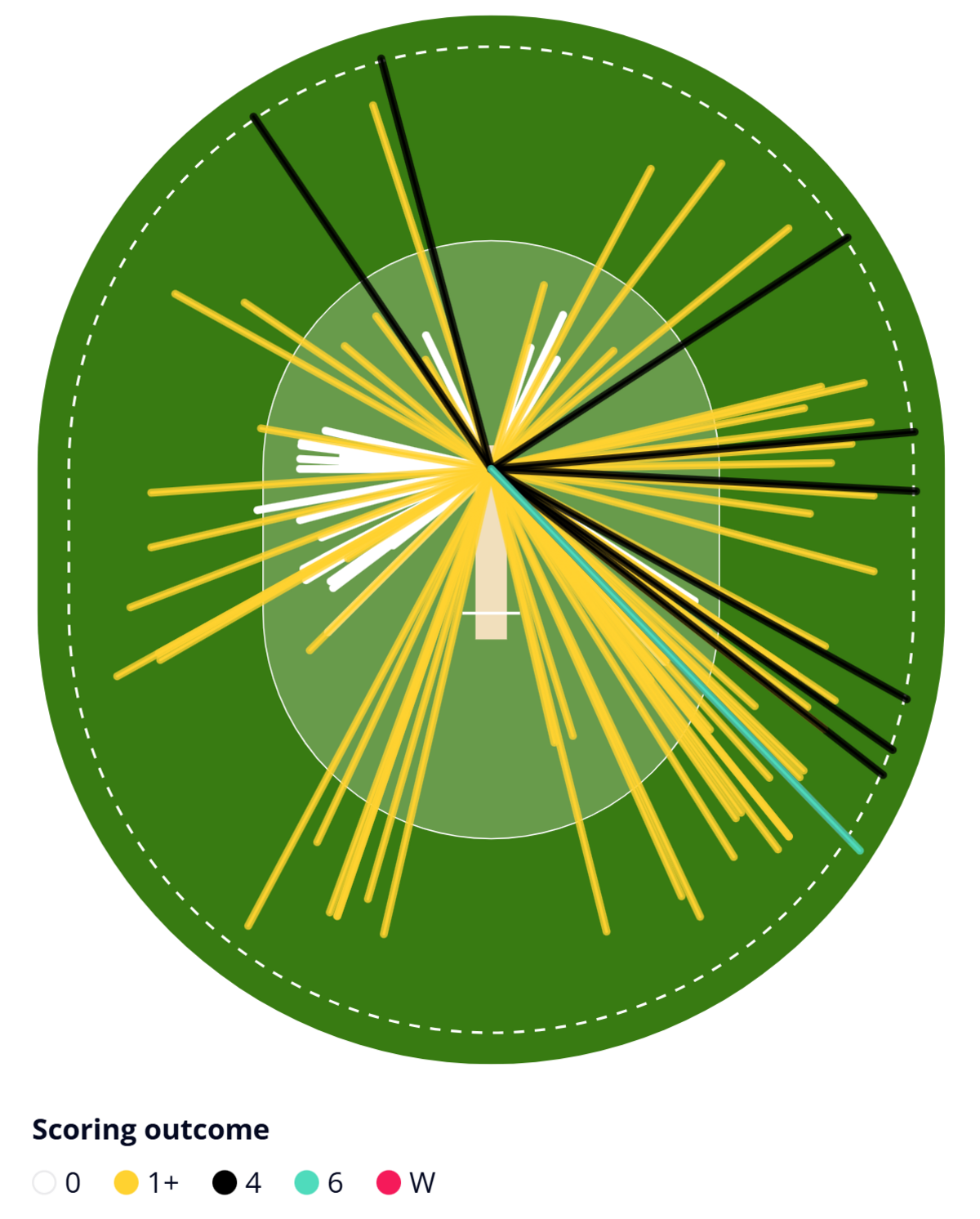
A wagon wheel graphic depicting where Joe Root scored his runs against Sri Lanka in the third one-day international
Spin bowling is the great separator in Asian cricket, and it is here that Root truly stands apart. While modern white-ball batting often revolves around power and risk, Root’s approach is built on balance, timing and options.
Across his ODI career, Root averages more than 73 against spin bowling, a figure bettered only by MS Dhoni among players with over 3,000 runs against slow bowlers. In several calendar years, his dominance has been almost absurd: averages of 202 in 2017, over 100 in 2018, and another remarkable return at the start of this year.
Crucially, Root achieves this without gambling. His false-shot percentage against spin sits at just 9.2%, one of the lowest in modern cricket. In simple terms, he misses less, panics less, and gifts fewer opportunities. On turning tracks where patience is currency, that discipline is priceless.
Root’s method is deceptively simple. Soft hands into the gaps. Late cuts and glides. A willingness to go deep in the crease or dance down the pitch when the moment is right. He does not try to dominate spin in the way some modern batters do. Instead, he outlasts it, drains its threat, and forces bowlers into error.
The Accumulator: Root’s Quiet Brilliance
If there is one word that defines Joe Root in Asia, it is accumulation. While others chase boundaries to break the game open, Root breaks it down. Over his 188 ODIs, he has scored more than 3,500 runs in singles alone, an astonishing figure that underlines how relentlessly he keeps the scoreboard moving.
His non-boundary strike-rate of 60.10 is the highest in ODI history. In Asian conditions, where dot balls can feel suffocating and pressure builds quickly, that ability is transformative. Bowlers cannot settle. Fields cannot stay static. Momentum, subtle though it may be, remains with the batting side.
Malan highlighted this aspect perfectly, noting how Root’s low dot-ball percentage removes the need for high-risk shots. There is no sense of desperation in Root’s innings. Even when boundaries dry up, the runs keep flowing.
That calm presence was on display again in Colombo when England slipped to 40-2 shortly after the powerplay. Root walked in, slowed the game down, and rebuilt. Partnerships of 126 with Jacob Bethell and an unbroken 191 with Harry Brook followed, turning a fragile position into total control.
Root, Brook and a Turning Point for England
Beyond individual brilliance, Root’s influence is increasingly visible in England’s wider white-ball reset. The partnership with Brook has flourished, yielding 672 ODI runs since 2023 at an average approaching 45. Together, they blend experience and intent, stability and acceleration.
Batting first in the sub-continent is notoriously difficult. Par scores are illusions, conditions change rapidly, and panic lurks behind every misread surface. Root understands this better than most. He builds innings that allow others to play with freedom later, as England did by smashing 130 runs in the final 10 overs of the decisive match.
For a squad still bruised by a heavy Ashes defeat just weeks earlier, this series win mattered. It offered proof that England can compete, and win, in conditions that have haunted them for decades. Root, inevitably, was at the heart of that shift.
Why the England Legend Joe Root Still Sets the Standard in Asia

Joe Root and Harry Brook sat on the outfield after the third one-day international against Sri Lanka
At 35, Root no longer has anything left to prove. Yet his hunger remains obvious. He has not played a T20 international since 2019, but in ODIs, particularly in Asia, he remains England’s most reliable constant.
What makes Joe Root so effective in Asia is not one skill, but a collection of habits honed over years: patience, adaptability, humility before conditions, and an unshakeable belief in his method. While others chase trends, Root trusts fundamentals.
As England look ahead to future global tournaments, especially in Asian conditions, they do so knowing they still have a batter who understands the rhythm of these places better than almost anyone. Another hundred will come. Another bat will be raised. And once again, Joe Root will make Asia look like home.


There are no comments yet. Be the first to comment!