





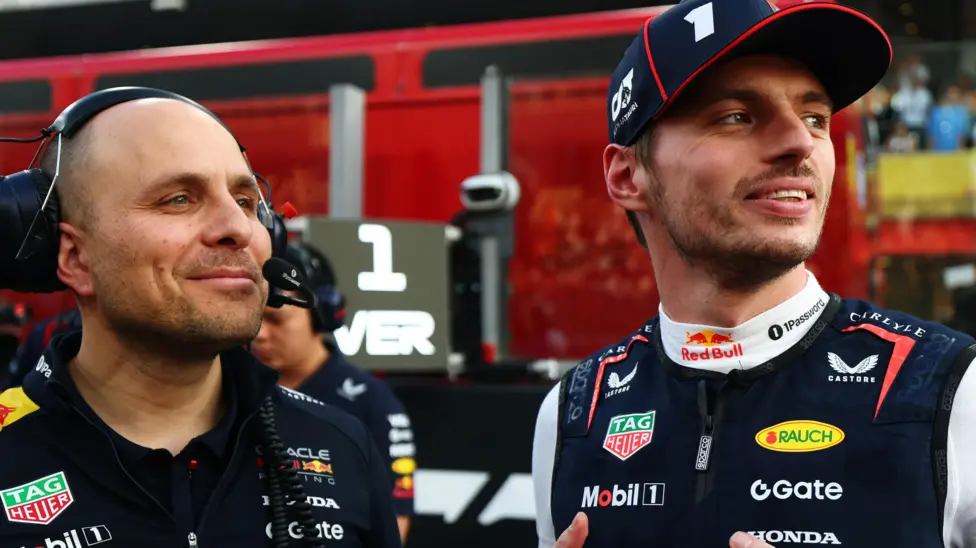
From Verstappen Voice to McLaren Future: Why Gianpiero Lambiase Move Could Reshape Formula 1
Verstappen Race Engineer Lambiase to Join McLaren — A Transfer That Signals a New F1 Power Shift
In Formula 1, driver transfers usually dominate headlines. Occasionally, a technical regulation change steals the spotlight. But every so often, a move behind the pit wall sends shockwaves through the paddock — and the decision by Gianpiero Lambiase, best known as Max Verstappen’s race engineer, to join McLaren from 2028 is exactly that kind of moment.
The Briton has quietly become one of the most influential figures of Formula 1’s modern era, not through public appearances or political maneuvering, but through calm, precise communication on race day and relentless operational excellence. His move from Red Bull to McLaren represents far more than a staffing change; it reflects shifting momentum at the top level of the sport.
Neither McLaren nor Red Bull have officially commented, but senior figures within both organizations have confirmed the agreement privately. And within F1 circles, the reaction has been immediate: this is a strategic hire with long-term consequences.
The Man Behind Verstappen’s Dominance
To understand the significance of the move, you have to understand who Gianpiero Lambiase is inside Formula 1.
Since Max Verstappen’s promotion to Red Bull during the 2016 Spanish Grand Prix weekend, Lambiase has been the calm voice guiding one of the most aggressive and talented drivers the sport has ever seen. Their radio exchanges — sometimes tense, often brutally honest — became part of Formula 1 folklore.
While Verstappen delivered the speed, Lambiase provided structure. Strategy execution, tire management decisions, race pacing, and pressure management all flowed through their partnership.
In modern Formula 1, the race engineer is effectively the driver’s second brain. Lambiase excelled at translating vast streams of data into clear instructions within seconds — a skill that helped Red Bull convert raw performance into consistent victories and world championships.
His promotion to head of race engineering at Red Bull only reinforced his influence within the organization.
So when news emerged that he would leave, even with a delayed start date of 2028, it immediately raised eyebrows across the paddock.
Why McLaren Wanted Lambiase
McLaren’s decision to recruit Lambiase fits into a broader, carefully constructed rebuilding strategy that has been unfolding over the last several seasons.
Under team principal Andrea Stella, McLaren has transformed from midfield hopefuls into genuine championship contenders. The team’s technical structure has evolved rapidly, but success in modern Formula 1 demands more than aerodynamic efficiency or car performance — it requires flawless race operations.
That is where Lambiase enters the picture.
His role, while not yet publicly defined, will focus on supporting Stella and strengthening McLaren’s race operations structure. Internally, the goal is clear: reduce operational pressure on Stella and sharpen trackside execution.
Stella currently carries an unusually heavy workload. Beyond serving as team principal, he effectively acts as a technical coordinator, overseeing multiple engineering departments responsible for aerodynamics, performance, and overall car design.
Adding Lambiase allows Stella to redistribute responsibility — particularly on race weekends, where split-second decisions can define championships.
A Growing Red Bull Influence Inside McLaren
Lambiase will not be walking into unfamiliar territory. McLaren has quietly assembled a leadership group with strong Red Bull DNA.
Rob Marshall joined as chief designer at the start of 2024, bringing deep technical knowledge from Red Bull’s dominant era. Earlier this year, former Red Bull head of race strategy Will Courtenay became McLaren’s sporting director.
Now, with Lambiase arriving in the coming years, McLaren strengthens the operational side of its organization even further.
Together, this trio represents expertise spanning car design, strategy, and race engineering — essentially reconstructing elements of Red Bull’s championship-winning framework within McLaren’s own philosophy.
It’s no coincidence. In Formula 1, competitive advantages rarely come from isolated brilliance; they emerge from cohesive systems. McLaren appears determined to build exactly that.
Red Bull’s Quiet Talent Drain
For Red Bull, Lambiase’s departure adds to a growing list of high-profile exits since the start of 2024.
Chief technical officer Adrian Newey — widely regarded as the greatest designer in F1 history — moved on, while sporting director Jonathan Wheatley also departed following organizational changes that culminated in Christian Horner’s dismissal in July 2025.
Individually, each exit might be manageable. Collectively, they represent a gradual reshaping of Red Bull’s internal structure.
The team still possesses enormous technical strength and competitive momentum, but Formula 1 history shows that sustained dominance depends as much on continuity behind the scenes as performance on track.
Losing figures who helped build operational excellence inevitably creates questions about long-term stability.
Where Lambiase Fits Inside McLaren’s Structure
McLaren insiders stress that Lambiase’s arrival is not connected to any leadership change involving Andrea Stella, despite speculation linking Stella with Ferrari.
Instead, the move is designed to enhance stability.
McLaren’s engineering hierarchy currently sees technical directors Peter Prodromou (aerodynamics), Mark Temple (performance), and Neil Houldey (engineering) reporting into Stella for car development decisions, alongside chief designer Rob Marshall.
By integrating Lambiase into race operations, McLaren effectively creates a bridge between factory performance and trackside execution — an area where championship-winning teams traditionally excel.
He is expected to work closely with sporting director Will Courtenay and racing director Randy Singh, forming a layered operational leadership structure capable of handling Formula 1’s increasing complexity.
Modern F1 weekends are data-heavy, strategically intricate, and politically sensitive environments. Having experienced decision-makers reduces risk — and McLaren clearly wants redundancy in expertise.
Beyond Strategy: Culture and Communication
Perhaps Lambiase’s greatest contribution won’t be technical at all.
Those who have worked with him consistently highlight his communication style: direct, calm, and solution-focused. In high-pressure environments where emotions run high, that approach can define team culture.
His relationship with Verstappen demonstrated mutual trust — something that cannot be engineered overnight. McLaren hopes to import that mindset across its race operations team.
As margins between teams shrink under cost caps and converging regulations, operational clarity becomes as important as raw car performance.
The fastest car doesn’t always win anymore. The best-executed weekend does.
A Move That Reflects Formula 1’s New Era
The delayed timing of the move — beginning in 2028 — also reflects Formula 1’s long-term planning cycles. Teams are already preparing for future regulation landscapes, power unit evolution, and competitive reshuffles.
McLaren’s investment signals confidence that it can remain at the front of the grid for years to come.
Meanwhile, Red Bull faces the challenge of renewing leadership while maintaining competitive continuity — something even dominant teams historically struggle to achieve.
Final Thoughts: More Than a Personnel Change
At first glance, the headline reads simply: Verstappen race engineer Lambiase to join McLaren.
But beneath it lies a deeper story about Formula 1’s shifting balance of power.
McLaren is not just recruiting talent; it is assembling experience, culture, and operational intelligence from the sport’s most successful recent dynasty. Lambiase’s arrival strengthens a structure already trending upward and signals a team preparing not merely to compete — but to sustain success.
In Formula 1, championships are rarely won by drivers alone. They are built by systems, decisions, and people working in perfect alignment.
By securing one of the paddock’s most respected race engineers, McLaren may have taken another decisive step toward becoming the sport’s next long-term benchmark.


There are no comments yet. Be the first to comment!