










































































































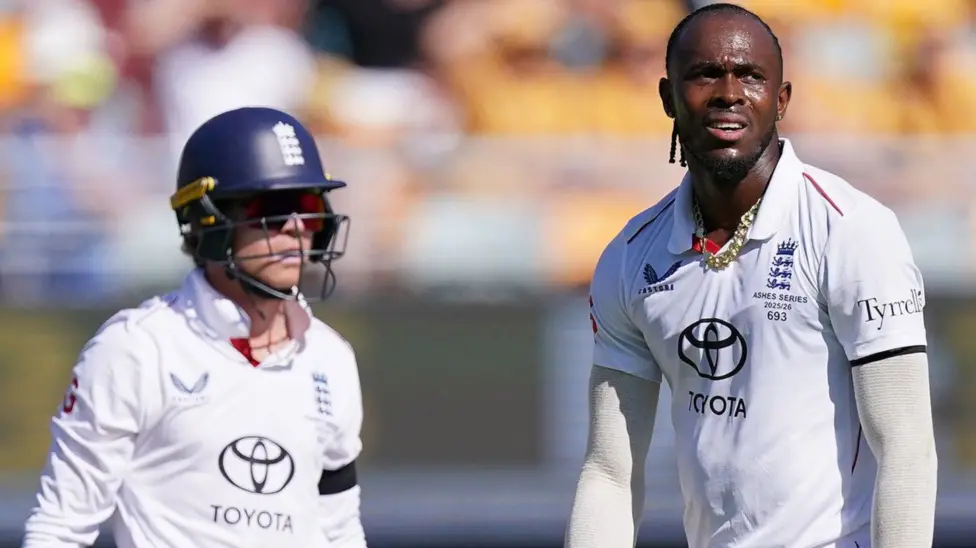
Hayden and Archer: The Pillow, the Gabba, and an Ashes Firestorm
Matthew Hayden Questions Jofra Archer at the Gabba
In the theatre of the Ashes, every detail becomes a talking point, every gesture a symbol. And on the morning of the third day at the Gabba, Jofra Archer walked into the spotlight without bowling a ball. The England fast bowler, under his arm, carried a pillow — a small detail that set off a surprisingly fierce reaction from former Australia opener Matthew Hayden.
With England chasing four wickets to stop Australia stretching a dangerously large first-innings lead, cameras caught Archer strolling into the ground, pillow tucked casually against his ribs. It wasn’t a dramatic moment, or so it seemed. But in the pressure-cooker world of Ashes cricket, it became a small spark that lit a debate about attitude, optics, and even the spirit of competition.
Hayden, watching from the Channel 7 commentary box, didn’t hold back. For him, it wasn’t just a pillow — it was a symbol of softness on a day when toughness was required. “I’m sorry, but that’s a shocking look,” he said, leaning into the microphone with a competitive edge that every Australian cricket fan would recognise. “If I was a batsman, I tell you what I’d be doing: I’d be digging in. Forever.”
Hayden’s point was simple: in the brutal arena of Test cricket at the Gabba, where nights are short and days run long under the sun, bringing a pillow looks like the wrong message. And when England desperately needed something special from their quicks, the optics fuelled criticism from an Australian legend who built his career on grit, presence and intimidation.
A Strange Start to a Vital Day for England
England had come into the third morning in a precarious position. Australia resumed on 378-6, already leading by 44, and with enough power in the lower order to turn that into something much larger. For England’s hopes to stay alive, they needed a burst of inspiration with the ball — and fast.
Instead, the session became a slow bleed of frustration. England grabbed two wickets: Ben Stokes found a feather-light edge from Michael Neser for 16, and Gus Atkinson — sharing the new ball with Archer — drew the outside edge of Alex Carey for a well-made 63. But in between those moments, Australia stacked runs, defended stubbornly, and pushed their advantage beyond 100.
By lunch, Australia were 450-8, a lead of 116 — a number loaded with history. Only twice before have England overturned a first-innings deficit of more than 100 to win a Test in Australia. The last time was 1979 at the Sydney Cricket Ground, a different era entirely.
What made the situation sting even more for England was the grinding nature of Australia’s tail. Mitchell Starc, the fiery left-armer, played a controlled, mature innings, moving to 46 by the break. Scott Boland, usually known for his quiet menace with the ball, stood firm at the other end on seven. Together they added 34 runs in 16 overs, slowly draining England’s energy and patience.
And all of it happened under daylight — a crucial factor. The longer Australia batted with the sun high, the newer the ball England would face under the floodlights later. For a team already staring at a deficit, it felt like another small loss in a day where every minor margin mattered.
Criticism, Questions, and a Jaded England
Hayden wasn’t the only former star raising an eyebrow. Michael Vaughan, never shy about assessing England’s readiness, suggested the team looked “jaded”. The missed chances on Friday did nothing to help that impression. England dropped five opportunities in the field — the sort of mistakes that become fatal in Australia, where momentum swings are brutal and unforgiving.
Archer himself has been at the centre of attention since his return to Test cricket this summer. After nearly four years away due to a catalogue of serious injuries, his resurrection has been emotional for fans who still remember the explosive force he brought in 2019. But the workload has been heavy.
By the first interval on the third day in Brisbane, Archer had already bowled 25 overs — his second-highest tally in a Test innings since 2019. Only once has he bowled more in a single innings: 26.1 overs at Old Trafford in the fourth Test against India earlier in his comeback.
On Friday, he sent down a seven-over spell straight after lunch — his longest uninterrupted burst in five years. For a bowler rebuilding his rhythm, that’s a serious test of physical and mental endurance. And perhaps, beneath the light teasing about pillows and optics, there’s a deeper truth: Archer is pushing himself hard, trying to rediscover the tempo that once terrified the best players in the world.
Hayden’s Bite vs Archer’s Reality
That’s why the pillow, despite how it looked to Hayden, may speak to something entirely different. Test bowling is brutal on the body. Recovery time becomes currency. Sleep is treatment. For a fast bowler with a recent history of elbow surgery, stress fractures, and endless rehab sessions, looking after his rest might be a sign of hunger rather than softness.
But cricket isn’t a science to everyone watching — it’s theatre. And in Australian Test culture, the Gabba is sacred ground. Hayden’s career was built on sending messages: batters who swaggered down the steps, quicks who kept their eyes cold and shoulders squared. A pillow doesn’t fit that myth.
“If I was a batsman,” Hayden said, “you’d be thinking: you are never going to sleep on that. Not any part of this day are you going to see it.” The competitive cruelty of those lines is pure Ashes — a reminder that even symbols become weapons when these two nations meet.
Pressure Rising, Session by Session
While the debate raged off the field, England’s concerns were on it. Every run from Starc felt like a punch, every block from Boland a tiny step further away from England’s dreams.
Archer’s five-over burst with the new ball went wicketless — 13 runs conceded, nothing loose, nothing magical. Atkinson carried the more immediate threat. It wasn’t a bad spell from Archer, but it lacked the explosion that once defined him.
In the commentary box, Hayden’s comments floated over the broadcast like another layer of pressure. A legend questioning your edge — it’s a familiar Ashes story. It happened to Anderson, to Broad, to Stokes, to both sides across generations. The talking never stops here.
What Comes Next at the Gabba
England’s mission isn’t over, but the mountain has grown taller with every Australian block and boundary. When they eventually bat, it will be under lights, facing a newer ball — an inversion of advantage that Australia earned through stubborn daylight accumulation.
If England are to find something extraordinary, Archer will be part of it. Whether Matthew Hayden’s criticism motivates him, annoys him, or simply fades into the background, the spotlight is now fixed on the 30-year-old. And that, perhaps, is exactly how Ashes drama is built — through moments that seem trivial, then escalate into something symbolic.
A pillow at the Gabba shouldn’t matter. But this is the Ashes. Every detail matters here. Every gesture is amplified. And sometimes, a quiet morning walk with a bit of comfort under your arm becomes the starting line for a national debate about intent, grit, and what it takes to win a Test match in Australia.


There are no comments yet. Be the first to comment!