


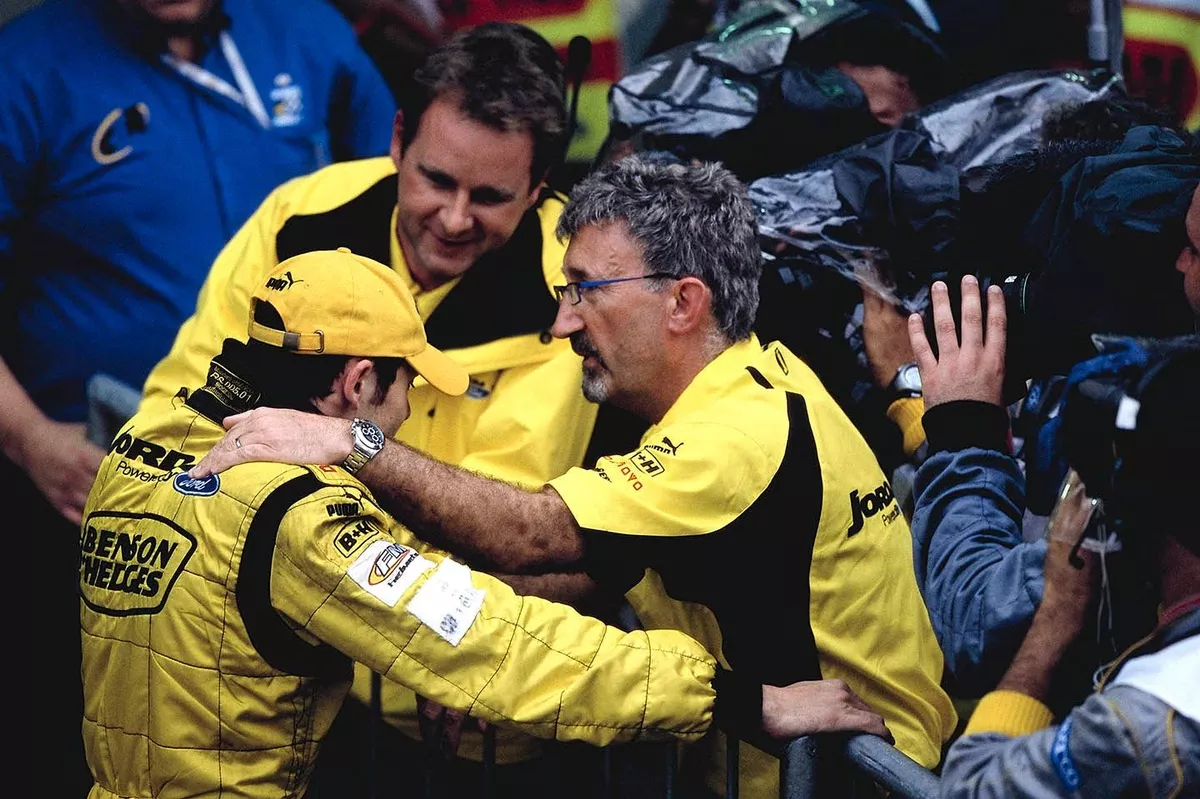
How Jordan won its last F1 race on this day in 2003
How Jordan won its last F1 race on this day in 2003 with a bold strategy gamble in the wet Brazilian GP
Formula 1 has always had a soft spot for chaos.
Not the polished, predictable kind. The real stuff. Sudden rain. Safety cars. Pit walls second-guessing themselves. Drivers hanging on by instinct more than grip. And somewhere in the middle of all that madness, a smaller team stealing a moment that should have belonged to somebody else.
That is exactly why people still talk about how Jordan won its last F1 race on this day in 2003.
Because this was not supposed to happen.
Not with the car Jordan had. Not with the money it didn’t have. Not with the giants lined up around it. And definitely not at a soaking Brazilian Grand Prix where the conditions were turning a normal Sunday into a survival contest.
Yet somehow, against all logic, Jordan won its last F1 race through a mixture of nerve, timing, sharp strategy and a little bit of post-race persistence in the stewards’ room.
It remains one of the great underdog stories of the modern F1 era.
When fans remember Jordan Grand Prix, the mind usually drifts to the late 1990s. The yellow cars. The swagger. The Eddie Jordan energy. The period when the team was loud, ambitious and just fearless enough to punch above its weight. This was the team that gave Michael Schumacher his F1 debut, the team that occasionally rattled the establishment, and the team that genuinely looked capable of becoming a regular nuisance to the sport’s heavyweights.
By 2003, though, the picture had changed.
The romance was still there, but the pace wasn’t.
Jordan had slipped badly from its peak years, and the EJ13 was not a car built to fight for wins on merit. On a normal dry Sunday, the team’s job was to survive, maybe steal a point, maybe nick some attention if others hit trouble. That was the reality. There were bigger budgets, stronger engines, better technical packages and far more stable operations elsewhere on the grid.
And yet, on one unforgettable afternoon at Interlagos, the sport reminded everyone that Formula 1 can still reward bravery as much as brute force.
That’s why the story still matters.
Jordan’s decline made its last F1 race win in 2003 even more remarkable
To really appreciate how Jordan won its last F1 race on this day in 2003, you have to understand where the team was at that point.
This was not the Jordan of 1998 or 1999, when podiums and occasional wins felt possible if the stars aligned. This was a team hanging on, trying to remain relevant in an era where Formula 1 was becoming more ruthless, more expensive and increasingly unforgiving to independent outfits.
The EJ13 was, bluntly, not a front-running machine.
In fact, many in the paddock would have argued it was among the weakest cars on the grid that season. Jordan was dealing with technical limitations, reliability concerns and the kind of financial strain that makes every weekend feel heavier than it should. The glamour of the earlier years had faded. The edge was still there in spirit, but the resources were no longer enough to consistently trouble the top teams.
That is what makes the 2003 Brazilian GP so special.
This was not a team trending upward. It was not a car on the verge of a breakthrough. It was not a classic “we saw this coming” performance. It was a team spotting a tiny window in complete mayhem and charging through it before it slammed shut.
That takes courage.
And in Formula 1, courage from the pit wall is sometimes just as important as courage in the cockpit.
How Jordan won its last F1 race with Giancarlo Fisichella and a wet-weather masterclass
If the team supplied the boldness, Giancarlo Fisichella supplied the composure.
He had already done a strong job in qualifying, putting the Jordan eighth on the grid for what was the team’s 200th grand prix start. In itself, that was a decent effort considering the machinery. But the real story was always going to begin once the skies opened and the race became less about raw pace and more about judgment.
And at Interlagos that day, judgment was everything.
The rain was so severe that the start was delayed, and when the race finally got underway, it did so behind the safety car. That instantly changed the strategic landscape. Teams had to think on the fly. Conditions were unstable. Grip was inconsistent. Visibility was poor. And in that kind of race, if you simply follow the obvious plan, you often end up buried in someone else’s accident.
Jordan knew it needed to be smarter than that.
So the team made the kind of call smaller outfits have to make when they know they cannot win conventionally: it rolled the dice.
Jordan brought in Fisichella and team-mate Ralph Firman Jr early to fuel them long, sacrificing track position in the short term in the hope that the race would come back to them later. On paper, dropping toward the back in a race already bordering on unmanageable looked risky. In reality, it was exactly the kind of thinking that gave Jordan a chance.
It was classic underdog logic.
If you cannot beat the big teams head-to-head, force the race to become something different.
And that is exactly what happened.
The wet Brazilian GP turned into chaos — and Jordan stayed alive
The 2003 Brazilian Grand Prix quickly descended into the sort of madness that Interlagos seems uniquely capable of producing.
Cars were skating off. Drivers were guessing more than attacking. The spray was brutal, the standing water dangerous, and the track kept punishing even the biggest names. In races like this, survival is not glamorous, but it is a weapon.
Jordan understood that.
While Ralph Firman Jr saw his race unravel with a front suspension failure, Fisichella kept going. More importantly, Jordan resisted the temptation to panic when the next safety car period and pit stop sequence began to shuffle the order once again.
That is where good strategy becomes great strategy.
You don’t just make one bold call and hope. You keep reading the race. You keep trusting the logic. You stay disciplined while everybody else gets dragged into the chaos.
Around them, the bigger names started to fall.
Michael Schumacher, never the kind of driver you expect to disappear quietly, was caught out by the conditions and crashed. That alone underlined how treacherous the track had become. Shortly after, Jenson Button also found trouble once the safety car peeled in. Even the best-prepared teams were being ambushed by the circuit.
Every retirement, every spin, every mistimed stop nudged Jordan closer.
And in races like this, the key is not to ask, “Can we win?”
It’s to ask, “Can we still be there when everybody else makes mistakes?”
Jordan was.
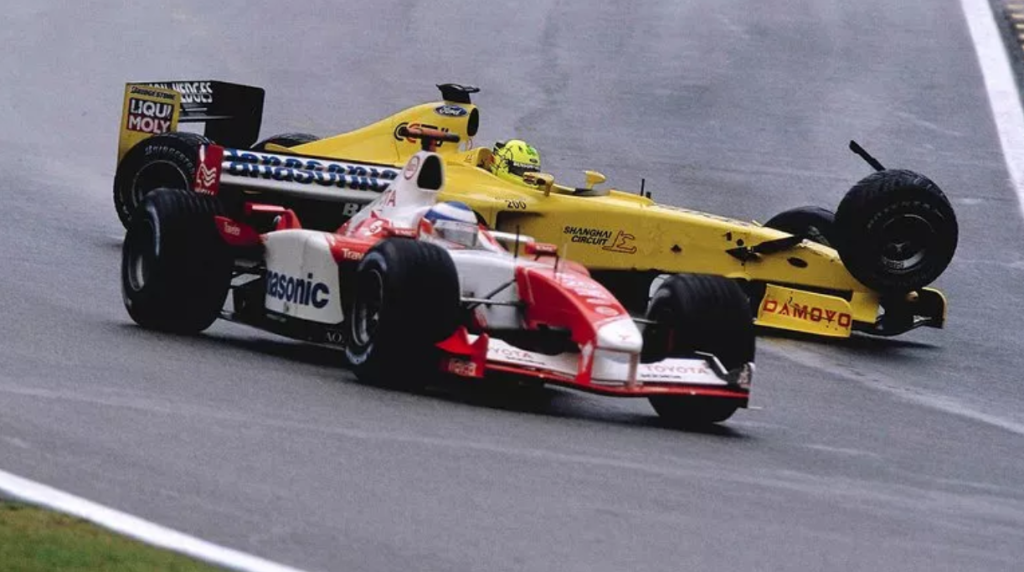
How Jordan won its last F1 race as the leaders stumbled at Interlagos
By the time the race moved into its latter stages, the order had become a constantly shifting puzzle.
Rubens Barrichello, carrying the hopes of the home crowd, surged into the lead after passing David Coulthard on lap 45. For the fans at Interlagos, it looked like the perfect script. A Brazilian leading at home, in front of a soaked and delirious grandstand, in a race already packed with drama.
But Interlagos had more twists left.
Barrichello then ran out of fuel.
That one moment changed everything.
Suddenly, the race reopened again, and Fisichella moved further into contention. Then Coulthard had to stop for fuel from the lead. Ralf Schumacher also headed for the pits. Positions kept flipping, and every strategic choice made earlier in the race started to pay off for Jordan.
This is the part people sometimes forget when they reduce the story to “a lucky win.”
Luck always plays a role in wet races. Of course it does. But luck alone doesn’t put a Jordan in position to inherit the lead deep into a grand prix while bigger teams are forced into reactive stops.
That comes from planning.
That comes from committing to an alternative strategy.
That comes from having the nerve to do something different before the race fully reveals itself.
And eventually, the moment came.
When Kimi Raikkonen made a mistake in his McLaren, Giancarlo Fisichella found himself leading the race.
For Jordan, it was surreal.
The yellow car was back at the front of a Formula 1 grand prix for the first time in more than two years.
In a dry race, that probably never happens.
In this one, it absolutely did.
The red flag confusion that decided Jordan’s last F1 race win
If the race itself was chaotic, the finish somehow managed to be even more confusing.
Shortly after Fisichella had hit the front, Raikkonen managed to get back ahead — at least that was the initial understanding in the immediate confusion of a race spiraling toward its conclusion. Then came the huge crash for Fernando Alonso, which triggered a red flag and brought proceedings to a halt.
And that is where the real controversy began.
In the immediate aftermath, Kimi Raikkonen was initially declared the winner.
McLaren celebrated.
The podium ceremony went ahead.
But Jordan believed something was off.
And this is another reason the story of how Jordan won its last F1 race on this day in 2003 remains so memorable: the team didn’t just rely on what happened on track. It also fought for the correct interpretation after the flag.
Jordan challenged the result, and after the FIA reviewed the timing and race classification rules, it was determined that the official result should actually be taken from the end of lap 54 — not the lap that many had first assumed.
That mattered enormously.
Because on that lap, Fisichella was ahead.
So after all the confusion, the uncertainty and the awkward delay, the result was overturned.
Giancarlo Fisichella was the rightful winner of the 2003 Brazilian Grand Prix.
Jordan had done it.
Not with the fastest car.
Not with the biggest budget.
But with smart calls, a cool driver, and the confidence to push back when the paperwork didn’t match what they believed had happened.
It was messy. It was unusual. It was very Formula 1.
And honestly, that makes it even better.
Why Jordan’s last F1 race victory still means so much in Formula 1 history
There are bigger wins in Formula 1 history.
There are more dominant wins. More glamorous wins. More important championship wins.
But there are not many that capture the soul of the sport quite like this one.
Because Jordan’s last F1 race win in 2003 was not just a result. It was a reminder of what independent teams once represented in this sport. Creativity. Nerve. Personality. Opportunism. The belief that if conditions got weird enough and you were brave enough, you could still steal a day from the giants.
That mattered.
It was Jordan’s fourth and final Formula 1 victory, and its first podium since the 2000 United States Grand Prix. For a team that had once looked capable of becoming a permanent disruptor, this was one last flash of the old magic.
A final roar before the long fade.
And after that, the identity changed.
Jordan eventually disappeared as a name, evolving through several different chapters: MF1 Racing, Spyker, Force India, Racing Point, and finally Aston Martin. The DNA, in some form, survived. The factory survived. The people, in many cases, stayed part of the story. But Jordan as Jordan never won again because there was no next time.
That is why this day stands alone.
Later versions of the same team would still have moments. Force India became one of the great overachievers of the midfield era. Racing Point even grabbed a famous win at the 2020 Sakhir Grand Prix. Aston Martin has since returned to the podium multiple times in its modern form.
But that 2003 afternoon at Interlagos was the final victory for the Jordan badge itself.
And that gives it a kind of emotional permanence.
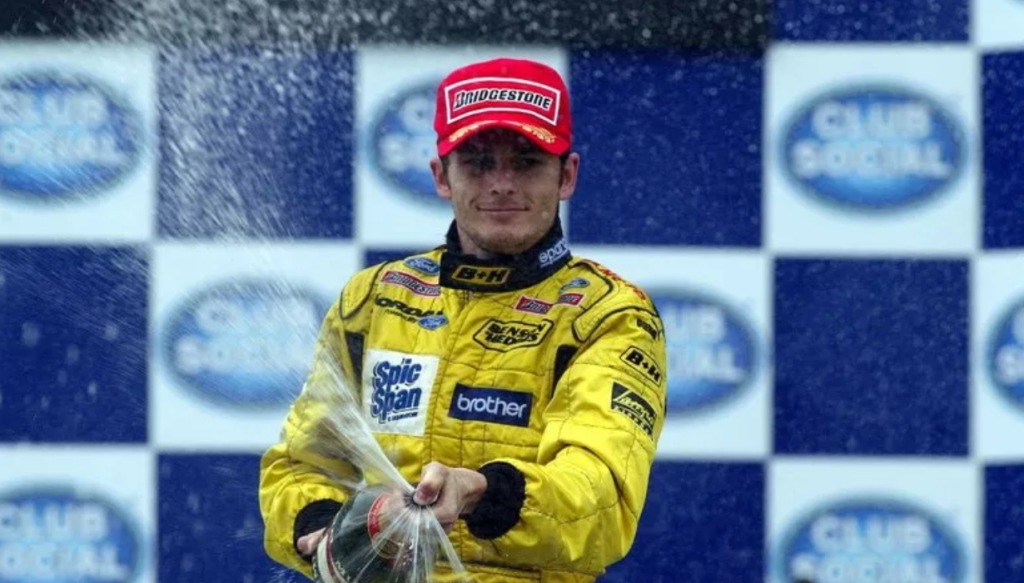
Final word: How Jordan won its last F1 race on this day in 2003
So, how Jordan won its last F1 race on this day in 2003?
By doing what underdogs have always had to do in Formula 1.
They saw a wet Brazilian GP turning into a lottery and refused to play it safely. They made a bold strategy gamble early, fuelled long, accepted short-term pain for long-term opportunity, and trusted that the chaos would come their way. Then, when the race started swallowing bigger names, Giancarlo Fisichella stayed calm, stayed in the fight, and kept the car alive.
When the leaders stumbled, Jordan was there.
When the red flag created confusion, Jordan pushed for clarity.
And when the FIA finally corrected the classification, the result reflected what the team had earned: one last, unforgettable victory.
That is why the story still resonates.
Because it wasn’t clean.
It wasn’t simple.
And it certainly wasn’t expected.
But it was pure Formula 1.
A soaked circuit. A brave call. A midfield team dreaming bigger than its car should allow. And for one strange, brilliant afternoon in São Paulo, the yellow Jordan was king again.


There are no comments yet. Be the first to comment!