

















































































Is the Australian Open still the ‘Happy Slam’?
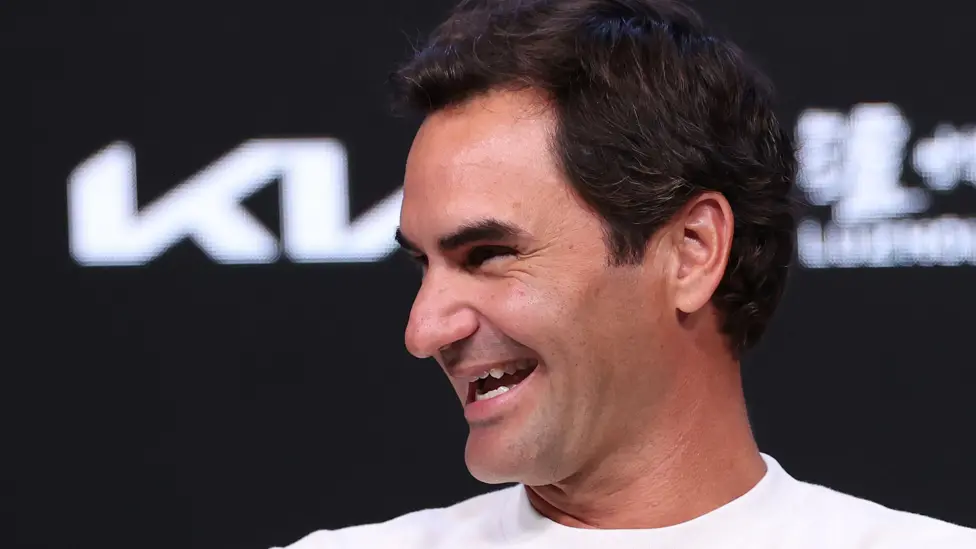
A moniker given to the Australian Open by Roger Federer has come to be a huge part of the tournament’s identity.
Nicknamed the “Happy Slam” by the Swiss great, the first major of the season is largely loved by the players and continues to attract record-breaking crowds.
Innovative additions, such as this year’s One Point Slam, have brought new eyeballs to the sport and been considered a roaring success.
But there have also been signs of cracks over the past three weeks.
Intrusive behind-the-scenes cameras watching the stars, overcrowding in the grounds and accusations too many attendees are not interested in the tennis have been among the chief complaints.
Now, with the mastermind of the Australian Open’s growth reportedly set for pastures new, BBC Sport looks at the tournament’s recent success and asks where it goes next.
Where does ‘Glastonbury of tennis’ go next?
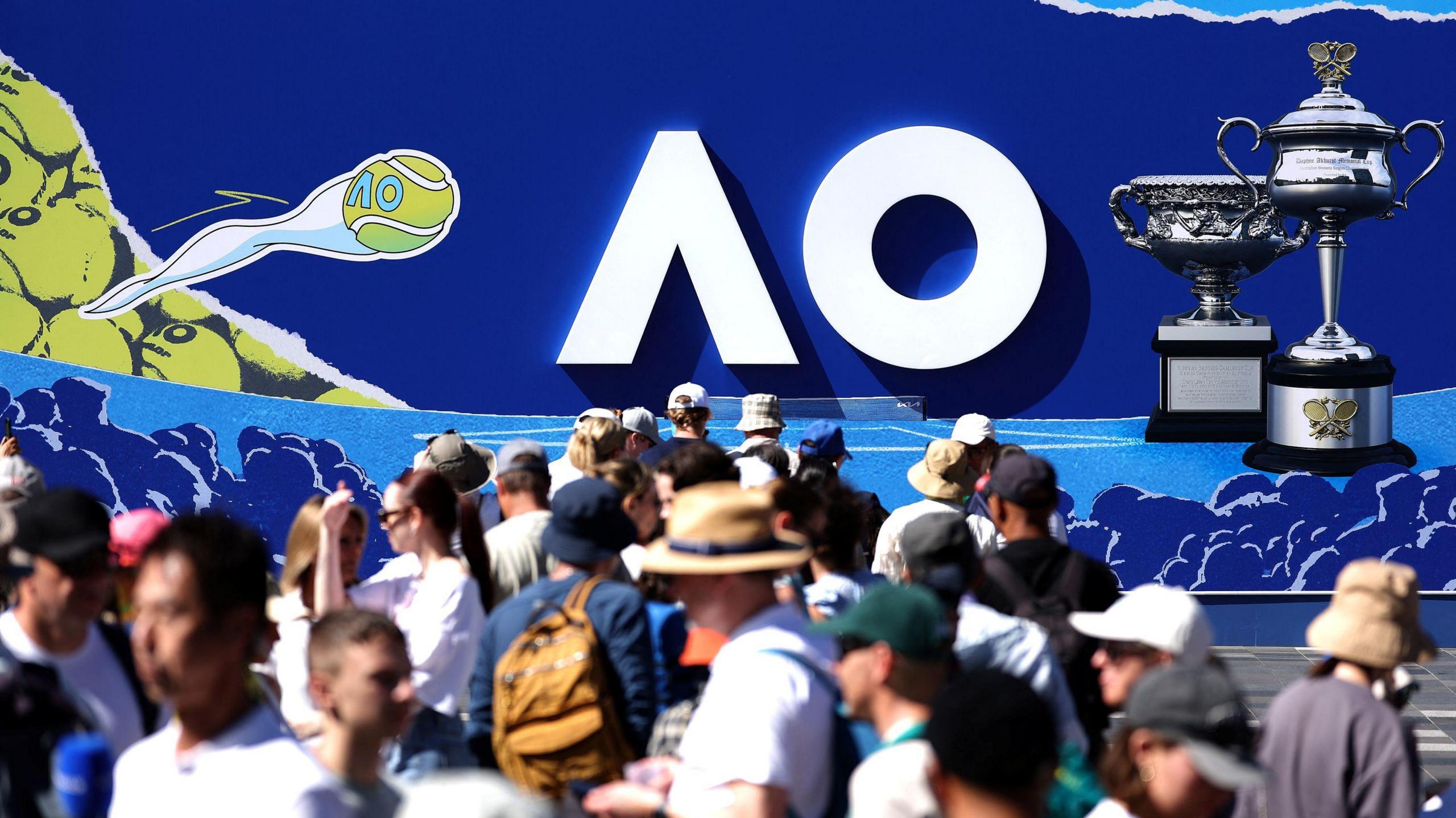
Grand Slams used to be fortnight-long events but are increasingly becoming three-week extravaganzas, with the Australian Open leading the way.
The week preceding the main draws was once a peaceful time, with sparse crowds watching qualifying and the players practising behind closed doors.
Now there are star-studded events taking place every day in what tournament director Craig Tiley tags the “festivalisation” of the core tennis product.
As well as the One Point Slam, this year’s Australian Open featured an opening ceremony that doubled as an evening with the ever-popular Federer, plus superstars such as Novak Djokovic and Aryna Sabalenka playing warm-up sets on Rod Laver Arena.
All of which came, of course, with a money-spinning entrance fee.
Around the grounds, superstar music acts, hip restaurant link-ups and family fun events have turned the Australian Open into the Glastonbury of tennis – a cultural jamboree blending sport, entertainment and food in one glamorous package.
The crossover was best demonstrated by global dance icon Peggy Gou and pop-rapper The Kid Laroi headlining the AO Live event.
The pair each played to 10,000 fans on John Cain Arena – the site’s third showcourt – with Korean-born, Berlin-based DJ Gou bringing the party to a close before Sunday’s men’s final.
Gou would have felt equally at home playing in Grand Slam Oval, a patch which feels like an Ibiza beach club throughout the tournament due to a thumping sound system and bougie lounge bars.
Tiley believes appealing to a wider audience can help the Australian Open thrive as it chases Wimbledon, the French Open and US Open in terms of status and commercial pull.
A former University of Illinois college coach and captain of the South Africa Davis Cup team, Tiley has driven the transformation since joining Tennis Australia in 2005.
American doubles legend Rajeev Ram, who played under Tiley at Illinois in the early 2000s, described him as “the leader” in making college tennis “more of a spectacle than a sporting event”.
“He managed to convince the marching band – a huge deal at American universities – to come and play in the intermission between singles and doubles matches,” Ram told BBC Sport.
“He would provide gifts for couples who showed up together to matches on Valentines Day or people who dressed in green during St Patrick’s Day.
“All of these things were very new in college tennis at the time.”
Tiley is not afraid to ruffle feathers, either.
On Sunday, he proposed turning the women’s singles matches into five-set contests from the quarter-finals onwards – whether the other three Slams agree or not.
He also wants further innovation. An interactive glass court and an immersive dome with 270-degree screens were ideas floated in an interview with The Age newspaper., external
But there remains an elephant in the room – will the 63-year-old even be in charge for the 2027 Australian Open?
A move to the same role at the United States Tennis Association appears imminent, although he has remained tight-lipped – for once – when it comes to his future.
‘An entire suburb’ – but space still at a premium

Superstar DJ Peggy Gou also watched eventual champion Carlos Alcaraz from his players’ box at Melbourne Park
The tournament’s buzz is felt across Melbourne and it has become one of the city’s must-attend summer events.
Over the course of the three weeks this year, almost 1.4m have rolled through the doors – a 16% increase on last year.
Seasoned Australian tennis journalist Courtney Walsh described the tournament’s growth during Tiley’s reign as “extraordinary”.
“I played here as a boy and you would walk around the courts thinking ‘this is unreal’. But you would never have imagined what has happened since,” he told BBC Sport.
“To have six showcourts, to have John Cain Arena – which was a basketball stadium – as a third showcourt, is amazing.”
The central location of the site – unlike its three Grand Slam counterparts – adds to the popularity.
Melbourne Park stretches from the iconic Flinders Street Station, past the looming Melbourne Cricket Ground and towards the neighbouring suburb of Richmond.
Daily crowds topped 100,000 in the early part of the tournament, with grounds passes costing A$69 (£35) in the opening week.
Galleries on the outer courts were often tens deep, while the image of thousands of Filipinos queuing in line to watch their idol Alexandra Eala was startling.
It led to accusations that too many tickets were being sold and ruining the experience for tennis-watching fans.
“It’s an exceptionally big site – like it’s own suburb. But space is still clearly at a premium,” Walsh added.
“It is indisputable that the amount of tennis on offer for grounds pass holders is far less than it used to be.
“In part that’s because we’ve spread the first round over three days – that means less matches on the main stadium courts which means less matches played outside.”
Are the players still happy?
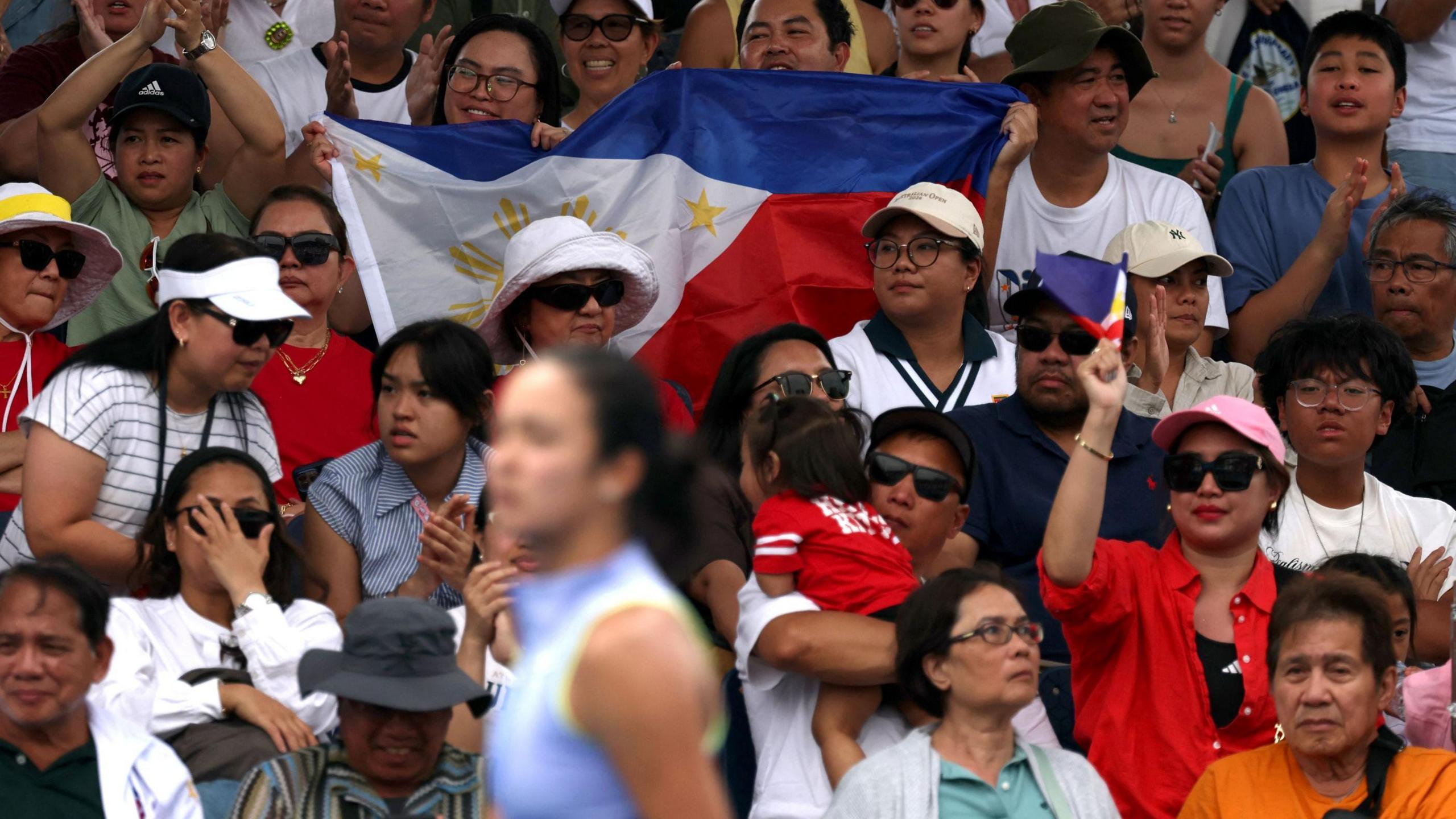
Thousands of Filipino fans queued to catch a glimpse of 20-year-old Alexandra Eala – the nation’s newest sporting superstar
The growth of the Australian Open, however, would not be the same without its core product – the players.
Going back a few decades, many European and American stars would not travel to Melbourne because of the distance and a general feeling it lacked prestige.
That has changed considerably – not least because Tiley introduced a travel grant for the players.
“A lot of players are happy to escape the European winter and see the other players again and catch up in the New Year,” Federer said.
“People are incredibly excited and pumped up about the Australian Open. The players can feel that. The vibe is incredibly happy.”
Particular emphasis is placed on high-quality player facilities.
A hi-tech racquet lab provides personalised strings and grips, while a health suite offers physiotherapy, massage therapy and plunge pools.
Specialist medical treatment – an ophthalmologist, dermatologist, podiatrist and orthopaedist – is available, as are nutritionists and hydrationists, while chefs rustle up home comforts from every corner of the globe.
A beauty salon, including barbers, pedicurists and manicurists, is also on hand, along with a laundry service and dry cleaners.
There is even an on-site bank.
“We have a complete tourism service. We provide pretty much anything you can think of to service an athlete,” Tiley said in a recent interview with Forbes magazine.
Another major plus point is the riches on offer, with a record prize pot of £55m stumped up this year.
A group of leading stars, however, want a greater share of the event’s revenue to be distributed throughout the field – arguing they remain the main drawing card.
This year, many players were also unhappy with the cameras recording their every move behind the scenes.
“We wanted to really push the envelope on how we can provide an even greater spotlight for the players, these magnificent athletes, on the court, that effectively becomes their stage,” Tiley added.
How the Australian Open continues to evolve over the next 12 months – with or without Tiley – will be fascinating to watch.


There are no comments yet. Be the first to comment!