







Australian Grand Prix Set to Feel “No Impact” from Travel Chaos as Formula 1 Season Opener Approaches
The countdown to a new Formula 1 season is usually filled with anticipation, fresh optimism, and endless speculation about who has found speed during the winter. This year, however, the build-up to the Australian Grand Prix has unfolded against a far more complicated global backdrop.
Despite widespread travel disruption caused by escalating tensions in the Middle East, organisers insist that Melbourne’s season-opening race will proceed exactly as planned. Behind the scenes, Formula 1 has been forced into a logistical sprint worthy of race day itself — rerouting flights, arranging charter planes, and ensuring that hundreds of team personnel arrive on time.
Yet, according to those closest to the operation, fans attending Albert Park this weekend are unlikely to notice anything unusual.
Australian Grand Prix Organisers Confident Travel Chaos Will Have “No Impact”
Australian Grand Prix Corporation chief executive Travis Auld struck a calm and confident tone when addressing concerns surrounding the situation. Speaking early in race week, Auld made it clear that while travel arrangements had required significant adjustments, the event itself remained firmly on track.
The disruption followed military escalation in the Middle East, which triggered widespread airspace complications and forced airlines to reconsider key international routes. Many Formula 1 personnel typically travel through hubs in Qatar and the United Arab Emirates — routes now affected by sudden restrictions and safety concerns.
For a global championship built on precision timing, the implications were immediate.
Close to 1,000 Formula 1 staff members found their travel plans suddenly uncertain. Engineers, mechanics, logistics coordinators, broadcasters, and operational crews all faced last-minute changes. At one stage, there were genuine fears that delays could impact preparations for the opening round.
Instead, Formula 1 activated contingency plans.
“The last 48 hours have required some reshuffling of flights,” Auld explained. “That is largely Formula 1’s responsibility. They coordinate the teams, drivers, and all the personnel needed to make this event happen.”
The solution came in the form of charter aviation. Three dedicated charter planes were arranged to transport roughly 500 affected staff directly from Europe to Melbourne, bypassing disrupted commercial routes.
According to organisers, those plans are now fully locked in.
“My understanding is that everyone will be here ready for the race,” Auld added. “Fans won’t notice any difference.”
Formula 1 Logistics Operation Steps Up Amid Global Uncertainty

Australian Grand Prix: Formula 1 season-opener to feel ‘no impact’ of travel chaos –
If Formula 1 prides itself on engineering excellence, its logistical operation is equally impressive — though far less visible.
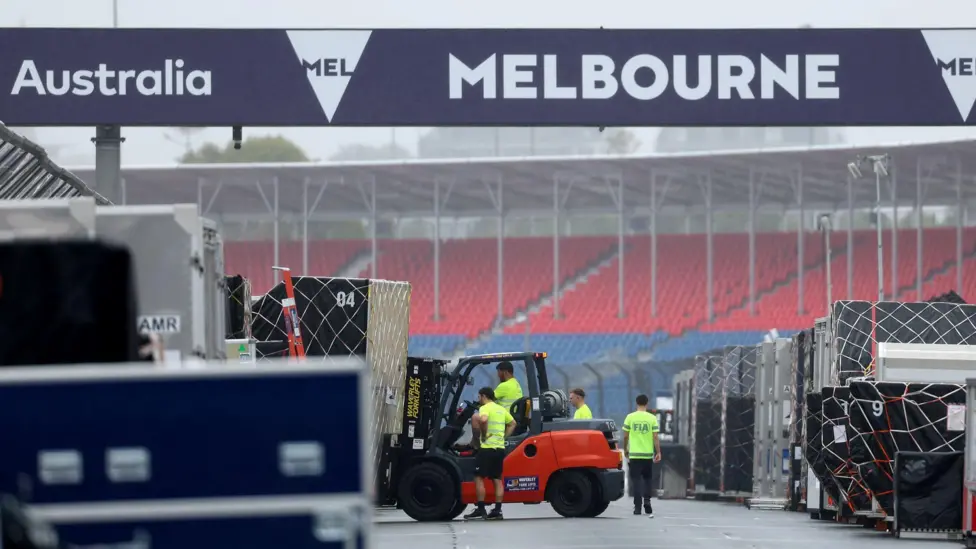
Each race weekend requires the movement of thousands of tonnes of freight across continents: cars, spare parts, garage equipment, broadcast technology, and hospitality infrastructure. In Melbourne’s case, organisers confirmed that all freight shipments had already arrived before travel disruptions intensified.
That timing proved crucial.
“All the freight is here and ready to go,” Auld said. “We’re in a space where we’re really confident there will be no impact.”
The sport’s ability to adapt quickly reflects years of experience navigating unpredictable global challenges. From pandemic-era calendar reshuffles to extreme weather disruptions, Formula 1 has learned to operate with contingency plans built into nearly every phase of its schedule.
Still, this situation presented a unique challenge. Unlike weather or mechanical delays, geopolitical instability introduces uncertainty that evolves hour by hour.
Formula 1 officials acknowledged the seriousness of the situation while stressing that immediate races remain unaffected.
An F1 spokesperson confirmed that the opening trio of events — Australia, China, and Japan — sit outside the affected region geographically and chronologically.
“As always, we closely monitor any situation like this and work closely with relevant authorities,” the statement read.
Eyes Already on Bahrain and Saudi Arabia
While Melbourne appears secure, attention inevitably turns toward races scheduled later in the calendar.
Rounds four and five of the championship are set for Bahrain on 12 April and Saudi Arabia on 19 April — both located in the broader Middle East region. Although those events are still weeks away, Formula 1 leadership is already considering potential scenarios should travel complications persist.
Auld hinted that forward planning is already underway behind closed doors.
“I’m sure Formula 1 are thinking ahead to what the implications might be,” he told Fox Sports. “As it stands there are no issues for us, but I’d imagine they’ll be thinking about what they might do to their calendar if they need to.”
Formula 1’s modern calendar leaves little margin for disruption. With 24 races packed into an already demanding schedule, relocating or postponing events would require careful negotiation between promoters, teams, and governing bodies.
For now, though, the focus remains firmly on Melbourne.
Melbourne Ready to Deliver Season Curtain-Raiser
Albert Park has long held a special place in Formula 1’s modern identity. The Australian Grand Prix often serves as the emotional reset button after months without racing — the first real glimpse of competitive form, new driver pairings, and technical innovations revealed under pressure.
Despite global uncertainty, preparations on the ground have continued uninterrupted.
Grandstands are in place. Team garages are operational. Media centres are buzzing with early arrivals. Local organisers insist the atmosphere surrounding the race has remained overwhelmingly positive.
The reassurance matters not just for fans but also for teams eager to begin the campaign without distraction. Pre-season testing provides hints, but Melbourne delivers answers.
Drivers arriving this week will step into a familiar rhythm: track walks, engineering briefings, simulator feedback sessions, and final setup refinements. For many, the travel complications will simply become another story from an unusually dramatic build-up.
In a sport defined by adaptability, Formula 1 once again appears ready to race regardless of circumstances beyond the circuit.
And that, perhaps, is the defining takeaway.
While geopolitical tensions have created real-world complications thousands of kilometres away, the Australian Grand Prix is set to open the 2026 season exactly as fans expect — engines roaring, grandstands full, and no visible sign of the travel chaos that briefly threatened to complicate the journey to Melbourne.
As Auld confidently summed up, everyone will be in place when the lights go out.
For Formula 1, the show — as always — goes on.


There are no comments yet. Be the first to comment!