






































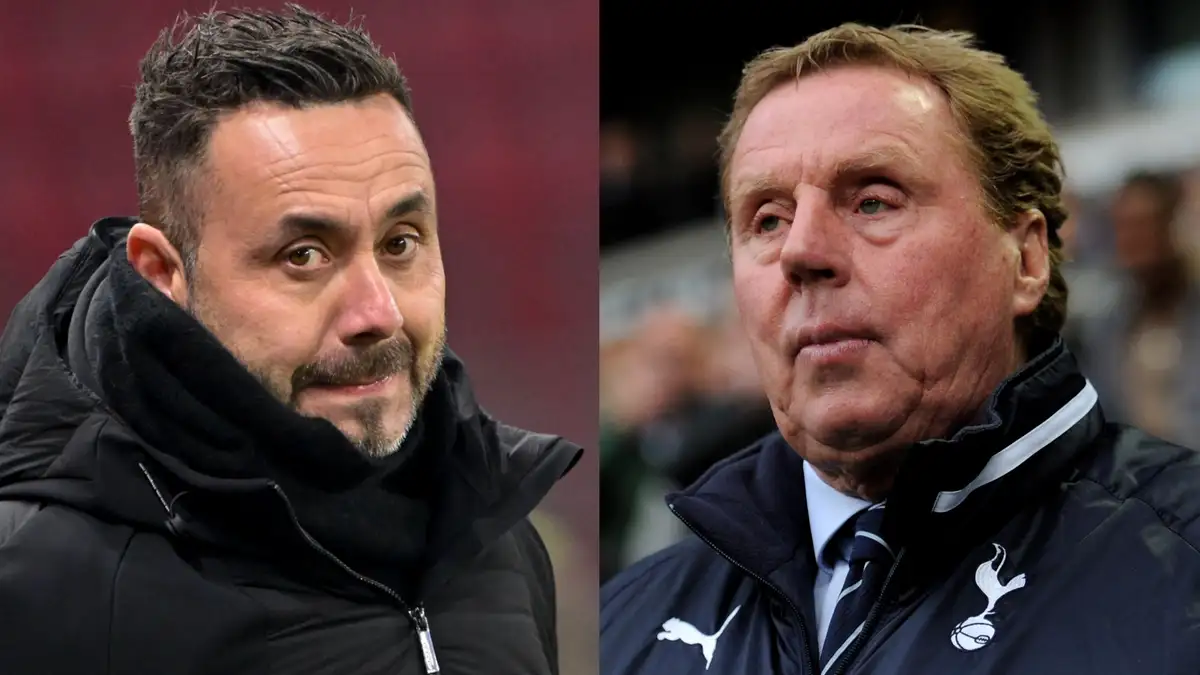
Roberto De Zerbi Over Harry Redknapp! Will Troubled Tottenham Pay the Price for Ignoring Familiar Faces in Premier League Survival Battle?
Roberto De Zerbi over Harry Redknapp? Why Tottenham’s latest gamble could define their Premier League survival battle
There are moments in a football season when a club stops thinking about style, identity and long-term vision, and starts thinking about one thing only: survival.
Tottenham Hotspur are in that place now.
For all the talk over the last few years about project managers, progressive football and building a modern identity, Spurs have once again found themselves dragged into the kind of fight no one in north London ever really believes will happen until it is already happening. Seven games to go, confidence drained, fans divided, the dressing room bruised, and the Premier League table staring back with brutal honesty — this is no longer about philosophy. This is about staying alive.
That is what makes the current managerial debate so fascinating, and so risky.
Roberto De Zerbi over Harry Redknapp is the sort of decision that sounds bold and ambitious in a boardroom, but in the middle of a relegation scrap, it can also look like a club forgetting what time of year it is. When the walls are closing in, supporters don’t always want the cleverest appointment. Sometimes they want the most human one. Sometimes they want the familiar face, the steady voice, the man who understands the shirt, the noise, the pressure, and exactly how ugly the next seven games might become.
And that is why this question won’t go away: will troubled Tottenham pay the price for ignoring familiar faces in this Premier League survival battle?
Former Spurs goalkeeper Brad Friedel clearly thinks it is a fair one.
Because while Roberto De Zerbi is undeniably an excellent coach, and arguably the most tactically attractive option available, the timing of this move is what makes it feel so delicate. Tottenham are not hiring for a fresh pre-season. They are not appointing in June with a transfer window ahead and a chance to reset the culture. They are potentially asking a high-level, detail-driven coach to parachute into chaos with the season on fire.
That is a completely different job.
Next Spurs manager chaos sums up a club spinning in circles
If ever there was proof that Tottenham have become trapped in their own cycle of uncertainty, the last few weeks have provided it.
Thomas Frank was relieved of his duties on February 11 after another poor run left Spurs wobbling dangerously close to the bottom three. There was a sense, at least briefly, that the club might finally choose pragmatism over ideology. Maybe this was the moment to bring in someone who knew the club, knew the league, and knew how to calm a panicked environment.
Instead, Spurs turned to Igor Tudor.
On paper, there was logic. Tudor is intense, demanding, and tactically sharp. He has personality, authority and enough top-level experience to command a dressing room. But football doesn’t happen on paper, and Tottenham are the kind of club that often expose that faster than most.
Tudor lasted just 44 days.
Seven games, one point from five league matches, a 1-1 draw at Anfield the only flicker of resistance, and a Champions League last-16 exit thrown in for good measure. Then he was gone. Another manager through the revolving door, another attempt to fix a deeper problem with a quick managerial switch, another reminder that at Spurs, turbulence has become the default setting.
This is what makes the De Zerbi conversation feel so loaded.
Because it is not happening in a vacuum.
It is happening after one failed appointment, after months of underperformance, after two seasons wrecked by injuries, and with the club sitting 17th in the Premier League, just one point above the drop zone.
That is not a project.
That is an emergency.
Roberto De Zerbi is a top coach — but is he the right coach for Tottenham right now?

This is the key distinction.
There is a big difference between asking whether Roberto De Zerbi is a good manager and asking whether he is the right manager for Tottenham in the middle of a Premier League survival battle.
The first question is easy.
Yes, he is.
De Zerbi built an impressive reputation at Brighton, where his football was brave, inventive and often a joy to watch. He showed he could coach structure into chaos, improve players, and build a side that could punch above its financial weight. His work in Marseille only reinforced the sense that he belongs at a high level. He is respected. He is modern. He has Premier League experience. And in a normal context, Spurs landing him would feel like a genuine statement.
But this is not a normal context.
This is not August.
This is not the start of a rebuild.
This is late-season firefighting, and firefighting is not always about the most sophisticated plan. Sometimes it is about who can get into the room, simplify the message, reconnect a broken team with a nervous crowd, and create belief quickly enough to steal points.
That’s where the Harry Redknapp argument becomes so compelling.
Because Harry Redknapp, Glenn Hoddle, even names like Ryan Mason or Tim Sherwood — however divisive some of those options may be — represent something De Zerbi does not: emotional familiarity.
And in a crisis, that can matter more than people like to admit.
Brad Friedel’s Harry Redknapp point is hard to ignore
Brad Friedel’s comments hit a nerve because they reflect what many supporters quietly think when a club is spiralling.
Sometimes, in moments like this, you don’t need the smartest tactical presentation. You need someone who knows the building.
Friedel openly said he believed the perfect moment for Harry Redknapp had come before Tudor was hired, and honestly, it’s not hard to see the logic. Redknapp knows Spurs. He knows the media circus. He knows how to lift pressure with personality, how to talk to supporters, and — maybe most importantly in a relegation battle — how to make anxious players feel like football can be simple again.
That’s an underrated skill.
When confidence collapses, players stop doing basic things well. They take extra touches. They hesitate in the final third. They overthink decisions. They hear the crowd. They feel the fear in every misplaced pass. At that point, all the tactical detail in the world means less if the players are mentally paralysed.
Redknapp, for all the jokes and nostalgia that surround him, has always had a gift for restoring belief.
Friedel knows that because he played for him.
And that personal insight gives his view weight.
It’s not about pretending Redknapp would suddenly transform Tottenham into a polished machine. It’s about recognising that, in the final seven games of a season, polished machines are not what save clubs.
Spirit does.
Clarity does.
Connection does.
That’s why the idea of a familiar face kept surfacing.
Not because it was romantic.
Because it made football sense.
Why Tottenham may still be right to choose Roberto De Zerbi over Harry Redknapp
And yet — this is the uncomfortable truth for those calling for a nostalgic rescue — Tottenham might still be making the right call.
Because while the emotional case for Harry Redknapp or Glenn Hoddle is strong, the practical case for Roberto De Zerbi is not just respectable. It’s serious.
First, he knows the Premier League. That matters enormously.
There’s no adaptation period to the rhythm, the physicality, the tempo or the media pressure. He understands what a survival fight feels like in England, even if he has not been in exactly this type of situation with Spurs. He knows how quickly momentum swings. He knows how one win changes everything. He knows how to prepare a team for hostile away days and high-pressure home games where the crowd can turn restless within 15 minutes.
Second, he is a genuinely elite coach.
And sometimes that matters more than familiarity. A good coach can simplify as well as complicate. A smart tactician knows when to shelve the tactics board and focus on psychology. Friedel himself hinted at that — that De Zerbi, for all his reputation as a detailed strategist, would surely understand that this is not the moment to overload players. This is the time for confidence, not complexity.
If De Zerbi gets that balance right, then Tottenham could end up with the best of both worlds: a top-level manager capable of stabilising the present and leading the future.
That is what makes this such a tempting move.
The risk is obvious.
But the upside is huge.
The break clause problem could make this another short-term Tottenham mess
One of Friedel’s sharpest points was not actually about tactics or club culture.
It was about contract structure.
And this may be the most “Tottenham” part of the whole story.
If Spurs bring in Roberto De Zerbi but allow a break clause in the summer in the event of relegation, then what are they really doing? They would be appointing a manager to try to save the club, while also building in the possibility that he walks away immediately if the mission fails.
That doesn’t exactly scream stability.
In fact, it risks creating yet another short-term arrangement at a club that has already burned through too many of them.
Tottenham need clarity right now. The players need to know the man in charge is all in. The fans need to believe this is not another temporary patch. The board need to stop acting like every appointment is a six-week experiment.
If De Zerbi comes in on a proper long-term deal, with no easy escape hatch, the message changes completely.
Then it looks like conviction.
Then it looks like Spurs have finally made a choice and committed to it.
Without that, it risks feeling like another hedge.
And in a relegation battle, hesitation is deadly.
Injuries, confidence and seven brutal games: this is now a pure survival story
For all the noise around managers, Tottenham’s survival will still come down to players.
That’s the part Friedel also touched on, and he’s right.
Spurs have been ravaged by injuries across the last two seasons, and at a time like this, getting two or three key players back can feel like a transfer window opening early. Suddenly the bench looks healthier. Suddenly the dressing room has more energy. Suddenly the manager has options. Suddenly a team that looked doomed starts looking merely vulnerable.
That matters.
Because with seven games remaining, Tottenham don’t need to become brilliant.
They need to become functional.
They need points, not performances.
They need ugly wins, scrappy draws, set-piece goals, second balls, clearances off the line, and a couple of afternoons where the crowd drags them over the line instead of sinking into dread.
The fixture list no longer contains distractions. The Champions League is gone. There is no glamorous side plot left. Sunday’s trip to Sunderland is not a side note. It is the season.
That is the reality now.
Every game is a cup final, but not in the dramatic cliché way. In the real way. In the tense, ugly, survivalist way where one result changes the mood of a whole club for a week.
That is what De Zerbi — or anyone else — would be walking into.
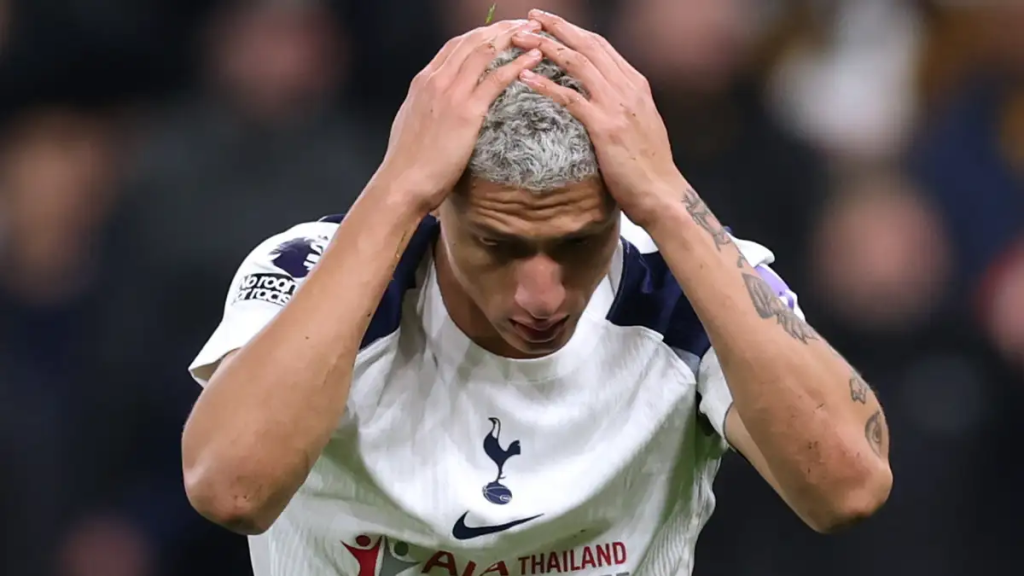
Will troubled Tottenham pay the price for ignoring familiar faces?
That is the question hanging over north London, and it’s a fair one.
If Spurs go with Roberto De Zerbi and he struggles to connect quickly, if the fanbase remains split, if the message gets lost, if the first result goes badly, then yes — the club may absolutely pay the price for overlooking the emotional intelligence of a familiar figure like Harry Redknapp or Glenn Hoddle.
In that scenario, the decision will look like classic Tottenham: too clever, too late, too concerned with optics and long-term ambition when the immediate danger demanded something more instinctive.
But if De Zerbi arrives, calms the dressing room, simplifies the football, gets one or two injured players back, and steals the points Spurs need to survive, then this could look like a masterstroke.
Then the narrative flips completely.
Then it becomes: while others wanted nostalgia, Tottenham found courage.
That is why this is such a fascinating gamble.
Because both outcomes feel believable.
Roberto De Zerbi over Harry Redknapp may be a gamble — but Tottenham have no room left for fear
At some point, a club in crisis has to choose.
Not just a manager.
A direction.
Tottenham can keep circling familiar names, hoping memory alone will rescue them. Or they can bet on a coach with modern pedigree and trust that he is adaptable enough to understand the moment.
There are arguments for both.
Plenty of them.
But what Spurs cannot afford now is half-measures. No more caretaker energy. No more 44-day experiments. No more acting like the next game will somehow solve structural chaos.
If it is Roberto De Zerbi over Harry Redknapp, then make it real. Back him. Commit to him. Give him authority, clarity and a dressing room that knows exactly what is being asked.
Because this is not really about whether De Zerbi is better than Redknapp.
It’s about whether Tottenham finally understand the stakes.
Seven games left.
One point above the drop.
No more distractions.
No more excuses.
And if they get this wrong, nobody in north London will care how progressive the appointment looked on paper.
They’ll only remember one thing:
When survival was on the line, Tottenham ignored the familiar faces — and may have paid the price for it.


There are no comments yet. Be the first to comment!