







































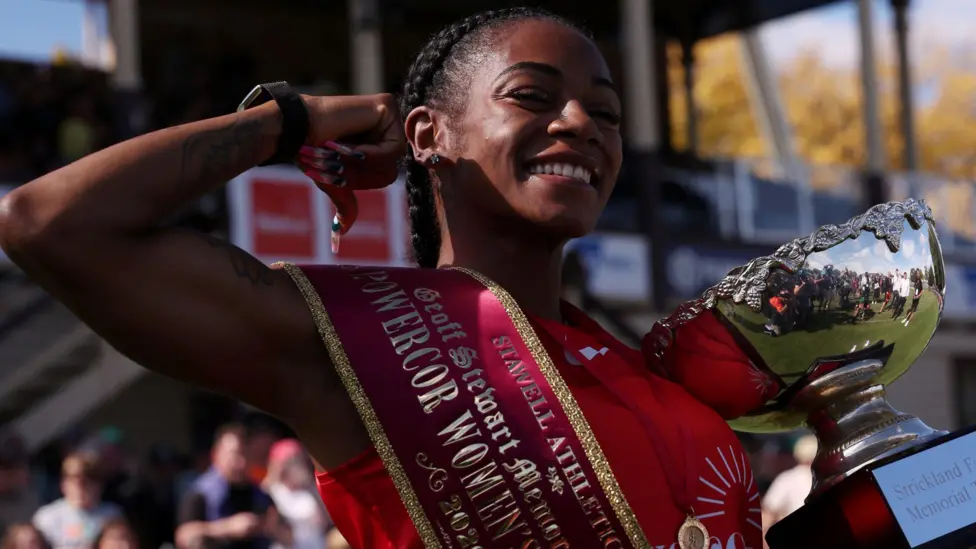
Sha’Carri Richardson Defies the Handicap: How Richardson Won the Stawell Gift from Scratch
Richardson wins Stawell Gift despite 10m handicap in one of sprinting’s most unique races
Track and field has always celebrated raw speed, but every now and then the sport produces a moment that feels bigger than time on a stopwatch. Sha’Carri Richardson’s victory at the historic Stawell Gift was exactly that — a performance that blended tradition, spectacle, and pure competitive instinct into something unforgettable.
On paper, the challenge looked almost unfair. Richardson, an Olympic silver medallist and one of the fastest women on the planet, started from the “scratch” mark, meaning she had no handicap advantage at all. While her rivals stood as much as 10 metres ahead on Australia’s famous uphill grass track, she faced the daunting task of chasing down the entire field across 120 metres.
By the finish line, however, the gap had disappeared — and history had been rewritten.
Richardson wins Stawell Gift despite 10m handicap is not just a headline; it perfectly captures the scale of what unfolded in the small rural town of Stawell, where one of athletics’ oldest traditions once again delivered global drama.
A race shaped by tradition and pressure
The Stawell Gift is unlike any other sprint event in the world. First staged in 1878, it blends elite athletics with a uniquely Australian handicap system designed to give every competitor a theoretical chance of victory. Athletes are assigned starting marks based on form and ability, meaning the fastest runners must chase from the back.
For a global star like Richardson, that meant beginning at scratch — the most difficult position possible.
It also meant expectation.
Fans gathered around Central Park’s grass track not simply to watch a race, but to witness whether world-class speed could overcome mathematical disadvantage. The uphill surface adds another layer of difficulty, punishing runners who mistime their acceleration or burn energy too early.
Richardson approached the challenge with visible excitement rather than caution. Throughout the three-day meet, she embraced the atmosphere, interacting with fans and treating the event less like an exhibition and more like a celebration of athletics culture.
That energy carried into the final.
The chase that defined the Stawell Gift
When the gun fired, Richardson immediately faced a wall of runners ahead of her. Competitors such as Australian teenager Charlotte Nielsen already held massive advantages thanks to their handicap starts.
For the first half of the race, Richardson appeared patient, almost controlled. Unlike traditional 100m sprinting, where explosive starts define outcomes, the Stawell Gift rewards pacing and tactical awareness.
At around the halfway mark, the momentum shifted.
Richardson began eating into the deficit with smooth, powerful strides, her acceleration unmistakable even on the uneven grass surface. By 90 metres, she later admitted, she already sensed the outcome.
“I realised I was going to win right past 90 metres,” she said afterward.
The final metres became a dramatic duel as she surged past Nielsen, who had started nine metres ahead. Richardson crossed the line in 13.08 seconds — the fastest women’s time recorded in the event’s 148-year history.
Considering the uphill track and handicap format, the performance bordered on extraordinary.
A global star embracing local tradition
What made Richardson’s victory resonate even more was her genuine appreciation for the event itself. Many elite athletes treat historic handicapped races as curiosities, but Richardson fully immersed herself in the experience.
She described the meet as one of the most enjoyable competitions of her career, praising the atmosphere and community support that surrounded the event.
“This is one of the most exciting, fun and entertaining track meets I’ve ever run in,” she said. “The love and support for track and field here is unbeatable.”
That sentiment mattered. The Stawell Gift thrives on its connection between elite sport and grassroots participation. More than 700 athletes competed across the weekend, sharing the same venue and traditions as Olympic champions.
Richardson’s enthusiasm helped bridge the gap between global athletics and local sporting culture.
Joining an exclusive list of champions
By winning from scratch, Richardson became only the third woman ever to claim the Stawell Gift from the back mark — an achievement that places her alongside some of the event’s most legendary performances.
The race’s history includes appearances from icons such as Asafa Powell, Linford Christie, and Cathy Freeman, athletes whose presence elevated the meet’s international profile across generations.
Richardson’s triumph now belongs firmly within that lineage.
Her ability to adapt elite sprinting mechanics to an unfamiliar format highlighted her versatility. Grass racing demands subtle adjustments in stride length and balance, while the uphill incline punishes inefficiency.
Yet she looked comfortable, confident, and increasingly dominant as the rounds progressed.
A weekend of storylines beyond the headline
The men’s competition added its own drama, featuring Richardson’s partner, American sprinter Christian Coleman. The former world champion entered with strong expectations but fell short in the semi-finals, finishing fifth and missing the final.
Instead, Australian 21-year-old Olufemi Komolafe claimed victory with an impressive 11.93 seconds off a five-metre handicap start, showcasing the unpredictable nature of the format.
Runner-up Jake Ireland, starting at 4.5 metres, pushed him closely, reinforcing how finely balanced handicap racing can be.
Across the three-day festival, prize money totaling A$155,000 underscored the event’s significance within Australian athletics despite its rural setting.
But ultimately, the weekend belonged to Richardson.
Momentum ahead of a crucial Olympic cycle
At 26, Richardson sits at an interesting stage of her career. She is no longer the emerging prodigy who burst onto the global scene with bold personality and explosive speed. Instead, she appears more composed, more focused, and increasingly comfortable with her status as one of sprinting’s leading figures.
Winning an unconventional race like the Stawell Gift may not carry Olympic ranking points, but it reveals something equally valuable: adaptability and competitive hunger.
The ability to win outside familiar environments often signals maturity in elite athletes.
Richardson showed patience, race intelligence, and emotional balance — qualities that translate directly into championship racing.
Why this victory matters beyond the stopwatch
Richardson wins Stawell Gift despite 10m handicap will be remembered not only because of the result but because of what it represented.
It was a reminder that athletics thrives on variety and tradition as much as records and medals. It showed how a global superstar can elevate a historic local event simply by embracing it fully. And it demonstrated that even the fastest athletes in the world can still find new challenges that test their competitive spirit.
As she celebrated with fans on the grass track, smiling and soaking in the moment, the victory felt refreshingly human.
Not just another win.
Not just another time on a results sheet.
But a moment where history, personality, and performance met perfectly — and where Sha’Carri Richardson proved that sometimes the greatest victories come when you start from behind and chase everything down.


There are no comments yet. Be the first to comment!