











Tears, Heat and Heartbreak: Australian Open Retirements Cast Early Shadow Over Melbourne
The Australian Open retirements came early this year, and they came heavy. On the outer courts of Melbourne Park, far from the glamour of Rod Laver Arena, tennis reminded everyone of its most unforgiving side. There were tears, wheelchairs, unanswered questions and the kind of silence that only arrives when a match ends before it truly begins.
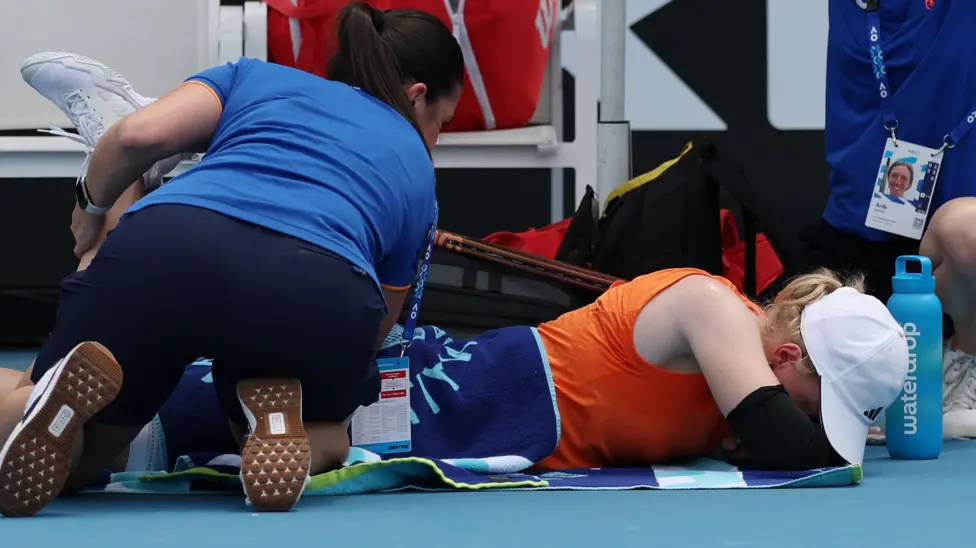
Among the most emotional moments of the opening rounds was the sight of Jones, sobbing beneath a towel as she limped away from the court, her Australian Open dream cut painfully short. Not long after, Felix Auger-Aliassime stood searching for words, beaten not by an opponent but by his own body. Together, their stories captured the fragile line elite athletes walk at the season’s first Grand Slam.
Jones and the Cruel Timing of Australian Open Retirements
There was a sombre hush as Jones made her slow exit. The crowd, sensing the finality of the moment, rose to applaud her sympathetically. She pulled a towel over her head, shoulders shaking, as she walked off — a private heartbreak unfolding in public.
Jones’ presence at the Australian Open was, in itself, a victory long in the making. Born with a rare genetic condition that forces her to play with a modified grip, she has spent her entire career defying expectations. Every win has carried extra meaning; every appearance on a major stage has been earned the hard way.
Just a year ago, her future in the sport looked bleak. A difficult 2024 season saw her ranking slide outside the world’s top 150. At one point, she openly admitted that retirement in 2025 was a real possibility if things didn’t turn around. The grind, the travel, the physical toll — all of it had begun to feel overwhelming.
Then came the season that changed everything.
Jones found form, confidence and belief again. Wins followed. Her ranking climbed. For the first time in her career, she earned direct entry into the Australian Open main draw, no qualifiers, no backdoor routes. It was supposed to be a proud milestone, a moment to savour.
Instead, it became one of the most painful Australian Open retirements of the opening week.
Injuries do not care about narratives or timing. They arrive uninvited, and they do not negotiate. For Jones, the exit felt particularly cruel — a reminder that tennis can give and take away in the same breath.
A Career Defined by Resilience, Not One Match
What made the moment resonate was not just the injury, but the journey behind it. Jones has never taken a straightforward path. Her modified grip, born of necessity rather than choice, has required constant adaptation. Coaches have had to rethink techniques. Opponents have had to adjust to her unorthodox style.
She has lived on the margins of the tour, fighting for ranking points, funding, and belief. That she reached the Australian Open main draw at all felt like validation — proof that persistence still counts in a sport increasingly dominated by power and precision.
This retirement will sting, but it does not erase the progress she made. If anything, the crowd’s response underlined the respect she has earned. Melbourne applauded not just the player leaving the court, but the fighter who refused to disappear quietly.
‘I Don’t Have Answers’ – Auger-Aliassime Left Searching
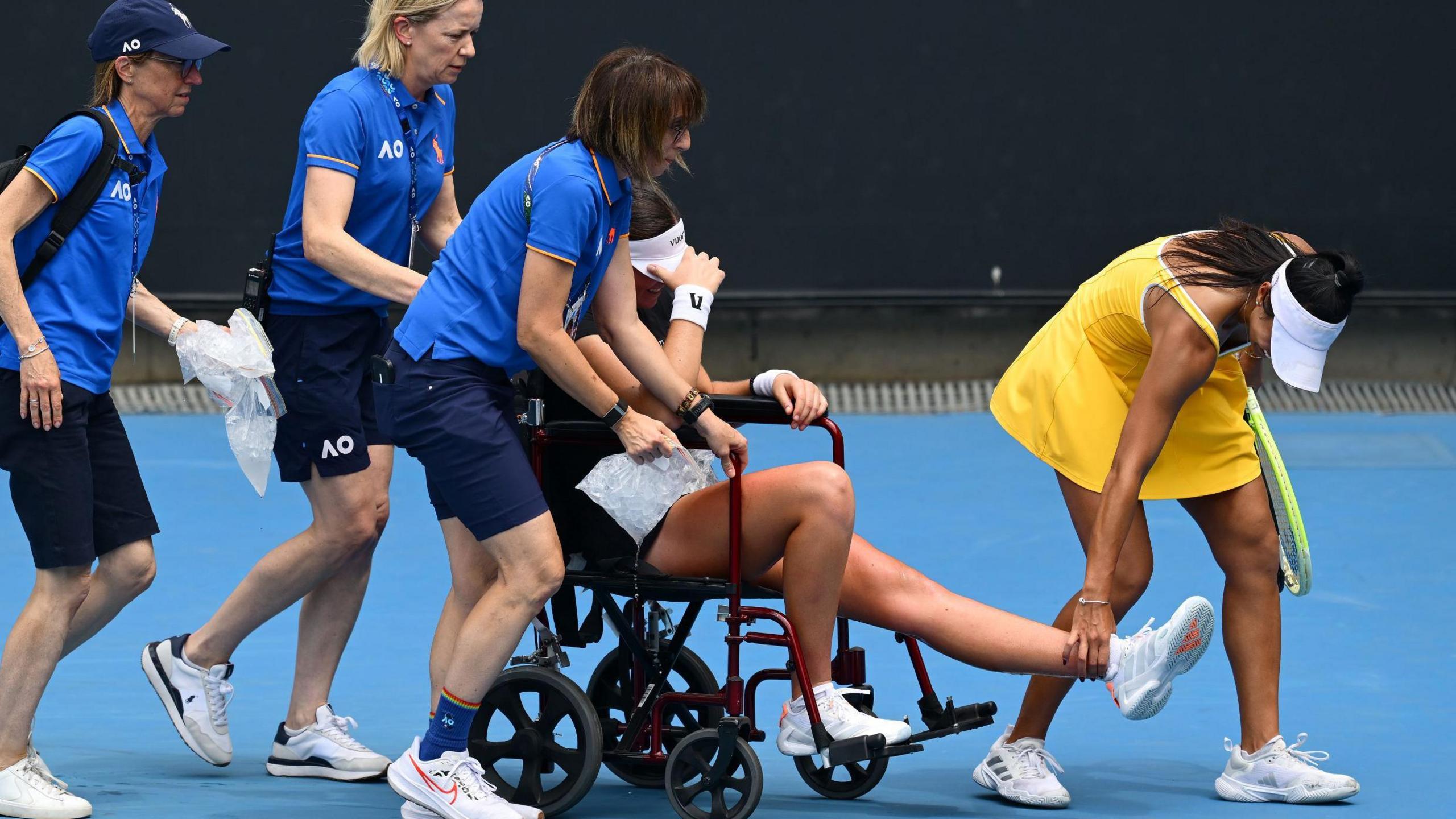
Marina Stakusic is wheeled off court at the Australian Open
While Jones’ exit was heartbreaking, Felix Auger-Aliassime’s retirement was baffling in a different way. The Canadian arrived in Melbourne as one of the men tipped to challenge the dominance of Carlos Alcaraz and Jannik Sinner. His end to last season had been electric — a surge into the world’s top five and a run to the US Open semi-finals suggested he was finally ready to contend at the very top.
Yet by the end of his first-round match, all that promise felt distant.
Auger-Aliassime took the opening set against Portugal’s Nuno Borges, looking sharp and composed. Then, gradually, his movement faded. Cramp crept in. Confidence drained away. Eventually, with the scoreline reading 3-6 6-4 6-4 against him, he was forced to stop.
“I can’t recall ever in my life this happening this early in a tournament, this early in a match,” he admitted afterwards. “I don’t have all the answers now.”
Those words carried more weight than frustration. They hinted at deeper concerns — about preparation, conditioning, and how even elite athletes can be blindsided by their own bodies.
Heat, Expectations and the Fine Margins
The Melbourne heat climbed to 30 degrees Celsius, but by Australian Open standards, conditions were manageable. The tournament’s heat stress scale read just 1.4 out of five — officially labelled “temperature playing conditions”. Players regularly compete in far worse.
Which made Auger-Aliassime’s struggle harder to explain.
Cramp is unpredictable. Hydration, nerves, travel fatigue, pre-season training loads — any combination can tip the balance. But for a player expected to go deep into the draw, an opening-round retirement felt like a shock to the system.
It also reshaped the men’s draw. One contender gone, another reminder that form on paper means little once the body says no.
More Australian Open Retirements as Bodies Give Way
The drama did not end there. Canadian teenager Marina Stakusic also suffered a heartbreaking retirement, her Australian Open debut ending in tears. Ranked 127th in the world, she was locked in a physical battle with Australia’s Priscilla Hon when severe cramp seized her leg in the third set.
Ice treatment failed to ease the spasm. Unable to continue, Stakusic was helped into a wheelchair by medical staff and Hon herself — a moment of sportsmanship amid the disappointment. Trailing 1-6 6-4 5-3, the 21-year-old could only watch as her opportunity slipped away.
These scenes, clustered so early in the tournament, served as a stark reminder: Grand Slams are wars of attrition. Talent gets you here. Durability keeps you alive.
A Tournament That Tests More Than Skill
The Australian Open markets itself as the “Happy Slam”, but beneath the sunshine and smiles lies a brutal truth. It is a tournament that exposes weakness quickly. Bodies are still adjusting after the off-season. Expectations are high. The margins are unforgiving.
For Jones, Auger-Aliassime, and Stakusic, this year’s Melbourne story will be remembered not for what they achieved, but for what they were denied.
Yet tennis moves on, relentlessly. New matches begin. New narratives form. But for those who watched the early Australian Open retirements, the images will linger — a towel over a head, a player searching for answers, a wheelchair rolling quietly off court.
Sometimes, the most powerful moments at a Grand Slam come not from victory, but from vulnerability.


There are no comments yet. Be the first to comment!