











































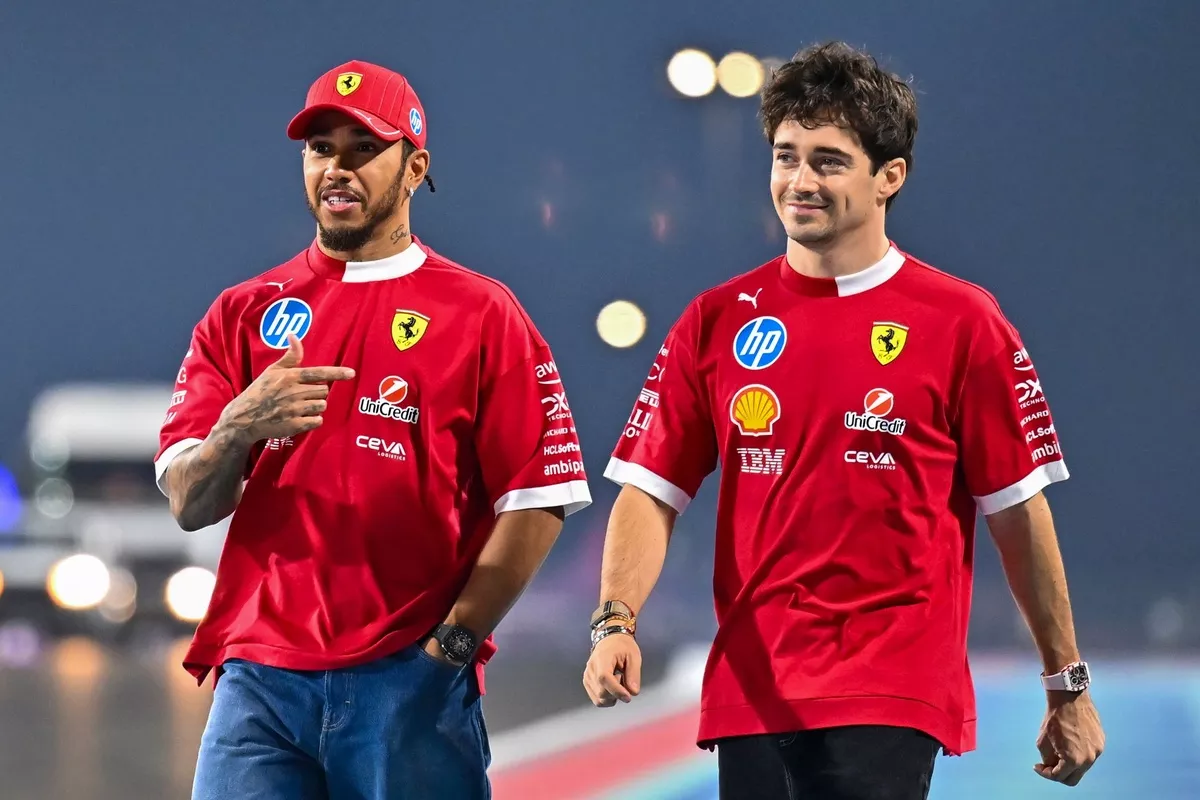
Why Charles Leclerc “Doesn’t Have Advice” for Lewis Hamilton After His First Ferrari F1 Season
Charles Leclerc Explains Why He “Doesn’t Have Advice” for Lewis Hamilton Following a Difficult First Ferrari F1 Season
Lewis Hamilton’s first season in Ferrari red was never going to be simple. When a seven-time world champion leaves the team that shaped over a decade of his career and steps into the most emotionally charged environment in Formula 1, turbulence is almost guaranteed. What perhaps surprised many was not that Hamilton struggled at times, but how exposed those struggles became under the relentless spotlight that follows Ferrari — and Hamilton himself — everywhere.
By the end of the 2025 Formula 1 season, Hamilton’s results told a story that felt unfamiliar. No podium finishes. A string of results hovering between fourth and eighth. A handful of painful Q1 eliminations that only amplified the noise. And a championship position under threat from his own Mercedes successor, teenage prodigy Andrea Kimi Antonelli.
Inside Ferrari, however, the narrative was more nuanced. And no one understood that complexity better than Charles Leclerc.
Empathy Without Interference
Leclerc has been Ferrari’s reference point for years now. He knows the rhythms of Maranello, the pressure cycles, the emotional highs and lows that come with driving for the Scuderia. So when asked about Hamilton’s adaptation struggles, the Monegasque responded with empathy — but also honesty.
“My job is to obviously maximise whatever I can do in my control,” Leclerc explained. “And there’s already so many things I’m focused on for myself, and the team.”
It was not a dismissal of Hamilton, nor a lack of respect. If anything, it was a recognition of reality. At the elite level of Formula 1, even teammates often exist in parallel worlds. Each driver fights his own battle with the car, the engineers, and his own expectations.
Leclerc made it clear that helping Hamilton adjust was not a priority he could realistically take on.

Lewis Hamilton, Ferrari
Why Leclerc “Doesn’t Have Advice” for Hamilton
The line that sparked headlines — “I don’t really have any advice to give him” — might sound cold without context. In truth, it speaks volumes about Hamilton’s stature in the sport.
“Lewis has achieved a lot more than I ever did,” Leclerc admitted. “I don’t really have any advice to give him.”
It was not false modesty. Hamilton arrived at Ferrari as one of the most successful drivers in history, carrying experience from championship-winning teams, legendary engineers, and pressure situations that few drivers ever encounter.
What advice could Leclerc realistically offer? How to win? Hamilton knows that better than almost anyone. How to handle pressure? Ferrari’s pressure is unique, but Hamilton has lived under global scrutiny for over a decade.
What Leclerc hinted at, without saying explicitly, is that adaptation is personal. No two drivers feel a car the same way. No two minds process change identically.
A Season Defined by Adjustment
Hamilton’s move from Mercedes to Ferrari was seismic. Eleven years of muscle memory, habits, communication styles, and trust had to be rebuilt from scratch. New engineers. New terminology. New working culture.
Early signs were encouraging. His sprint race victory in China briefly suggested that the transition might be smoother than expected. But Formula 1 seasons are marathons, not sprints.
As the year unfolded, the gaps appeared. Ferrari’s SF-24 lacked the ultimate performance to fight at the front consistently. Development stalled early, with Ferrari opting not to evolve key concepts beyond April. While the car was relatively consistent, it was consistently short of where it needed to be.
Leclerc acknowledged this bluntly.
“I felt like we did a good job maximising our car throughout the year,” he said. “But the performance of the car is just not good enough.”
The Ferrari Reality
Ferrari is not just a Formula 1 team. It is an institution. Drivers don’t just race cars — they carry expectations, history, and emotion on their shoulders.
Leclerc has had years to internalise that. For him, the relationship with Ferrari feels natural now. Instinctive. Almost subconscious.
“I’ve been here for a long time,” he hinted. “So things feel natural.”
Hamilton, by contrast, was learning that reality in real time. Every radio exchange scrutinised. Every body language moment dissected. Social media narratives suggested tension with race engineer Riccardo Adami, although Ferrari repeatedly insisted the relationship was strong and evolving positively.
Leclerc stayed clear of those discussions. Not out of indifference, but because he understands how misleading the outside noise can be.
Two Drivers, Two Paths
One of the understated truths of Formula 1 is that teammates rarely develop in identical ways. Leclerc’s growth at Ferrari came through years of internal struggle, car limitations, and leadership development. Hamilton’s challenge was different: adapting quickly while the car itself was flawed.
Leclerc’s priority remained singular.
“My focus is making sure that my driving fits the car in the best possible way,” he said.
That might sound selfish, but it’s survival at this level. If a driver loses focus trying to solve someone else’s problems, he risks compounding his own.

Charles Leclerc, Ferrari
Consistency Without Pace
Ferrari’s 2025 season was frustrating in its own way. The team avoided wild performance swings but lacked the raw speed to challenge Red Bull and McLaren. Compared to Mercedes, whom Leclerc described as having “very big ups and bigger downs,” Ferrari’s issue was monotony.
“We’re probably more consistent,” Leclerc admitted. “But unfortunately consistently off the pace.”
That consistency offered stability for Leclerc, but limited Hamilton’s ability to find breakthrough moments. For a driver used to influencing car direction through experience and feedback, the lack of development momentum made adaptation even harder.
The Pressure of Expectations
Hamilton didn’t arrive at Ferrari to be solid. He arrived to win. Anything short of podiums was always going to feel like failure — not just externally, but internally.
Leclerc understands that pressure intimately. He has lived through seasons where Ferrari promised more than it delivered. He knows how quickly optimism can turn into frustration in Maranello.
That shared understanding is perhaps more valuable than advice.
Looking Ahead
Neither driver sees 2025 as a defining verdict. Ferrari’s focus has already shifted toward long-term competitiveness, and both Leclerc and Hamilton remain central to that vision.
For Leclerc, the path forward is clear: extract everything possible, keep pushing, and trust that performance will eventually follow.
For Hamilton, adaptation continues. Not just to the car, but to the rhythm, emotion, and complexity of Ferrari life.
Leclerc summed it up without drama, without judgment.
“I’m focused on my job,” he said. “And Lewis will do what he’s always done — work it out.”
In Formula 1, sometimes the best support isn’t advice. It’s space.


There are no comments yet. Be the first to comment!