

















































































Man Utd & Liverpool Informed of Adam Wharton Transfer Fee Crystal Palace Would ‘Bite Your Hand Off’ For as Ex-Eagles Striker Predicts England Star’s Future
Why Man Utd & Liverpool Have Been Informed of the Adam Wharton Transfer Fee Crystal Palace Would ‘Bite Your Hand Off’ For
There are certain players in the Premier League who don’t need a huge number of headlines to make the right people take notice. Adam Wharton is one of those players.
He’s not the loudest name in the market. He doesn’t play with the kind of social-media flash that instantly turns every touch into a clip. He’s not yet the finished article either, and that’s probably part of the appeal. But if you speak to coaches, scouts, or anyone who values midfield intelligence over empty hype, you’ll hear the same thing over and over again: this kid has serious upside.
That is why Manchester United and Liverpool are both being linked.
That is why Crystal Palace know exactly what they are sitting on.
And that is why the numbers now being mentioned are so revealing.
According to former Crystal Palace striker Clinton Morrison, if a club were to arrive with an offer in the region of £80 million for Wharton, the Eagles would “bite your hand off.” It’s a wonderfully blunt phrase, the kind football people still use when they want to cut through the polished language of transfer speculation and get straight to the point.
And yet, even in that quote, there’s a layer of nuance.
Because while Morrison clearly believes Palace would seriously consider a huge bid, he also sounds convinced that Wharton is more likely than not to remain at Selhurst Park for at least one more season. In other words, the talent is real, the interest is real, the valuation is climbing — but the timing of the move is still up for debate.
That, in many ways, is exactly where Adam Wharton’s career now sits.
He is no longer just a promising young midfielder.
He is now entering that dangerous and exciting phase where potential becomes expensive.
Man Utd & Liverpool Informed of Adam Wharton Transfer Fee as Palace Protect Their Prize Asset
Crystal Palace are not in the business of being naive anymore.
For years, clubs like Palace were expected to produce good players, enjoy them briefly, and then eventually watch them leave when one of the traditional giants came calling. That cycle still exists, of course, but the economics have changed and so has the confidence of well-run Premier League clubs. Palace know they are under no obligation to sell cheaply, and they know the market for elite young English talent can become borderline absurd once multiple top clubs are involved.
Adam Wharton falls squarely into that category now.
He may still be only 22, and there may still be rough edges to his game, but that is exactly what makes him so attractive. Clubs aren’t just buying what he is today. They are buying what he could become at 24, 25, 26 — and if they believe that ceiling is elite, the fee naturally balloons.
That’s why Morrison’s estimate of £60 million to £70 million as a realistic minimum actually sounds pretty reasonable in the current market. Once you factor in age, contract length, homegrown status, Premier League experience, and England potential, those numbers stop sounding inflated and start sounding familiar.
And then there’s the key detail: Palace have him tied down until 2029.
That changes everything.
A long-term contract doesn’t just give a club security — it gives them power. It means they are negotiating from a position of calm, not panic. There is no countdown clock forcing them into a compromise. There is no financial emergency compelling them to cash in early. If they choose to sell, it will be because the offer becomes too good to ignore, not because they have to.
That is exactly why the “bite your hand off” line matters.
It doesn’t mean Palace are desperate.
It means they know what the top end of the market looks like.
If someone genuinely puts £80 million on the table for Adam Wharton, that’s no longer a routine enquiry. That’s the sort of number that forces every club outside the established financial elite to at least sit down and think.
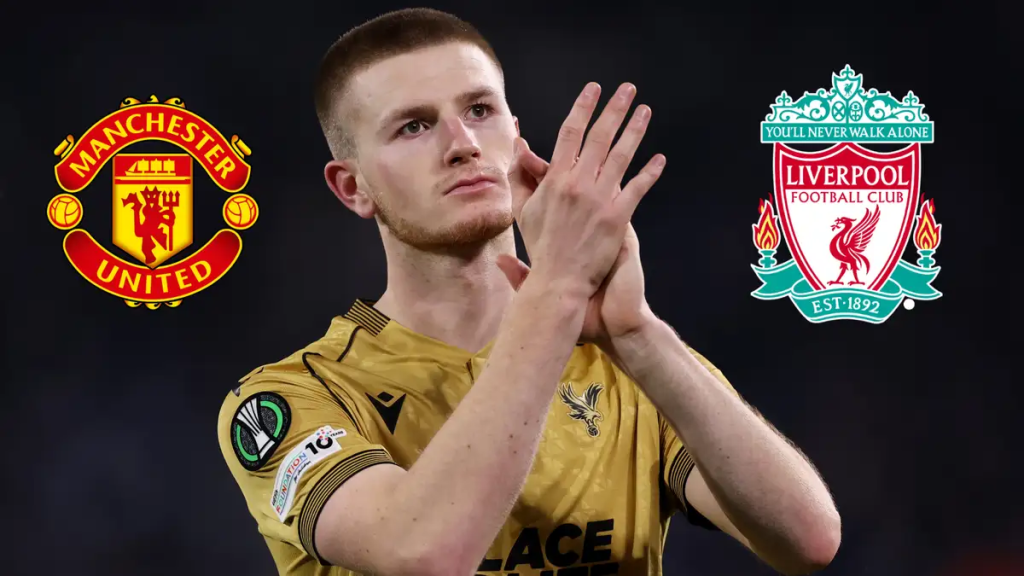
Why Manchester United Are Circling Adam Wharton
Manchester United’s interest makes sense on almost every level.
This is a club that continues to search for midfield clarity. Even when United spend heavily, there always seems to be another unresolved question in the engine room. The squad has often looked imbalanced in recent seasons — too open in transition, too dependent on individual inspiration, or simply too vulnerable when the tempo rises against them.
That is why Wharton’s name is interesting.
He is not the kind of midfielder who solves everything overnight, but he is the kind of player who can improve the shape of a team. He plays with maturity beyond his years, sees passes early, and has a calmness in possession that stands out immediately. He doesn’t look rushed. He doesn’t look panicked. And in a league where midfield can become chaotic very quickly, that kind of composure is worth serious money.
United are also expected to reshape that area of the squad in the coming months.
Casemiro’s future continues to be a major talking point, and while the Brazilian remains a decorated and intelligent footballer, the sense has been growing for some time that his cycle at Old Trafford is nearing its natural end. Then there is the ongoing uncertainty around Bruno Fernandes — not necessarily because he lacks quality, but because when a club enters another phase of rebuild, every major player becomes part of the conversation.
Wharton wouldn’t be a like-for-like replacement for either man, but that’s not really the point.
He would represent a different type of investment: younger legs, long-term growth, and the chance to build a midfield identity that feels less improvised and more sustainable. In that sense, he could be one of those signings that looks sensible now and even smarter two years from now.
And if United really are serious, they will know they cannot wait forever.
The moment a player like Wharton starts to look like an England World Cup squad member, the price doesn’t stay still.
Liverpool’s Interest Feels Equally Logical
Liverpool being in the conversation is no surprise either.
If anything, Wharton looks like the sort of midfielder Liverpool would naturally admire: technically secure, tactically intelligent, capable of moving the ball quickly, and young enough to be developed within a high-level environment. He’s not the finished article, but that has rarely frightened Liverpool when they believe the player’s football IQ is strong enough.
What makes the Liverpool angle especially intriguing is the way they tend to think about squad evolution.
At Anfield, recruitment is often less about plugging the most obvious hole and more about identifying the next stage of a player before everyone else agrees on the ceiling. That doesn’t mean they always get it right, but it does mean they are comfortable investing in profiles rather than just reputation.
Wharton fits that approach beautifully.
He has the kind of understated quality that grows on you the more you watch him. He doesn’t dominate matches through spectacle. He influences them through rhythm. Through timing. Through clean decision-making. Through the little moments that serious midfielders understand and casual viewers sometimes miss.
Those players can look even better in strong teams.
Put him next to high-level runners, better spacing, and a side that dominates more possession, and suddenly the qualities become louder. That is probably part of why the biggest clubs are sniffing around now. They can already imagine the upgraded version.
And Liverpool, like United, know the homegrown market is brutal.
If you wait until the player becomes fully established at international level, the premium only gets uglier.
Crystal Palace Would Be Reluctant Sellers — But Every Player Has a Price
The most important thing in all of this is that Crystal Palace do not appear eager to sell.
That should not be overlooked.
This is not a club actively preparing the fanbase for a departure. This is not a situation where the player is entering the final years of a deal and leverage is shifting. Palace are in a strong contractual position, they have already lost major names in recent windows, and there is a clear understanding internally that too much turnover can destabilise an entire project.
That is why Morrison’s comments are actually quite balanced.
He believes Wharton will likely still be a Palace player next season.
He also believes massive money changes the equation.
Both things can be true.
Palace have already seen players like Eberechi Eze and Marc Guehi move on in recent windows, and while selling well is part of the modern Premier League model for clubs outside the top bracket, there is always a tipping point. Lose too many pillars too quickly, and the entire sporting project starts to wobble. Keep too many for too long, and you risk missing the peak market moment.
This is the dance clubs like Palace constantly have to perform.
With Wharton, the temptation to hold firm is obvious. He is young, improving, tied down long-term, and clearly trusted as part of the club’s medium-term vision. But if a giant club comes with a fee north of £70 million, particularly edging toward £80 million, that becomes a different conversation entirely.
At that level, you are not just selling a midfielder.
You are potentially funding multiple squad moves.
You are reshaping the club’s next two windows.
You are taking a development success story and turning it into strategic capital.
That’s why Morrison’s “bite your hand off” line lands so hard.
Because in modern football, even the most reluctant sellers eventually have a number.
England Ambitions, European Football, and Why Timing Matters
One of the more fascinating parts of Wharton’s situation is that his immediate football logic may not actually demand a transfer just yet.
There is a strong case for staying.
At Palace, he is playing regularly, learning fast, and developing in an environment where he is not yet crushed by the weekly hysteria that comes with a move to Old Trafford or Anfield. He is not being asked to carry the identity of a giant club. He can make mistakes. He can grow. He can discover the next layers of his game without every pass becoming a national debate.
That matters a lot for a 22-year-old midfielder.
Midfield is not a position where hype alone survives. You need reps. You need difficult moments. You need games where you learn how to control tempo, survive pressure, and understand what top-level football really asks of you over 90 minutes, not just in highlight clips.
Wharton is getting that now.
And there’s another factor: England.
If he can continue his trajectory, stay healthy, and keep earning trust, there is a very real path toward becoming part of Thomas Tuchel’s World Cup plans. That would be enormous for him, and for Palace too. Once a young English midfielder becomes a realistic World Cup squad player, the market reacts instantly. Fees rise. Competition intensifies. Negotiating power shifts even further toward the selling club.
In other words, Palace may actually benefit from waiting.
And so might Wharton.
Morrison hinted at that too. His view seems to be that the move will come eventually — maybe to one of the top four or five clubs, maybe to European football, maybe even this summer if the right offer arrives — but there is no rush to force the jump before the player is truly ready.
That feels like sensible football thinking.

Final Word: Adam Wharton Looks Destined for the Top — The Only Question Is When
There’s always a moment in a young player’s career when the noise stops being speculative and starts becoming expensive. Adam Wharton is there now.
Manchester United are watching.
Liverpool are watching.
England are watching.
Crystal Palace are watching the market very carefully.
And somewhere in the middle of all that, a 22-year-old midfielder is quietly becoming one of the most interesting transfer stories of the summer.
The headline number is eye-catching, of course. £60 million, £70 million, maybe even £80 million if the bidding gets serious. Those are huge figures for a player still learning the game. But modern football doesn’t price players on present comfort alone. It prices trajectory, scarcity, profile, and the fear that someone else will get there first.
Wharton ticks all the boxes.
He’s young.
He’s homegrown.
He’s technically excellent.
He has Premier League pedigree.
He looks built for more.
And crucially, he still feels like a player whose best football is ahead of him.
That is exactly the kind of talent elite clubs overpay for.
Will he leave this summer? Maybe.
Will Palace fight to keep him? Absolutely.
Would they seriously consider a monster offer? Without question.
For now, the smartest prediction is probably the simplest one: Adam Wharton’s future is not in doubt — only the timing is.
Whether it’s this summer or the next, he looks like a player destined to make that leap.
And when he does, nobody will be talking about whether the interest was real.
They’ll be talking about who blinked first.


There are no comments yet. Be the first to comment!