





Vincent Kompany Bayern Munich: A Glimpse of Football After Guardiola?
Are Kompany’s Bayern Munich the Blueprint for Football After Guardiola?
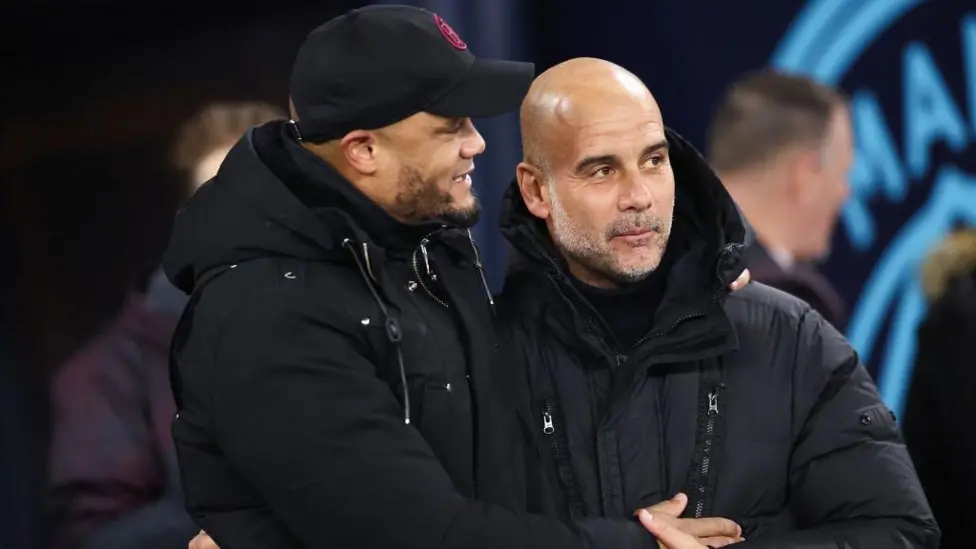
There’s a certain symmetry to it all. A former captain shaped under one of the most influential coaches of modern football now stepping into the spotlight, not as a successor just yet, but as a thinker in his own right.
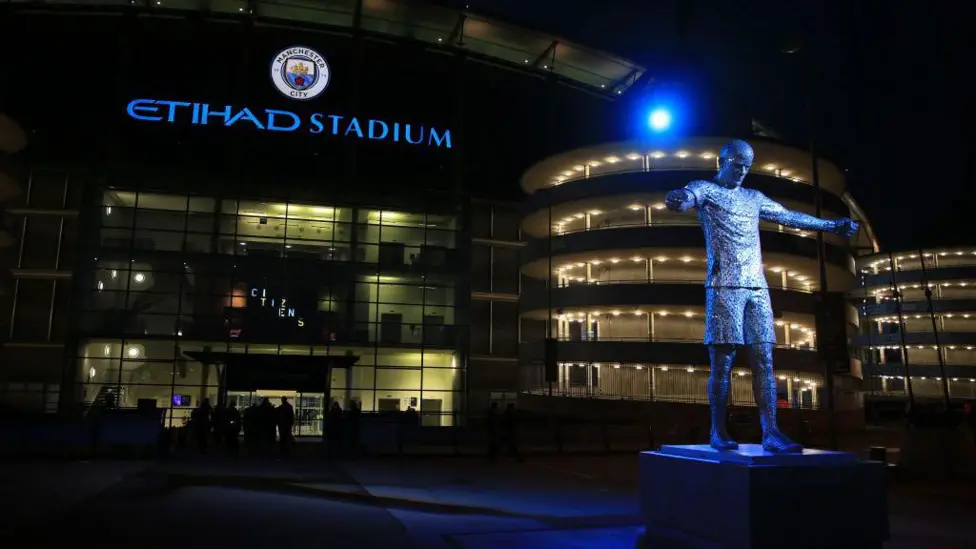
Vincent Kompany has never done things the easy way. Not as a player, where he built his legacy at Manchester City, and certainly not as a coach, where his journey has already taken a few unexpected turns. His appointment at Bayern Munich raised eyebrows for a reason. Relegation with Burnley doesn’t usually lead to one of the biggest jobs in world football.
And yet, here we are.
A Bundesliga title already secured last season, another one within reach, and a UEFA Champions League campaign that has started to turn heads—not just because of results, but because of how those results are being achieved.
The bigger question now feels unavoidable: are we watching the early stages of football’s next tactical evolution? And is Kompany quietly sketching out what the game might look like after Pep Guardiola?
From Guardiola’s Influence to Kompany’s Identity
It would be easy—lazy, even—to frame Kompany purely as Guardiola’s disciple.
Yes, he absorbed a lot during his years at City. Positional play, structured build-up, the idea that control begins from the first pass out of defence. Those principles are still there, visible in Bayern’s DNA.
But watch them closely, and something feels… different.
Where Guardiola’s teams often lean towards calculated control, Kompany’s Bayern embrace a touch more chaos. Not recklessness, but a willingness to destabilise games, to stretch structures, to invite moments that feel slightly unpredictable.
It’s still positional football, but with a looser grip on the script.
And that’s where it gets interesting.
Movement, Rotation and Controlled Chaos
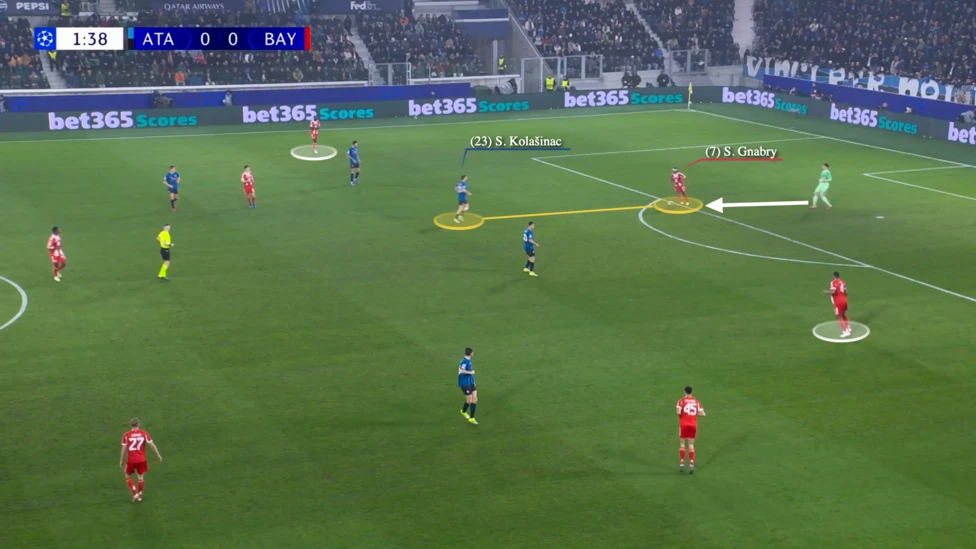
If there’s one defining feature of this Bayern side, it’s movement—constant, deliberate, and often disorienting for the opposition.
Against Atalanta in the Champions League knockout rounds, the idea was taken to its extreme. Man-to-man marking, usually designed to simplify defensive responsibilities, became a trap.
Players rotated relentlessly.
Serge Gnabry drifting into defensive zones. Midfielders appearing on the last line. Attackers pulling markers into spaces they had no business occupying.
The result? Defensive structures collapsing under their own logic.
Atalanta’s defenders found themselves chasing shadows, their attackers dragged into areas they couldn’t control. The aggregate scoreline—10-2—only told part of the story. The real damage was structural.
It wasn’t just dominance. It was manipulation.
Bayern Munich vs Real Madrid: A Tactical Chess Match
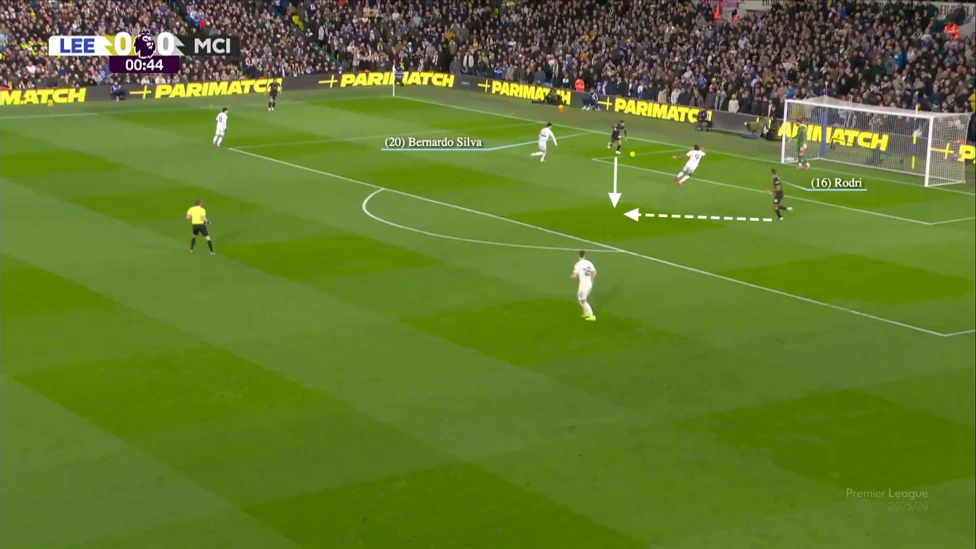
The real test, though, came against Real Madrid.
Different challenge. Different level of opponent. And a different kind of game.
In the first leg, Kompany’s Bayern showed another layer to their identity. Less chaos, more precision—but still rooted in flexibility.
Take the build-up phase.
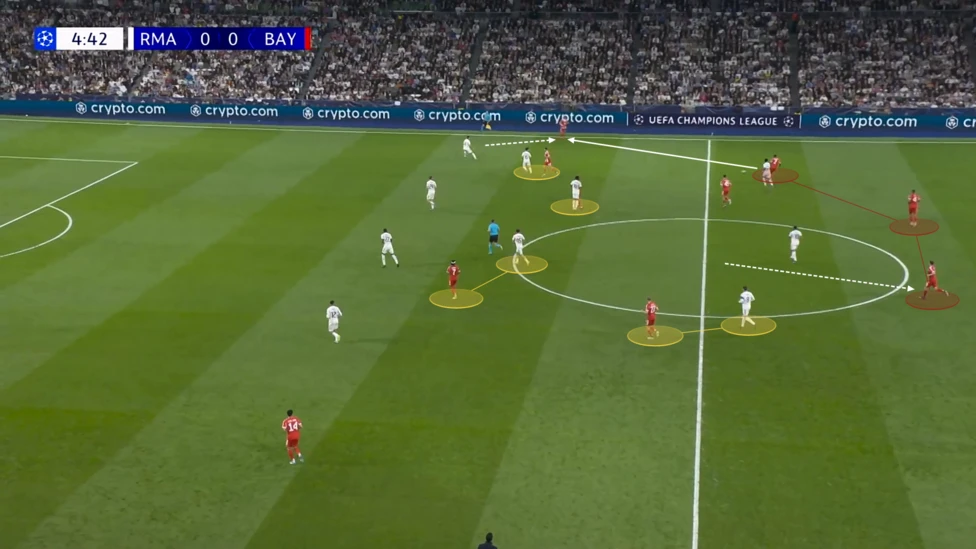
Against Madrid’s front two—Vinicius Junior and Kylian Mbappe—Joshua Kimmich dropped into the defensive line, creating a temporary back three. Simple on paper. Effective in execution.
It created overloads. Forced decisions. Opened angles.
Then came the next layer.
Full-backs drifting inside. Wingers holding width. Midfielders adjusting their positioning depending on pressure.
Suddenly, Madrid’s shape—normally so compact—started to stretch.
And in that stretching, spaces appeared.
The Role of Directness in a Possession System
One of the most intriguing aspects of Kompany’s Bayern is how they balance control with directness.
Possession isn’t just about recycling the ball. It’s about creating moments.
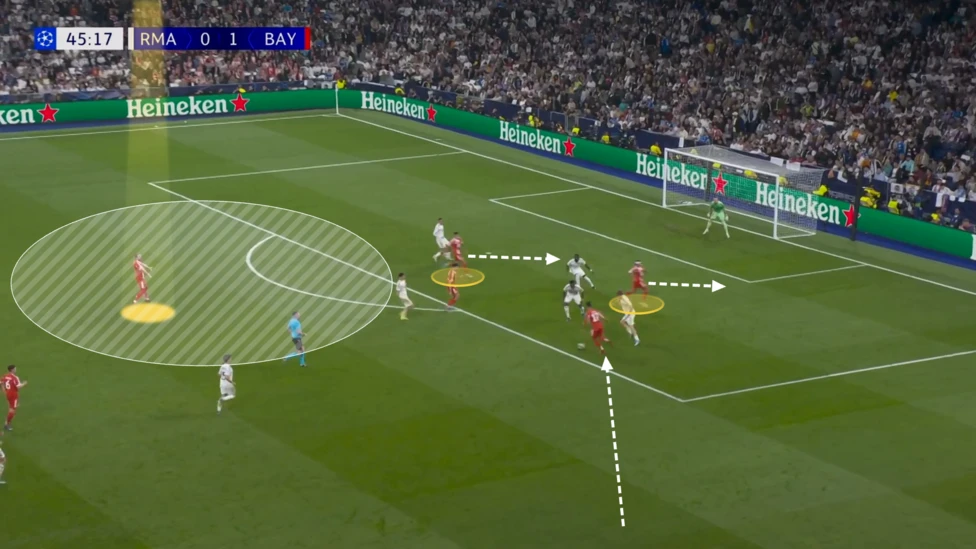
Michael Olise embodies that idea perfectly. Receiving wide, often in space created by the movement inside, he doesn’t hesitate. He drives. Attacks. Forces defenders to retreat.
Alongside him, Luis Diaz provides relentless running in behind, stretching the line vertically. And then there’s Harry Kane—the connector.
Dropping deep. Linking play. Arriving late.
For Bayern’s second goal against Madrid, all those elements came together. The dribble. The runs. The space opening just enough for Kane to operate at the edge of the box.
It looked simple.
It wasn’t.
Pressing With Purpose, Defending With Flexibility
Out of possession, Bayern are just as fascinating.
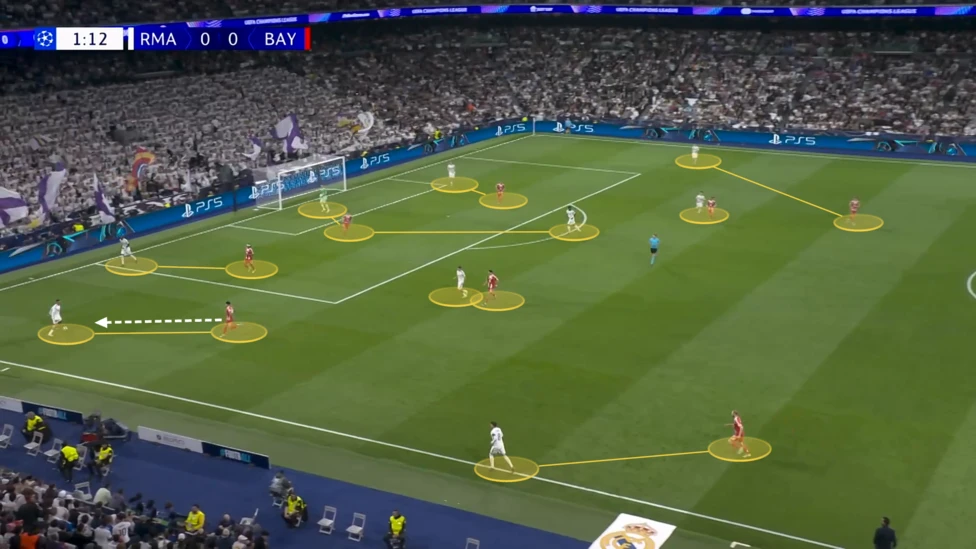
They’ll press man-to-man high up the pitch, aggressively, almost daring opponents to play through them. But unlike teams that commit fully to that idea, Kompany’s side can shift gears.
Quickly.
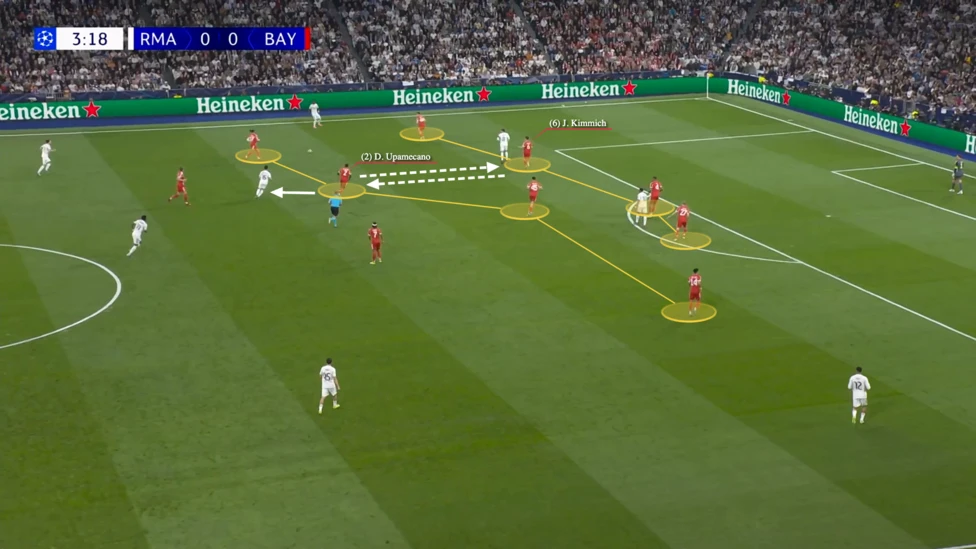
When the press is broken, they drop into more conventional shapes—4-4-2, sometimes even a 5-2-3—without losing their structure.
It’s not rigid. It’s reactive.
Against Real Madrid, this adaptability was key. At times, Bayern funnelled play into specific areas, setting pressing traps. At others, they sat deeper, compact, disciplined.
And crucially, even within that structure, players weren’t afraid to follow opponents into unusual zones—because they trusted the system behind them to cover.
That trust is everything.
Is This Football After Guardiola?
So, back to the original question.
Are Kompany’s Bayern a glimpse at football after Guardiola?
Maybe not in a direct, linear sense.
But they do feel like a natural evolution.
The principles remain—positional awareness, build-up play, control—but they’re being stretched, reinterpreted, adapted to a game that is increasingly chaotic, increasingly physical, increasingly fast.
Kompany isn’t replacing Guardiola’s ideas.
He’s bending them.
Adding layers. Taking risks. Accepting that control in modern football might look a little less… controlled.
A Manager Defining His Own Era
For now, it’s still early.
Trophies matter. Longevity matters. Sustained success at the very top is the ultimate test.
But what Kompany has already done at Bayern Munich suggests something significant is taking shape.
Not just a winning team.
But a team that feels like it belongs to the next phase of the game.
And maybe, just maybe, when the Guardiola era eventually fades, the blueprint won’t come from imitation.
It will come from evolution.
And Kompany might already be a step ahead.


There are no comments yet. Be the first to comment!