






































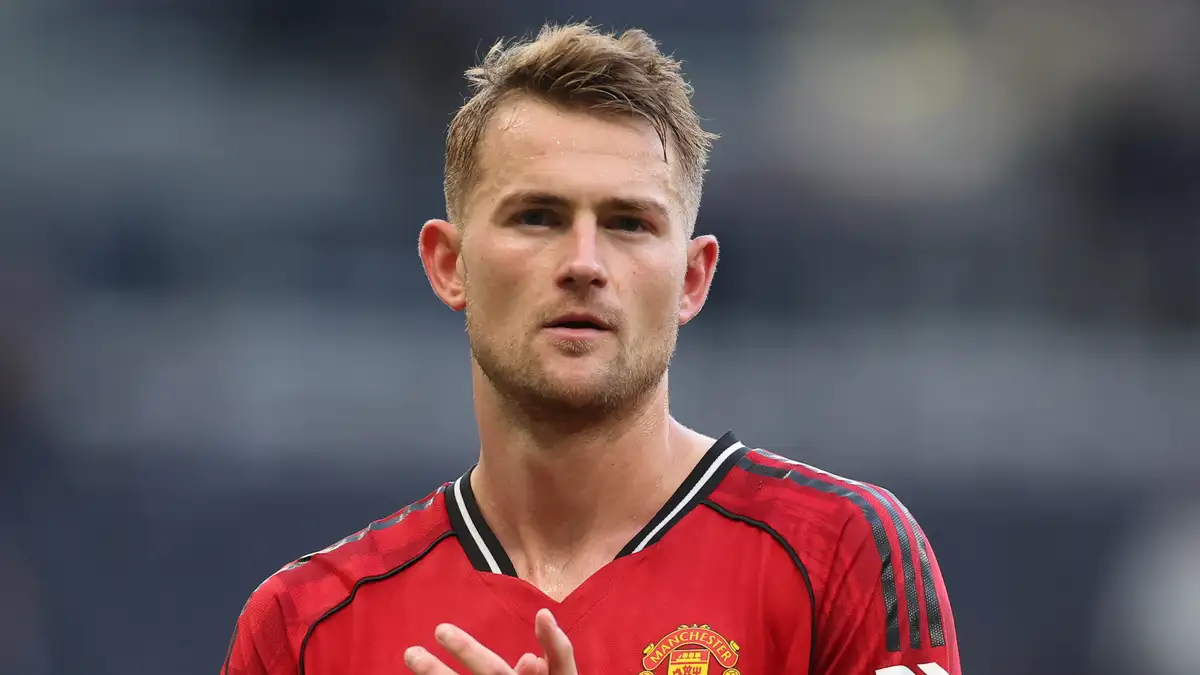
Matthijs de Ligt Targeting Man Utd Return Before Season Ends as ‘Complicated’ Back Injury Shows Signs of Improvement
Matthijs de Ligt Targeting Man Utd Return Before Season Ends With ‘Complicated’ Back Injury Improving
There are some injuries in football that come with a clear timeline.
A hamstring strain? Six weeks, maybe eight. A rolled ankle? Depends on the swelling, but clubs usually have a decent idea. A muscle tear, a minor ligament issue, even a broken bone — brutal as those can be, they often come with a structure. A date to aim for. A target. A sense of order.
Back injuries are different.
Back injuries can lie to you.
They can feel manageable one day and flare up again the next. They can look minor on paper and become a months-long frustration in reality. They can stall momentum, drain confidence and turn what was supposed to be a short absence into one of those long, strange recoveries that seem to drift without warning.
That, in many ways, has been the story of Matthijs de Ligt’s season.
What initially looked like a brief setback has become a four-month battle, one that has kept the Manchester United defender away from competitive football since late November and left the club repeatedly cautious about promising too much, too soon. Yet despite the stop-start nature of the recovery and the understandable uncertainty surrounding a “complicated” back problem, there is now a growing sense that the Dutchman may yet have one final chapter to write before the 2025-26 campaign closes.
And for United, that possibility matters more than it might seem.
Because this is not just about getting another centre-back back on the grass.
It is about restoring one of the side’s most dependable defenders at a time when every point, every clean sheet and every late-season margin could prove decisive.
Why Matthijs de Ligt’s Potential Man Utd Return Before the Season Ends Matters So Much
For a player who has only been at Manchester United a relatively short time, De Ligt has quickly become one of those figures whose absence changes the shape of the team more than the headlines sometimes reflect.
He is not always the loudest personality in the squad.
He is not the flashiest defender in the league.
He is not the kind of player who trends every week for outrageous stepovers or dramatic social media clips.
But he is exactly the sort of footballer top teams quietly rely on.
Before his injury, he had been an ever-present in United’s opening 13 Premier League matches. That tells its own story. Managers rotate when they can. They protect players when the calendar gets heavy. They tweak combinations based on opponents. But when a defender starts every league game at the beginning of a season, it usually means one thing: the manager trusts him.
Completely.
De Ligt had quickly become that kind of presence.
Reliable in the air, physically imposing without being reckless, strong in duels, and increasingly comfortable as the organiser in the back line, he brought a level of authority that often goes unnoticed until it disappears. Manchester United have had periods this season where they have still found ways to win, and their position near the top of the table reflects that. But anyone watching closely knows there have also been stretches where the defensive line has looked a little less certain, a little less natural, and a little more vulnerable in moments that De Ligt might normally help manage.
That is the hidden cost of a long-term absence.
It is not always about the individual.
It is about what the rest of the team becomes without him.
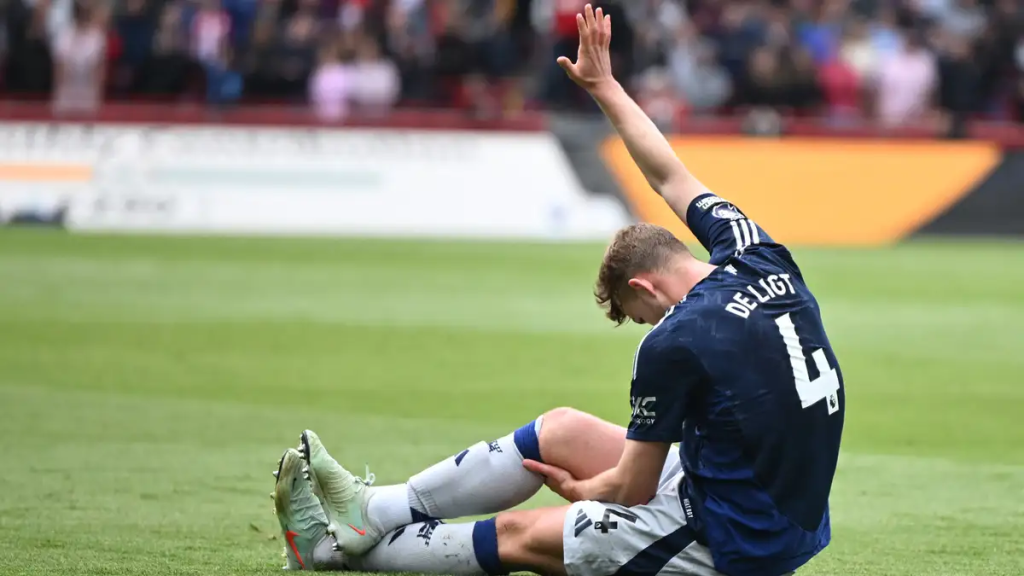
The ‘Complicated’ Back Injury That Changed De Ligt’s Season at Man Utd
The word “complicated” is doing a lot of work here — and probably accurately so.
Because what started as something that initially looked relatively minor has become one of those nagging, stubborn injuries that no club ever wants to see attached to a central defender. The expectation at first had reportedly been that De Ligt would only miss around a week. Instead, he has now spent roughly four months on the sidelines.
That kind of gap tells you everything.
When an injury blows past its first estimate by that much, it usually means the problem is either more delicate than first thought, slower to settle, or more unpredictable in how the player responds to each stage of rehab. In the case of a back issue, it can often be all three at once.
And that is why Michael Carrick has been so cautious whenever the subject comes up.
The United interim manager has not tried to offer false hope or tidy timelines, and to be fair, that is probably the right approach. Supporters always want dates. They want “two weeks”, “back after the break”, “fit for the derby”. But with back injuries, certainty can become misleading very quickly.
Carrick’s comments reflected exactly that reality.
He admitted it was “difficult to say” when De Ligt would return, largely because the recovery has already taken much longer than anyone expected. More importantly, he pointed to the frustrating nature of back problems themselves — the way a player can seem fine, only for something not to feel right again without warning.
That is not a manager being vague.
That is a manager being honest.
And in football, honesty around injury is often rarer than it should be.
Signs of Improvement Give Manchester United and Matthijs de Ligt Real Hope
The encouraging part now is that there finally seems to be movement.
Not dramatic movement.
Not the kind where a player suddenly appears in first-team training and fans start circling a comeback fixture on the calendar.
But real movement all the same.
Reports suggest De Ligt’s back issue is improving, and just as importantly, the player himself remains optimistic about returning before the end of the season on May 24. That optimism matters. Players usually know their own bodies better than anyone, especially after months of repetitive rehab, setbacks, daily treatment and endless conversations with physios. If De Ligt believes there is still a realistic path back before the campaign closes, that is a sign the internal mood around his recovery has shifted at least slightly in the right direction.
He is still undergoing intensive treatment at Carrington.
He has not yet returned to grass-based work.
And that detail is important, because it means nobody should expect an immediate comeback.
But recovery is rarely linear, especially with a back injury. Sometimes the biggest step is not a dramatic one. Sometimes it is simply reaching the point where the pain is finally settling enough to make the next phase possible.
That may be where De Ligt is now.
And for a player who was once feared to be done for the season entirely, that is no small development.
Man Utd’s Run-In Makes a Matthijs de Ligt Return More Valuable Than Ever
Timing is everything in football.
A player can return in September and be eased back quietly.
A player returning in late April or May enters a completely different atmosphere.
There is no gentle reintegration at that point.
Every match feels heavier. Every mistake feels louder. Every dropped point seems to reshape the table. And for Manchester United, that tension is very real right now.
They sit third, but only just.
Aston Villa are only a point behind in fourth, which means the margin for error is thin. The difference between finishing strongly and stumbling late could mean more than pride. It could affect momentum, perception, summer planning, and depending on the wider context, potentially even European positioning.
That is why De Ligt’s possible return matters.
Not necessarily because he would walk straight back into 90-minute starts — that would be unrealistic after such a long layoff — but because his availability alone would change things. It would give Carrick another trusted option. It would allow smarter rotation. It would restore a measure of leadership at the back. It would reduce the strain on others who have had to carry the load for months.
And if he can return for even two or three matches in the final stretch, those appearances could be significant.
Sometimes, at this stage of the season, a defender does not need to play every game to make an impact.
He just needs to be there when the big moment comes.
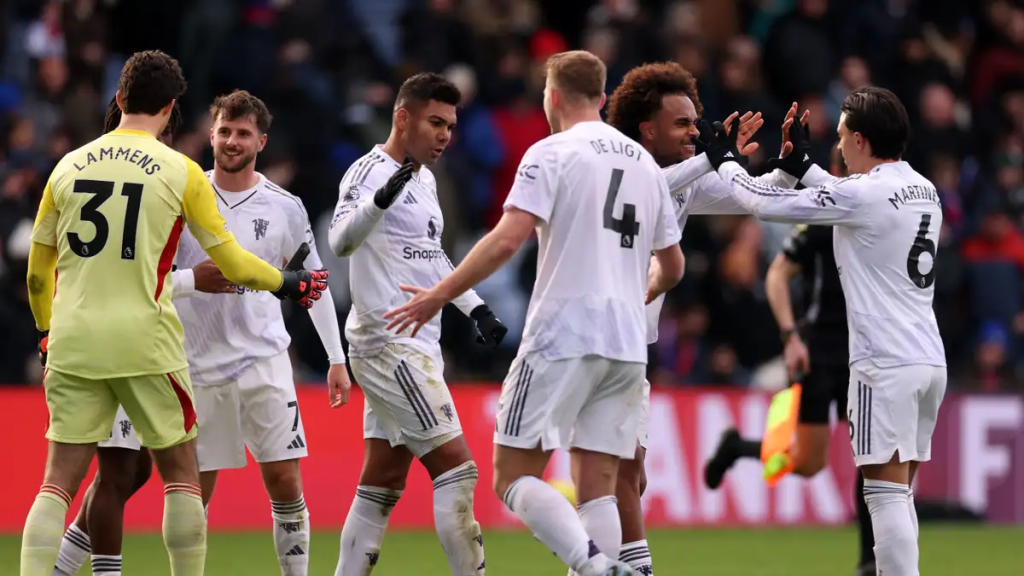
Carrington, Patience and the Reality of a Long Rehab
One thing modern football fans do not always see is how mentally exhausting long rehab can be.
For a player like De Ligt — someone used to rhythm, structure and the physical certainty of regular match action — four months can feel endless. Especially when the injury is not a clean, dramatic one with a simple script. A back issue forces patience. It asks for trust. It asks the player to respect days when nothing seems to move forward and to avoid the temptation to rush because the pain is “not too bad” that morning.
That can be maddening.
Every footballer wants to feel useful.
Every footballer wants to be with the group.
And every footballer, especially one who had nailed down a starting place, wants to avoid watching too much of the season from the treatment room.
Carrington becomes your world in those stretches.
Treatment.
Gym work.
Mobility.
Core stability.
Monitoring.
Repeat.
That cycle can wear on even the strongest professionals. Which is why De Ligt’s determination to still target a return before the season ends says something positive about his mindset. He has not mentally checked out of the campaign. He has not accepted that his year is over. He is still chasing the chance to contribute.
That matters inside a dressing room.
Players notice that.
Staff notice that.
Managers definitely notice that.
The Netherlands Angle: Can De Ligt Still Force His Way Into World Cup Thinking?
There is also the international subplot, and while it may be a long shot, it is impossible to ignore.
If De Ligt can get back before the season ends, even for a handful of appearances, he at least gives himself a fighting chance to re-enter conversations around the Netherlands setup ahead of the 2026 World Cup. That may sound ambitious after such a lengthy absence, and realistically, it probably is. A defender missing four months and returning late is never in an ideal position when national team squads are being shaped.
But football changes quickly.
A strong return, even brief, can alter perception.
A fit De Ligt with form in his legs is a very different proposition to an unavailable De Ligt with question marks over his physical state. And given his pedigree, experience and previous standing with the Dutch national team, it would be foolish to completely rule him out if he can prove his body is responding again.
That may not be the primary motivation right now.
Right now, the first goal is simply getting back on the pitch.
But elite players always think in layers.
Club comeback first.
Then rhythm.
Then selection.
Then bigger dreams.
What Comes Next for Matthijs de Ligt and Manchester United?
The next key milestone is obvious: grass work.
Until De Ligt returns to outdoor training, everything remains cautious and conditional. It is encouraging that the back issue is improving, but the real turning point in recoveries like this usually comes when the player can begin football-specific movement again — turning, sprinting, decelerating, opening the body, absorbing contact, and rediscovering the small physical demands that gym rehab cannot fully replicate.
Once that happens, the picture becomes clearer.
If he handles that phase well, team training becomes possible.
If team training becomes possible, then a bench appearance starts to feel realistic.
And once a player is back on the bench, momentum can build quickly.
United’s next focus is the post-international-break clash with Leeds United, but that may come too soon depending on where De Ligt is physically. The more realistic target may be somewhere in the final cluster of fixtures, where even a managed reintroduction could still make a difference.
That will be the hope.
Not a rushed return.
Not a desperate gamble.
A smart one.
Because the last thing anyone wants is for a complicated back injury to become even more complicated.
Final Word: Matthijs de Ligt Is Targeting a Man Utd Return Before the Season Ends — and That Alone Is a Lift
A few weeks ago, the mood around Matthijs de Ligt’s injury was darker.
There was a genuine fear his season was finished.
A back problem that was supposed to be brief had dragged on for months. The updates stayed vague. The timeline kept slipping. And the longer it went, the more it began to feel like one of those absences that simply never resolves in time.
Now, there is at least a different tone.
Still cautious.
Still careful.
Still far from guaranteed.
But different.
De Ligt’s “complicated” back injury is improving. He remains optimistic. Manchester United are not rushing him, but they have not ruled him out. And with seven games still to play, there is just enough space left in the calendar for one final contribution if the next stage of rehab goes well.
That would be a welcome boost for Carrick.
A timely lift for United.
And, on a personal level, a deserved reward for a player who has spent four long months fighting through one of football’s most frustrating kinds of injury.
No one should expect miracles.
But the door, which once looked closed, now seems slightly open again.
And for Matthijs de Ligt, that may be all the encouragement he needs.


There are no comments yet. Be the first to comment!