

































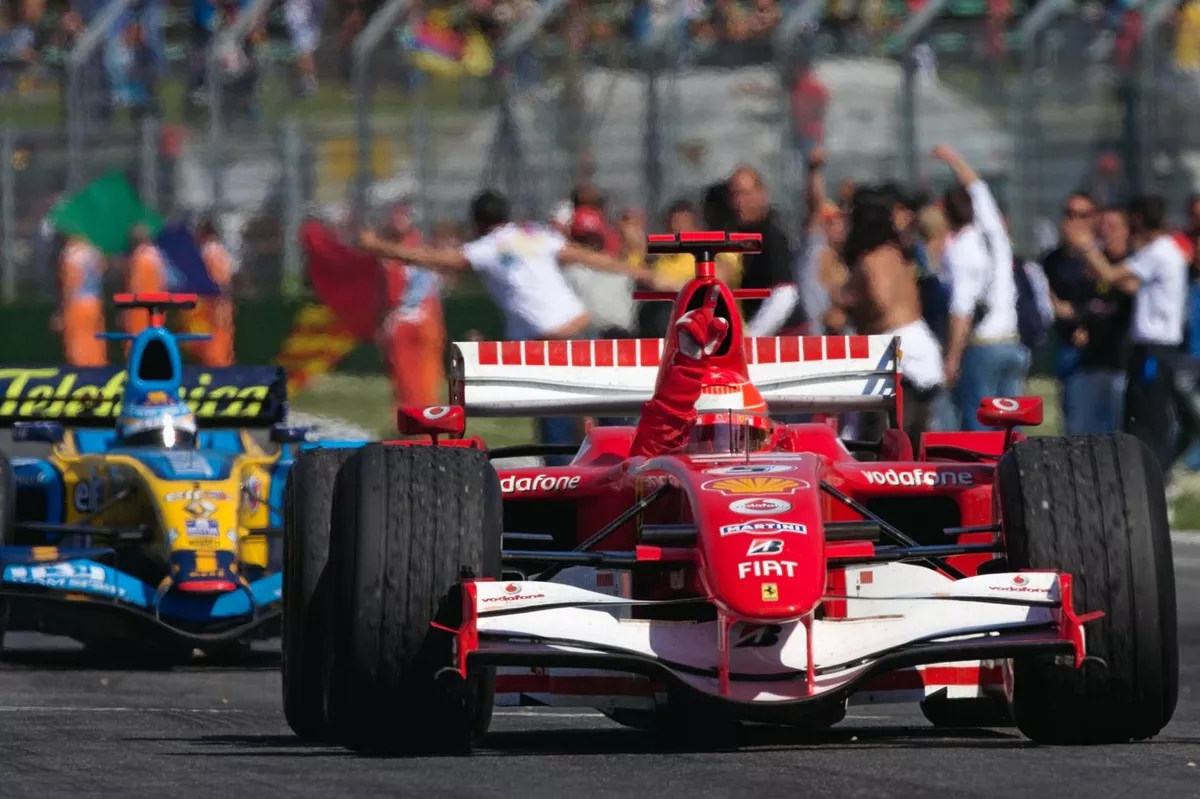
20 years ago, Michael Schumacher held off Fernando Alonso in Imola F1 duel
20 years ago, Michael Schumacher held off Fernando Alonso in Imola F1 duel
There are certain Formula 1 races that don’t just belong to a season—they belong to history. The 2006 San Marino Grand Prix at Imola is one of those afternoons that still feels vivid even two decades later, not because of chaos or controversy, but because of the sheer purity of a fight between two generations.
On one side, Michael Schumacher—already a seven-time world champion, racing at a circuit where he had built much of his legend. On the other, Fernando Alonso—the reigning champion, young, sharp, and increasingly confident that the era was shifting in his direction.
What unfolded over 62 laps was less a race and more a chess match at 300 km/h. A duel shaped by strategy, tyre management, timing, and nerve.
And in the end, it was Schumacher who held firm.
A rematch of a modern classic rivalry
The story in Imola didn’t begin in 2006. To understand it properly, you have to go back a year earlier, to 2005, when the balance of power in Formula 1 was beginning to tilt.
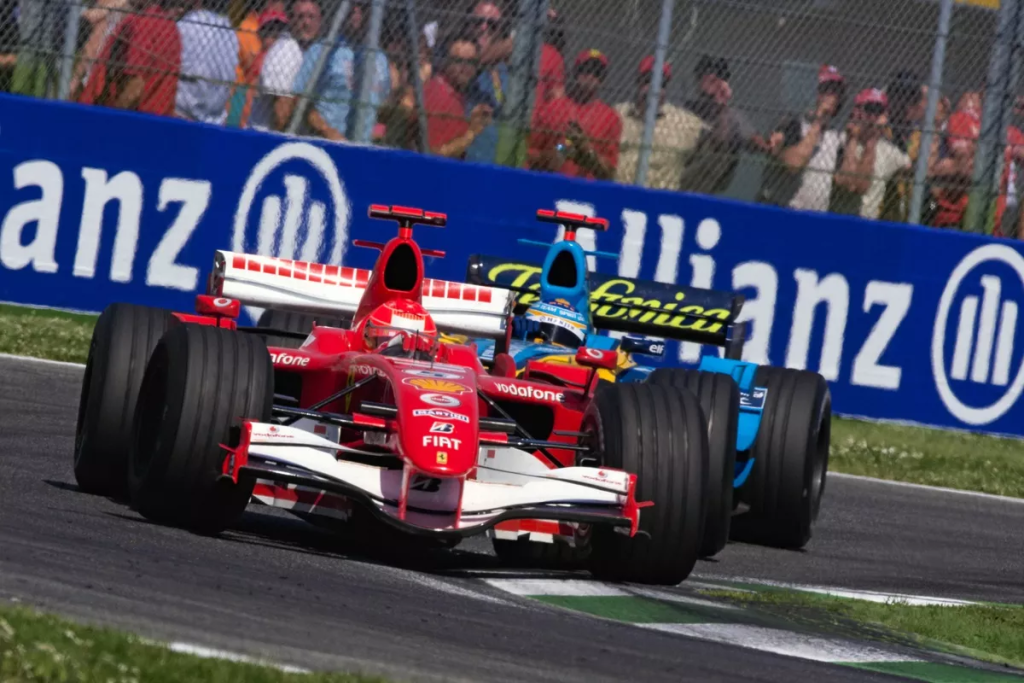
That season’s San Marino Grand Prix produced a very different narrative. Alonso, driving for Renault, took victory by just 0.215 seconds after fending off relentless pressure from Schumacher’s Ferrari. It was a race defined by tension in the final laps, with Schumacher charging from deep in the field and Alonso forced to defend every inch of track.
It felt like a passing of the torch moment—or at least the beginning of one.
But Formula 1 rarely follows a straight script.
Twelve months later, the stage was set again at Imola. Same circuit, same protagonists, but a very different dynamic.
Schumacher on pole, Alonso in pursuit
This time, it was Schumacher who arrived with the advantage.
The Ferrari driver secured pole position in qualifying, a significant moment in itself as he surpassed Ayrton Senna’s long-standing benchmark for career poles. It was a reminder that, even in the later stages of his career, Schumacher was still rewriting record books.
Alonso, meanwhile, found himself further back in fifth place. Not out of contention, but certainly on the back foot compared to the previous year.
At lights out, the race immediately began to take shape.
Alonso made a sharp start, immediately gaining ground by overtaking Rubens Barrichello around the outside of Tamburello—a bold move that set the tone for his afternoon. From there, he quickly dispatched both Felipe Massa and Jenson Button during the first round of pit cycles, using Renault’s strategy and race pace to climb back into the fight.
By the time the first pit stops had played out, Schumacher still led—but Alonso was closing in.
The gap closes and pressure builds
When Alonso rejoined after his stop on lap 26, the gap stood at just over 11 seconds. On paper, it looked comfortable. In reality, it was anything but.
What followed was a textbook example of controlled pressure.
Lap by lap, Alonso began to chip away at the deficit. The Renault was strong in the middle stint, and Schumacher, for once, found himself in a slightly vulnerable phase of the race. By the time the chase reached its peak, Alonso had reduced the gap to around eight seconds in just a handful of laps.
It wasn’t just speed—it was intent. Alonso wasn’t waiting for mistakes; he was trying to force them.
But Schumacher, as he so often did, refused to blink.
The decisive phase: experience versus momentum
As the race entered its final stages, the battle became less about outright pace and more about control.
Schumacher’s strength lay in his ability to manage the race from the front. Even when not pushing flat out, he maintained a rhythm that kept Alonso just far enough behind. Every corner, every braking zone, every exit was calculated.
Alonso, by contrast, was pushing harder. He knew the situation required aggression. At a circuit like Imola—narrow, technical, and notoriously difficult to overtake—track position was everything.
Renault attempted to shift the balance with strategy, bringing Alonso in earlier for his second stop in an attempt to undercut Ferrari. It was a calculated risk: gain clean air, push hard, and leapfrog Schumacher in the pits.
But Ferrari responded in kind.
Schumacher’s in-lap proved crucial. Even though his second stop was marginally slower, his timing on track ensured he retained the advantage. It was a small margin, but at Imola, small margins decide everything.
As Renault engineer Pat Symonds later reflected, the pace difference between the two cars was perhaps less dramatic than it appeared on television. The real difference was how each driver managed their stint under pressure.
Imola as a circuit that forgives nothing
One of the defining characteristics of Imola has always been its difficulty for overtaking. Narrow sections, limited braking zones, and high-speed sequences leave very little room for error—or opportunity.
That reality shaped the entire race.
Schumacher knew it. Alonso knew it even better as the laps ticked down. The truth was simple: unless the Ferrari driver made a mistake, passing on track would be almost impossible.
And Schumacher, with years of experience and countless battles behind him, understood exactly how to avoid giving Alonso that chance.
He didn’t need to be fastest every lap. He just needed to be consistent.
Alonso pushes, but the door never opens
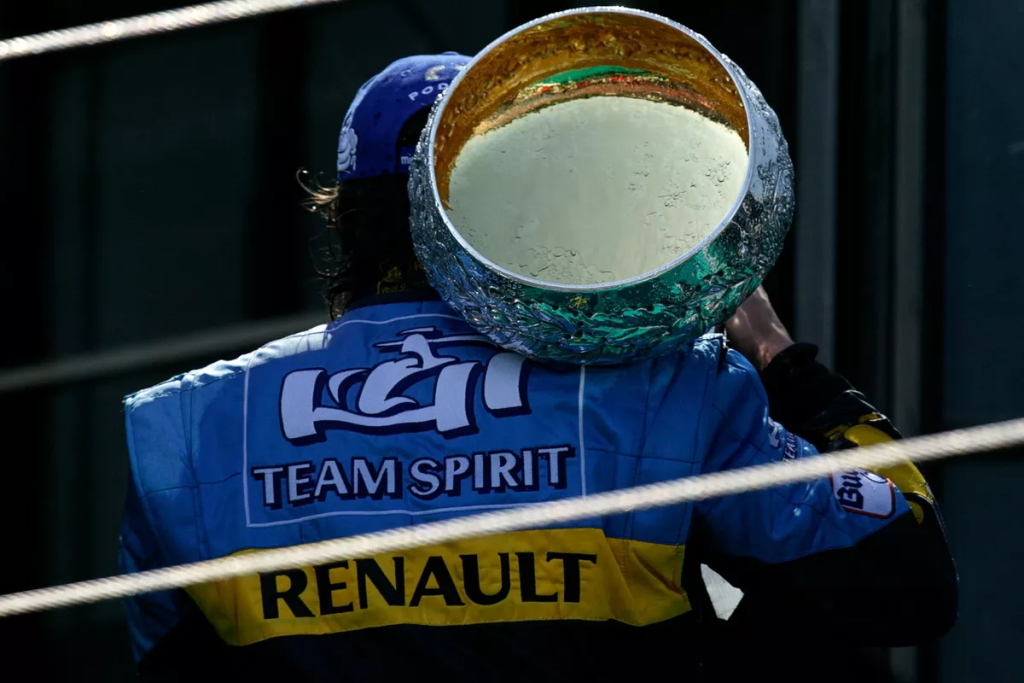
In the closing laps, Alonso made one final attempt to apply pressure. He closed in, stayed in the slipstream, and looked for any opportunity—any slight misstep that might open the door.
But Schumacher remained composed.
Even when Alonso increased engine revs and tried to force a move, the Ferrari responded. The gap never quite became small enough, and the opportunities never materialised.
Then came the decisive moment.
On lap 59, Alonso made a rare error at the Villeneuve chicane. It wasn’t dramatic, but at a circuit like Imola, even a small mistake has consequences. The momentum was lost, the gap stabilised, and with it, the final realistic chance of overtaking disappeared.
From there, Schumacher controlled the remainder of the race to the chequered flag.
Post-race reflections: respect and reality
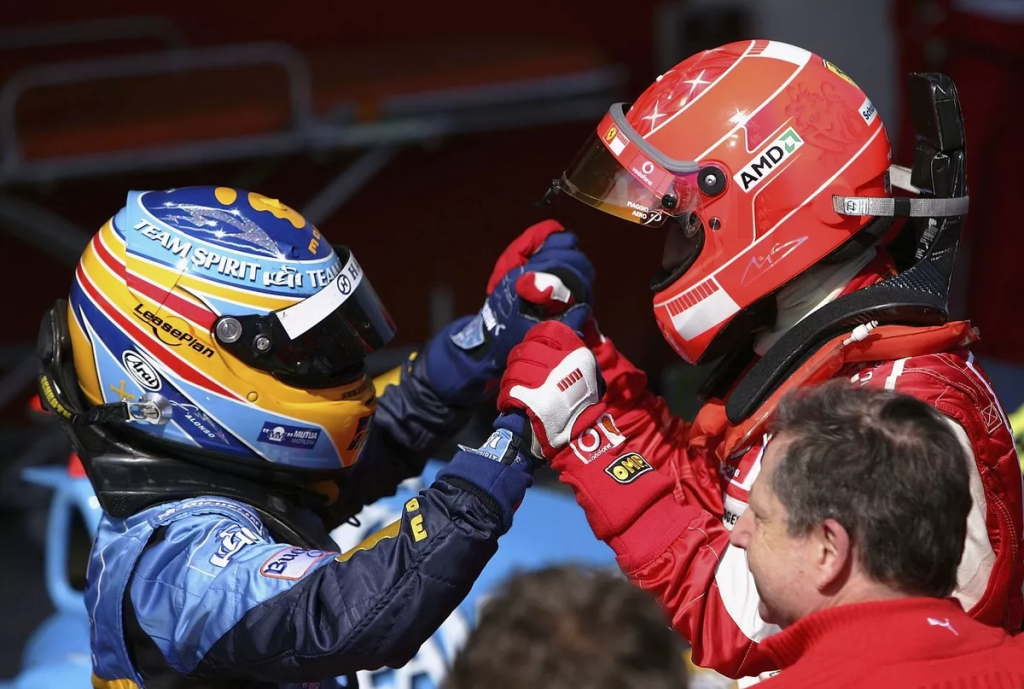
After the race, both drivers offered measured reflections on what had unfolded.
Schumacher was clear in his assessment. He acknowledged that overtaking was almost impossible at Imola and emphasised the importance of track position and consistency. For him, the key moment wasn’t any single lap—it was staying ahead after the second pit stop.
Alonso, meanwhile, was honest about his pace advantage in the second stint but equally realistic about the limitations of the circuit. He felt faster at points, but not fast enough where it mattered most.
Interestingly, Alonso also framed the result in terms of the championship picture. At the time, he still held a comfortable lead in the standings, and finishing second behind Schumacher while taking points from his closest rivals was not seen as a disaster.
In hindsight, however, it was becoming increasingly clear that Schumacher would be his main challenger over the course of the season.
A championship battle taking shape
Going into the weekend, Alonso led the standings ahead of Giancarlo Fisichella and Kimi Raikkonen, with Schumacher and Jenson Button slightly further back. But Imola subtly shifted the narrative.
Alonso left with an increased points lead, but Schumacher’s performance sent a message: Ferrari were not just competitive—they were closing the gap.
And as the season progressed, that proved to be true.
Schumacher would go on to win more races, applying pressure across the championship fight and turning what initially looked like a clear Renault dominance into a far tighter battle.
Eventually, Alonso would prevail and secure the title. But the 2006 season was no longer a solo procession. It had become a fight.
And Imola was one of its defining chapters.
Looking back at a generational duel
Two decades later, the 2006 San Marino Grand Prix still stands as a perfect snapshot of Formula 1 at its strategic peak.
It wasn’t a race filled with chaos or collisions. There were no safety cars changing the order, no dramatic weather swings. Instead, it was something more subtle—and arguably more impressive.
Two world-class drivers, separated by experience and youth, locked in a battle where every tenth of a second mattered, and where victory was decided as much in the pit lane and on in-laps as it was on the racing line.
Schumacher’s victory that day wasn’t just about speed. It was about control, patience, and knowing exactly when not to push.
Alonso’s challenge, meanwhile, showed a champion already capable of sustaining pressure at the very highest level.
It was, in many ways, a passing of respect between generations—even if the result still went to the established king.
And at Imola, as so often in Formula 1, that made all the difference.


There are no comments yet. Be the first to comment!